
If you’ve ever wondered how analysts put a price tag on a company before it goes public, gets acquired, or raises funding, the answer often starts with Comparable Company Analysis (CCA). It’s one of the most widely used valuation methods in investment banking, equity research, and corporate finance — and for good reason: it’s fast, market-driven, and grounded in real-world data rather than speculative assumptions.
This guide breaks down what CCA is, how it works, when to use it, and where it can go wrong.
What Is Comparable Company Analysis?
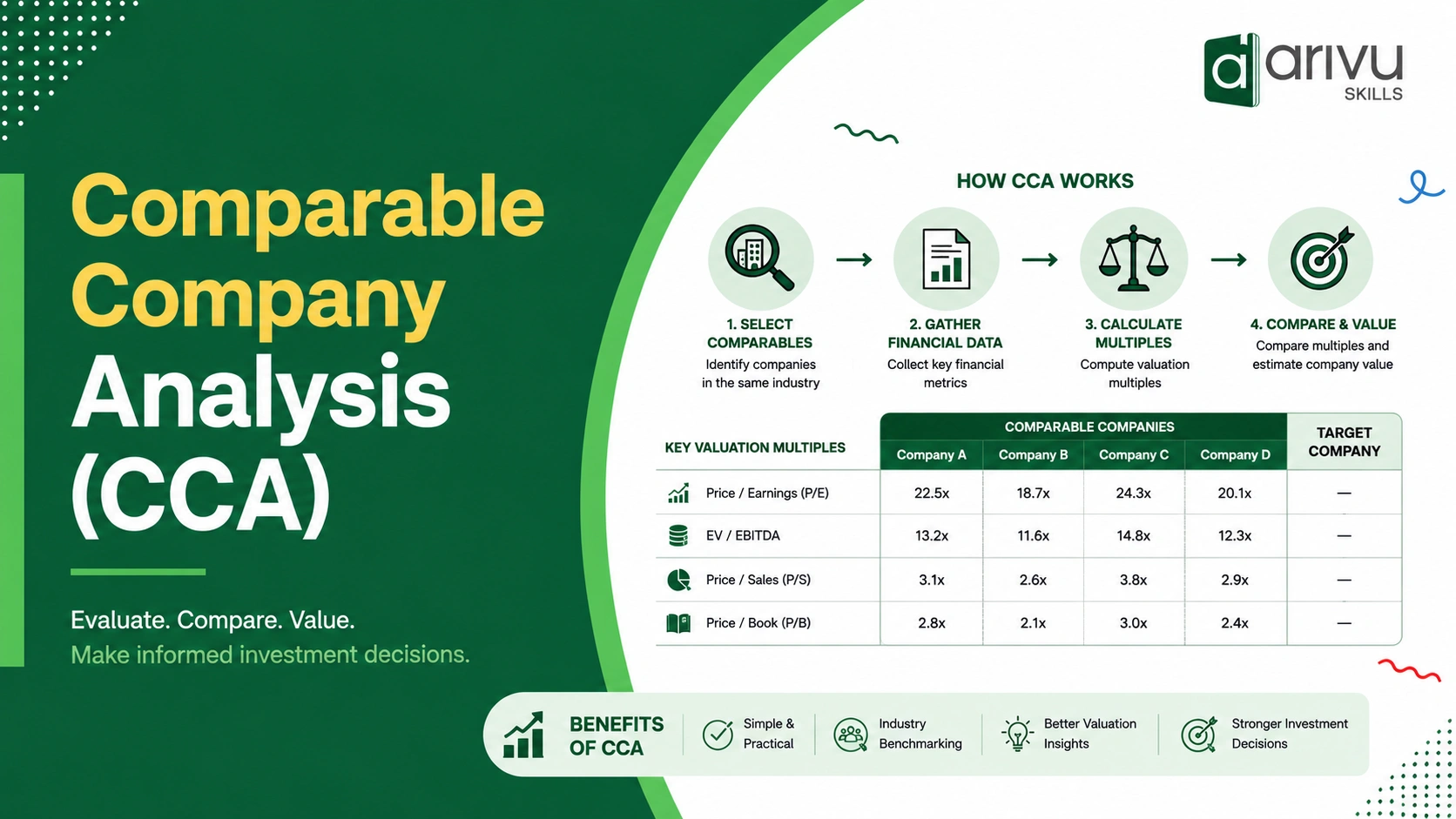
Comparable Company Analysis, often called “trading comps” or “comps,” is a relative valuation method that estimates a company’s value by comparing it to similar publicly traded companies. Instead of forecasting future cash flows from scratch (as in a Discounted Cash Flow model), CCA asks a simpler question: what is the market currently paying for companies like this one?
Analysts identify a peer group of comparable businesses — similar in industry, size, growth rate, and geography — and analyze the valuation multiples the market assigns to them. These multiples are then applied to the target company’s own financial metrics to estimate its value.
Looking for an Investment Banking Course in Bangalore? Join Arivu Skills and build job-ready finance skills.
Why CCA Matters
CCA is popular because it reflects current market sentiment. Valuation models like DCF rely on long-term projections and assumptions that can be highly subjective. CCA, by contrast, is anchored to observable, real-time trading data, making it useful for:
- Sanity-checking valuations from other methods
- Pricing IPOs and secondary offerings
- Supporting M&A negotiations
- Benchmarking a company against its sector during equity research
Because it’s quick to build and easy to explain to stakeholders, CCA is often the first valuation approach analysts reach for.
How Comparable Company Analysis Works
Step 1: Select the Peer Group
Choose publicly traded companies that closely resemble the target in terms of industry, business model, revenue size, growth trajectory, margins, and geography. A tight, relevant peer set is the single biggest driver of accuracy in this method.
Step 2: Gather Financial Data
Collect key financial metrics for each peer: revenue, EBITDA, net income, market capitalization, and enterprise value (EV). This data typically comes from company filings, financial databases, or investor presentations.
Step 3: Calculate Valuation Multiples
The most commonly used multiples include:
- EV/EBITDA — Enterprise Value divided by EBITDA; useful across capital structures
- EV/Revenue — Common for early-stage or low-profitability companies
- P/E Ratio — Price per share divided by earnings per share
- P/B Ratio — Price divided by book value, often used for financial institutions
Step 4: Apply the Multiples
Calculate the average or median multiple across the peer group, then apply it to the target company’s corresponding financial metric. For example, if peers trade at an average EV/EBITDA of 10x and the target’s EBITDA is $50 million, the implied enterprise value is $500 million.
Step 5: Adjust and Interpret
Raw multiples rarely tell the full story. Analysts adjust for differences in growth rate, risk profile, margins, or capital structure, and often present a valuation range rather than a single number.
CCA vs. Other Valuation Methods
| Method | Basis | Best For |
|---|---|---|
| Comparable Company Analysis | Market multiples of peers | Quick, market-based benchmarking |
| Discounted Cash Flow (DCF) | Projected future cash flows | Intrinsic, long-term valuation |
| Precedent Transactions | Multiples from past M&A deals | Valuing a company in an acquisition context |
Most professional valuations use CCA alongside DCF and precedent transactions to triangulate a well-supported value range, rather than relying on any single method in isolation.
Advantages of CCA
- Market-relevant: Reflects real, current investor sentiment
- Simple and fast: Requires less forecasting than DCF
- Widely understood: Easy to present to clients, boards, and investors
- Useful cross-check: Validates outputs from more complex models
Limitations to Keep in Mind
- Peer selection bias: No two companies are truly identical; imperfect comps distort results
- Market mispricing: If the overall market or sector is overvalued or undervalued, CCA inherits that distortion
- Limited for unique businesses: Companies with no close public peers (novel business models, niche sectors) are harder to value this way
- Ignores company-specific catalysts: CCA doesn’t account for unique growth drivers, pending litigation, or management changes
Practical Tips for a Reliable CCA
- Use at least 5–8 peers where possible for a statistically meaningful range
- Prefer median over average multiples to reduce the impact of outliers
- Normalize financials for one-time items before calculating multiples
- Cross-check results against DCF or precedent transaction analysis
- Revisit peer sets periodically, as market conditions and comparables shift
Final Thoughts
Comparable Company Analysis remains a cornerstone of modern valuation because it keeps analysts grounded in what the market is actually paying — not just what a spreadsheet projects. Used well, alongside other valuation frameworks, it provides a fast, credible, and defensible way to answer one of finance’s most important questions: what is this company really worth?
FAQs
CCA is a valuation method that estimates a company’s worth by comparing its financial metrics to those of similar publicly traded companies, using valuation multiples like EV/EBITDA or P/E.
The most widely used multiples are EV/EBITDA, EV/Revenue, P/E ratio, and P/B ratio, with the choice depending on the industry and company’s profitability profile.
CCA values a company based on how the market prices similar businesses today, while DCF estimates value based on projected future cash flows discounted back to present value. CCA is market-driven; DCF is intrinsic and assumption-driven.
Most analysts aim for 5 to 8 closely matched peers. Too few can skew results, while too many can dilute relevance if the peers aren’t truly comparable.
CCA is less reliable when a company has no close public peers, operates in a niche or emerging industry, or when the broader market is significantly overvalued or undervalued at the time of analysis.
No. While common in investment banking and M&A, CCA is also used in equity research, private equity, venture capital, and corporate finance for benchmarking and decision-making.