
If you are planning to build a career in data science you probably would have heard one piece of advice over and over again to learn Python. And honestly there’s a good reason for that. Python has actually become one of the most popular programming languages for data science because it’s simply easy to learn and also easy to read. But learning Python alone is not enough.
The real power of Python comes from its libraries. Instead of writing hundreds of lines of code for every task you can use ready-made Python libraries for data science that make data analysis faster and more efficient. Whether you are cleaning data assets or performing calculations or just building machine learning models there is a library designed to help you do the job.
The best part is that you don’t have to learn dozens of libraries at once. A few essential ones are just good enough.
What are Python libraries?
You can think of the Python library as a toolbox. Just imagine you are building a piece of furniture. Instead of creating a hammer screwdriver and measuring tape from scratch you just need to pick the tools that you need and start working. Python libraries work in the same way. They are actually collections of pre written code that help developers complete tasks without writing everything from the beginning.
These libraries save a lot of time and reduce errors while allowing you to focus on solving problems instead of building basic functions. For data scientists Python libraries make it possible to analyse large data sets, perform mathematical calculations and also visualize information and even build intelligent machine learning models with just a few lines of code.
Why are Python libraries important for data science?
Data science projects involve much more than just writing code. Before you can even build predictions or create dashboards it’s very important for you to collect data and present your findings in a meaningful way. Doing all of this manually would take a lot of time. This is exactly where the Python library for data science comes in.
They simplify repetitive tasks, improve accuracy and help data scientists work much more effectively. Instead of spending time solving basic programming problems you can just focus on understanding data and find valuable insights. Whether you are working on healthcare finance marketing or technology, Python libraries make data analysis much faster and more practical.
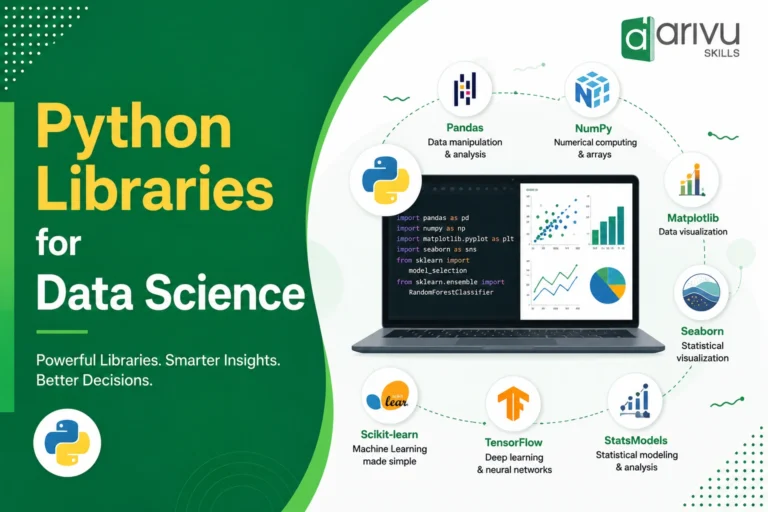
Essential Python Libraries Every Data Scientist Should Learn
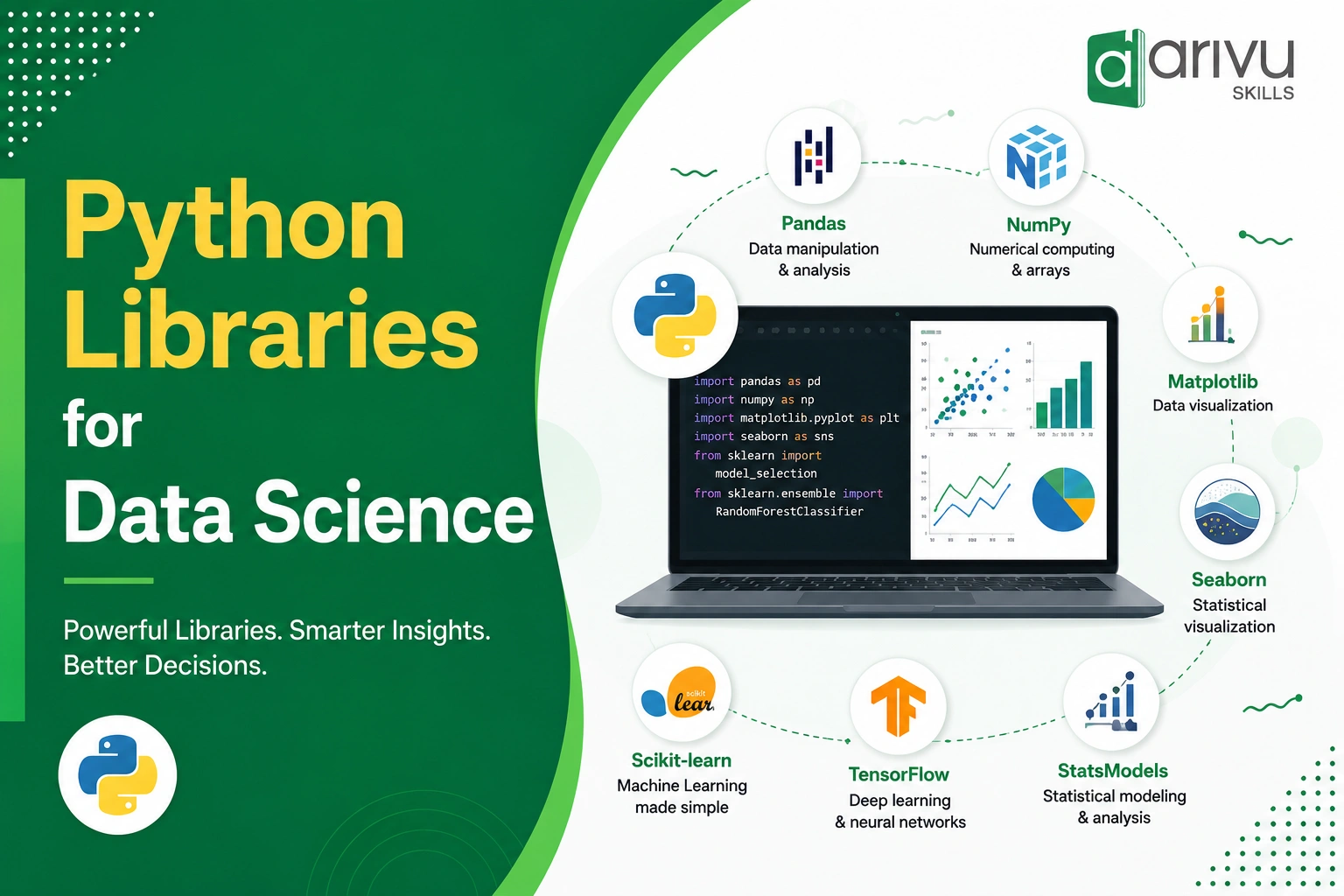
| Python Library | Primary Use |
| NumPy | Numerical computing and mathematical operations |
| Pandas | Data cleaning, manipulation, and analysis |
| Matplotlib | Data visualization and charts |
| Seaborn | Advanced statistical visualizations |
| Scikit-learn | Machine learning models |
| TensorFlow | Deep learning and AI applications |
NumPy- The foundation of numerical computing
One of the first libraries every beginner learns is Numpy. Data science often involves working with large amounts of numerical data. Performing calculations manually can be very slow and inefficient. Numpy solves this problem by allowing you to work with powerful multidimensional arrays and perform mathematical operations as soon as possible. Whether you are calculating averages performing matrix operations or operating data for machine learning models, Numpy makes the process much easier.
Pandas
If there is one library that almost every data analyst uses everyday, it’s pandas. Real world data is rarely clean. It often contains duplicate records and incorrect entries. Pandas help you organize and clean this data before analysis begins.
Matplotib
Numbers alone do not always tell the complete story. Just imagine presenting thousands of rows of sales data to your manager. It would be difficult to identify trends just by looking at numbers. Now imagine presenting the same information using a line chart or a bar graph. Suddenly everything becomes much clearer. That’s exactly where Matplotzins comes in the picture. It helps you create professional charts, graphs and visual reports that make complex information easier to understand.
Benefits of Learning Python Libraries
There is a reason Python continues to dominate the world of data science.
Some of the biggest advantages include:
- Makes coding faster and more efficient.
- Reduces repetitive programming tasks.
- Handles large datasets with ease.
- Supports data visualization and reporting.
- Simplifies machine learning development.
- Backed by a large global developer community.
- Widely used by companies across industries
Why learn Python libraries with Arivu Skills?
Learning the Python library becomes much easier when you work on practical projects instead of just simply reading theory. At Arivu Skills we focus on helping learners understand through real world applications. Our industry focused training includes hands-on assignments and expert guidance so you can build the confidence that employers are looking for. You will learn how to work with Python tools by solving practical business problems other than just remembering syntax. Join a Data Science Course in Chennai today.
FAQs
The most commonly used Python libraries for data science include pandas and Matplotlib besides seaborn.
It’s better to start with essential libraries like pandas. As your knowledge grows you can gradually learn additional libraries.
Yes, Python is considered one of the easiest programming languages to learn. With consistent practice and structure training you can quickly understand Python libraries.
The time depends on your learning pace and consistency.
Yes, most employers look for candidates who are comfortable using popular Python libraries for data science.