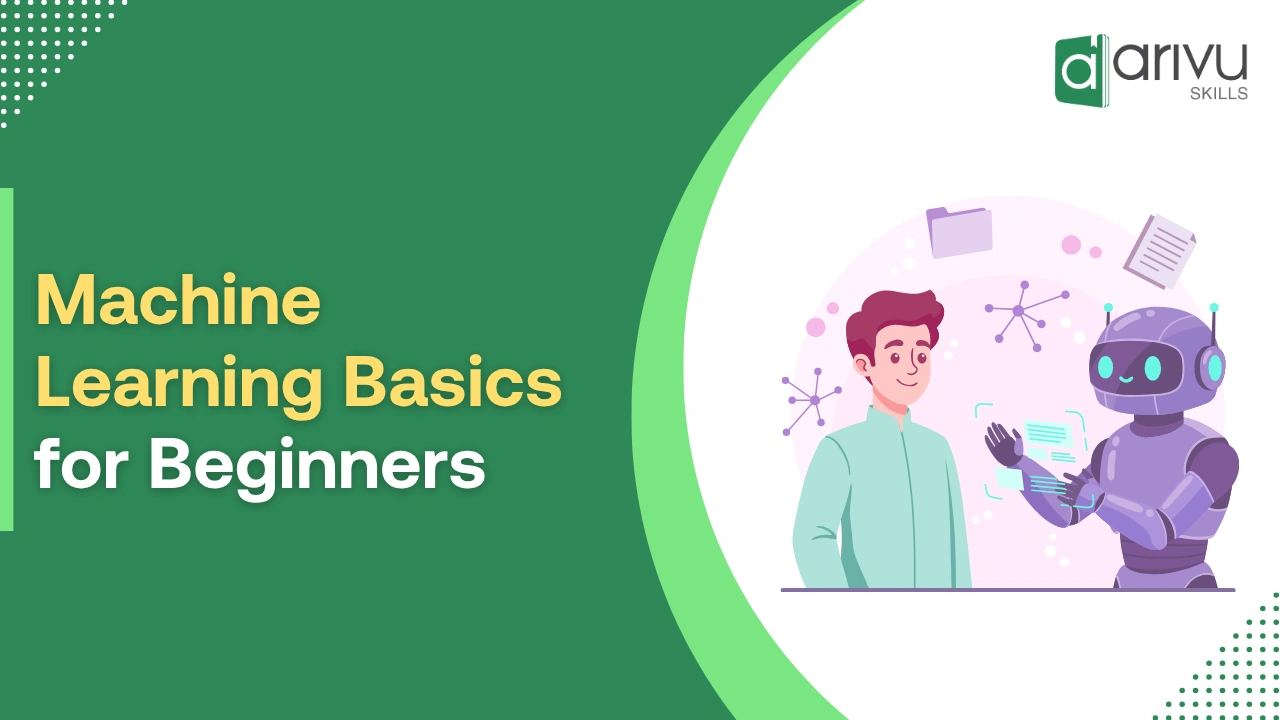

Machine learning basics is just a simple idea that systems learn from data patterns instead of programming rules each time. You allow the computer to learn the data and make its own decisions based on the pattern. If you’ve ever opened a social media platform and were recommended to follow an old acquaintance, that is machine learning in action.
In traditional programming you write the rules for the system to follow. In machine learning, the system figures out the rule from the data. This shift is what makes machine learning a very vital tool of the hour. It helps you declutter your feed and helps make life easy in smaller ways.
Machine learning is not magic though, it entails structured problem solving which is done using data, statistics, and iteration.
What is machine learning?
Machine learning is a subset of artificial intelligence that allows systems to learn from data and improve over time without being programmed.
Imagine teaching a child how to identify a colour, initially you provide them examples, over time, they recognize patterns. Machine learning models follow the same method but instead of images, they are exposed to datasets and mathematical optimization.
How does machine learning actually work?
Machine learning runs multiple tasks in the background to deliver accurate results.
| Step | What Happens |
| Data Collection | Gather relevant data, usable data |
| Data Cleaning | Fixing missing values, removing noise |
| Training | Feeding data into a model to learn patterns |
| Evaluation/ Testing | Checking how well the model performs |
| Prediction | Applying it to new, unseen data |
The real effort spent behind each step is very important. It is assumed that the model itself is the hardest part of the job but in reality, the majority of the time is spent on preparing data. A well cleaned dataset paired up with a simple model usually performs well.
If you’re looking at emerging tech hubs, the data analytics course in Coimbatore focuses on practical implementation, helping you turn theoretical knowledge into usable skills.
Strengthen data skills with real‑life context at Arivu Skills data analytics course in Coimbatore
Types of machine learning
1. Supervised Learning
As the name suggests this is learning with supervision. The model is trained using labeled data. All the instructions are made clear for the model to understand. This is the most beginner-friendly method. The goal is to just learn mapping from input to output. A very easy example is classifying emails as spam or not spam or image classification.
2. Unsupervised Learning
Just the opposite of supervised learning, unsupervised data has no labels.
The model doesn’t get answers, they have to find the hidden pattern on its own.
Trying to find patterns on a group of customers based on behavior or detecting unusual activity in financial transactions is unsupervised learning.
3. Reinforcement Learning
In this method the system learns by interacting with the environment and receives feedback in the form of rewards or penalties. This way it is always learning through trial and error. When you get asked to rate an app you are giving feedback for the machine to learn from. Recommendation systems refine user engagement.
Key Machine Learning concepts
1. Features versus Labels
Every machine learning problem starts here. Features are input variables which are provided to the model. Labels are output which you want to predict. The model is expected to learn the relationship between them.
2. Overfitting versus Underfitting
These are two sides of the same problem. An overfitting model memorizes data instead of learning patterns. Underfitting model is too simple and misses patterns.
A good model finds the balance and performs well not just on the data it trained on, but also on new data.
3. Training versus Testing Data
If you evaluate a model on the same data you trained it on, it will give you a false sense of accuracy. It’s like giving yourself answers before a test. Train on one dataset and test on another. This ensures your model generalizes.
4. Accuracy isn’t everything
If you receive accurate results it can still be useless in the long run of the scheme.
Imagine a dataset where 95% transactions are legitimate even if predicted accurately will be completely useless if cannot catch the fraud cases. Understanding context is more important than chasing high numbers.
Tools and languages used in machine learning
| Tool | Why it Matters |
| Python | Beginner-friendly, widely used |
| Pandas | Helps work with datasets |
| NumPy | Mathematical operations |
| Scikit-learn | Core ML algorithms |
| TensorFlow / PyTorch | Used for advanced models |
Many beginners jump straight into complex frameworks too early. It’s far more effective to start simple, understand how models behave and then move to advanced tools.
Data analytics courses in Bangalore offer hands-on exposure to tools, datasets, and industry practices, so you’re not just learning, but actually building.
Build career‑ready analytics skills with Arivu Skills’ data analytics course in Bangalore
Real-world applications of machine learning
1. Healthcare
Machine learning helps detect diseases in scans and predicts patient risks. Machine learning using medical imaging analysis improves accuracy and speed in diagnosis.
2. Finance
Banks use it to detect fraud, assess credit risk, check credit score and automate decision-making processes.
3. E-commerce
Machine learning in e-commerce is used for recommendation systems, dynamic pricing and customer segmentation.
4. Media & Content
Algorithms decide what you see and consume on social media and streaming platforms. The content moderation is also done via machine learning.
In almost every field there is common denominator of pattern recognition. Humans alone cannot do it at the speed and volume at which machine learning does.
How to start learning machine learning
The most effective way to approach machine learning is step-by-step, without rushing.
Step 1: Understand the basics
Start by understanding what machine learning basics is like what ML is, how it works and the types involved. Once your core concepts are cleared you are ready for the next step.
Step 2: Learn Python fundamentals
Learn Python focusing on how to handle data first before you jump into algorithms. Clear your basic fundamentals in Python.
Step 3: Work with data
If you have no practical knowledge or start with your own case studies you will not learn. Start with basic tools like Pandas and start data cleaning and build a dashboard and visualise your analysis.
Step 4: Build simple models
Once you feel confident in your skills start building small models.
Use linear regression and decision trees to start and then build with time.
Step 5: Do real projects
Real progress happens when you start working on real projects. Predict, classify, analyze something, start simple but something that forces you to apply what you’ve learned.
If you’ve tried learning machine learning on your own, you’ve probably noticed how scattered it can feel. That’s where structured guidance becomes useful.
If you’re based in Tamil Nadu, exploring a data analytics course in Chennai by Arivu Skills can help you move from confusion to clarity, with a curriculum that ties concepts to real-world use.
Learn how analytics and tools used with Arivu Skills’ data analytics course in Chennai
FAQs
Machine learning basics include understanding how systems learn from data, the types of machine learning, and key concepts like features, labels, and model evaluation.
A basic Python knowledge is recommended, but you can start learning concepts without coding initially.
With consistent efforts beginners can understand the fundamentals in 2 to 3 months.
It can feel challenging at first, but breaking it into smaller concepts makes it manageable. It gets easier with structured learning and practice.
Start with fundamentals, learn Python, work with data, and build small projects.