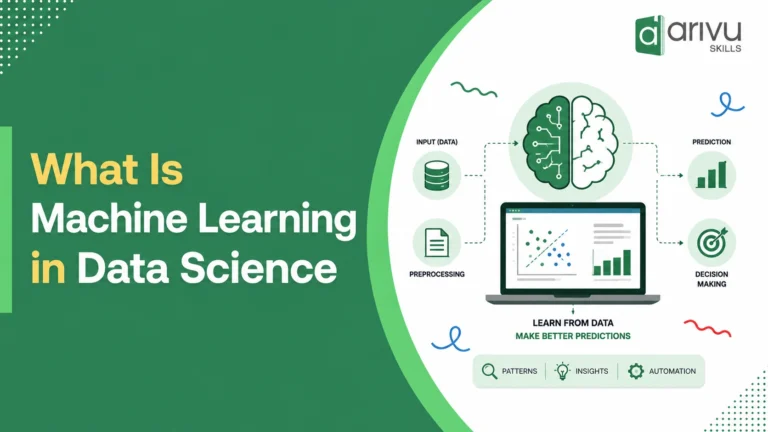
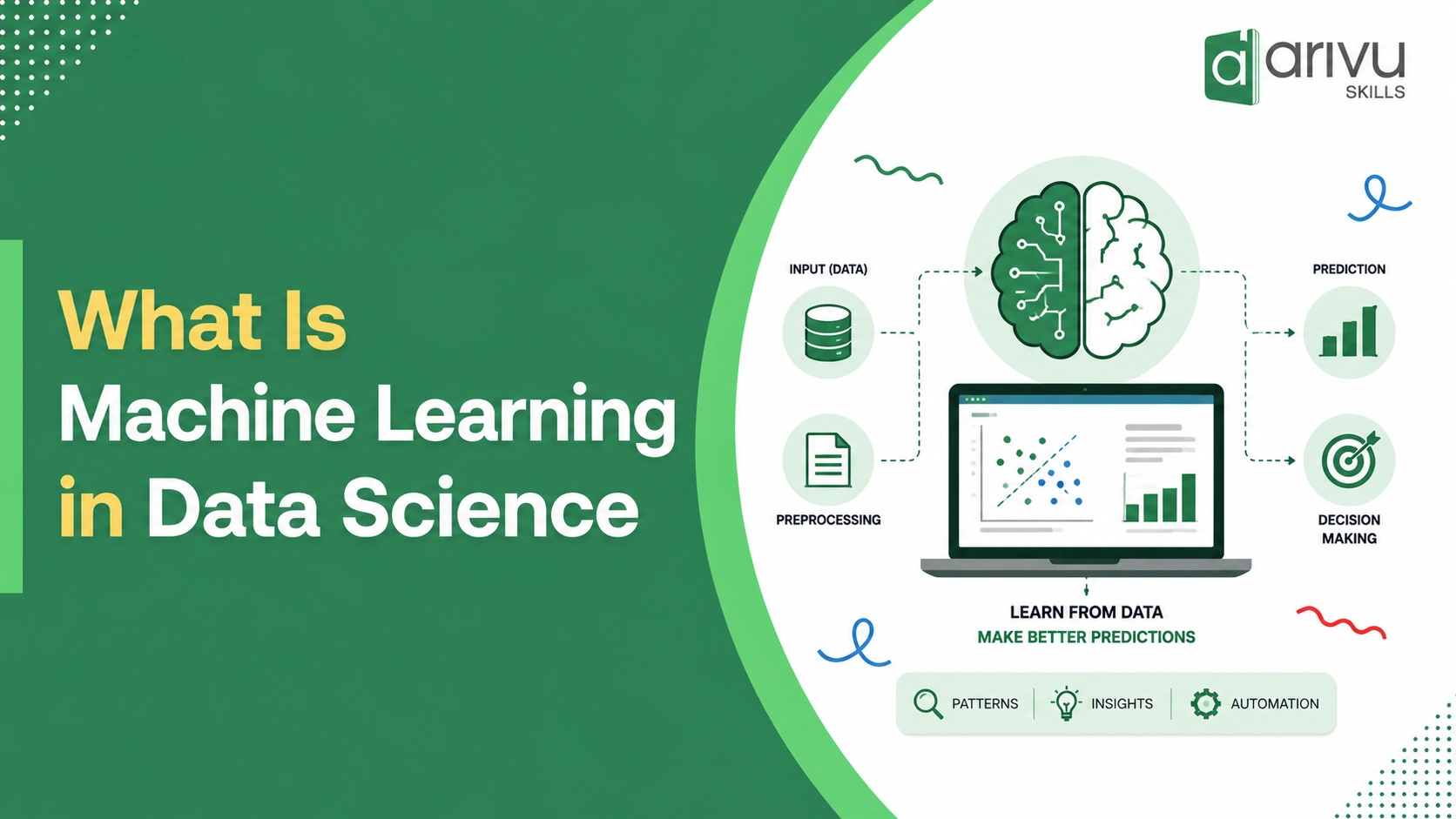

If you have been exploring careers in data science you might have come across the term machine learning more times than you can even count. From Netflix recommending your next favorite show to banks detecting fraudulent transactions in seconds, machine learning is quietly powering many of the technologies that you use every single day. But here is the interesting part: despite its growing popularity you might still think that machine learning is only for programmers or AI researchers.
The reality is quite different. Today machine learning and data science has become one of the most valuable skills for professionals who want to analyse data and build intelligent systems. The good news is you don’t have to be an expert or understand machine learning basics. Once you know how machine learning works and where it is used you will have a clearer picture of why it’s becoming an essential part of modern data science.
What is machine learning?
Machine learning is a branch of artificial intelligence that enables computers to learn from data and improve their performance without being explicitly programmed for every task. Instead of following a fixed structure, a machine learning model identifies patterns and data and uses those patterns to make predictions or decisions. The more relevant data it receives the better it becomes at performing the tasks. For example, just think about your email box. With time your email service becomes better at identifying spam messages it learns from previous examples rather than just relying on manually created lists of rules. That’s machine learning and action.
Why is machine learning important in data science?
Data science focuses on collecting, cleaning and analyzing data to support better decision making. Machine learning takes us one step further by allowing systems to learn from historical data and predict future outcomes. Instead of manually analyzing thousands of records, machine learning models can identify hidden trends and detect unusual behavior. This makes machine learning in data science valuable across industries because it helps organizations make faster and more informed decisions.
Some common business applications include:
- Predicting customer purchases
- Detecting fraudulent transactions
- Recommending products
- Forecasting sales
- Predicting equipment failures
- Personalizing user experiences
How does machine learning work?
Even though machine learning might sound very complex, workflow follows a series of logical steps. The process begins with collecting data from different sources like websites, applications or sensors. Like raw data often contains errors or missing values it must be first cleaned and prepared. Once the data is ready the appropriate machine learning algorithms are selected and trained using historical information.
During training the model identifies relationships and patterns within the data set. After training the model is tested using new data to evaluate its accuracy. If performance meets expectations it can then be deployed to solve real world problems like predicting customer behaviour or fraudulent transactions.
Types of Machine Learning
| Machine Learning Type | Purpose |
| Supervised Learning | Learn from labeled data to make predictions. |
| Unsupervised Learning | Finds hidden patterns or groups in data without labels. |
| Semi-Supervised Learning | Uses a combination of labeled and unlabeled data. |
| Reinforcement Learning | Learn by interacting with an environment and receiving rewards or penalties. |
Real world applications of machine learning
Machine learning has become a part of your everyday life even if you do not notice it. Some common applications include Netflix recommending content based on your preference. Ecommerce websites recommending content and products that you might want to buy. Banks detect suspicious transactions in real time while ridesharing apps estimating travel times and demand. These examples show machine learning in data science is helping businesses automate decisions and also improve customer experience
Popular Machine Learning Algorithms
As you move beyond the machine learning basics, you’ll come across several commonly used algorithms.
Some of the most popular ones include:
- Linear Regression
- Logistic Regression
- Decision Trees
- Random Forest
- K-Nearest Neighbors (KNN)
- Support Vector Machines (SVM)
- Naive Bayes
- K-Means Clustering
Tips for getting started with machine learning
If you are new to machine learning, focus on building a strong foundation instead of rushing into advanced algorithms. You can begin by learning Python and statistics. Practice working with real data stats can gradually move on to building simple machine learning models. You can participate in hands-on projects, explore open datasets and learn how different algorithms solve practical business problems.
So machine learning has transformed the way you use data to make decisions, automate processes and future outcomes. An essential part of modern data science enables computers to learn from experience and improve their performance without constant human intervention. Whether you are a student or a working professional understanding machine learning, mastering the machine learning basics and learning how it works can open doors to exciting career opportunities.
Ready to build a career in machine learning and data science? At Arivu Skills Our industry focus machine learning course helps you master the fundamentals and work on real world projects. Get in touch with us today and take the first step towards a successful career.
FAQs
Machine learning is a branch of artificial intelligence that allows computers to learn data, identify patterns and make predictions without being programmed for every task.
Yes, machine learning is one of the most core components of data science and is used to build predictive models.
Some of the essential skills include Python programming and statistics besides data visualization and problem solving.
Machine learning might seem challenging at first but with a strong understanding of the basics and regular practice and hands-on projects you can learn it successfully.
Artificial intelligence is the broader concept of creating machines that can perform tasks requiring human intelligence while machine learning is a subset of AI that enables systems to learn from data.