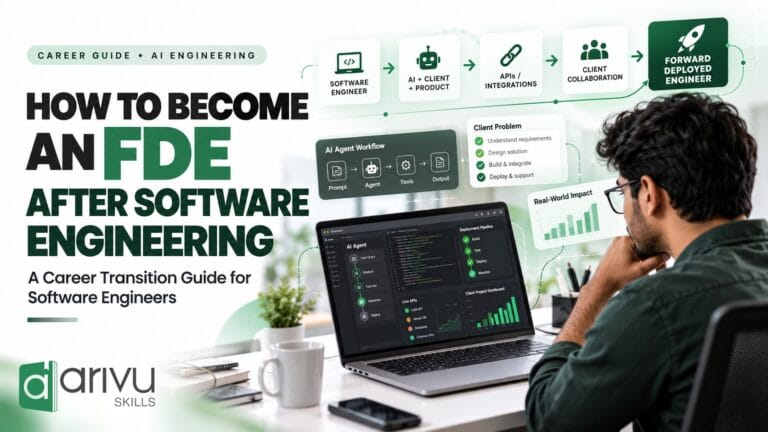
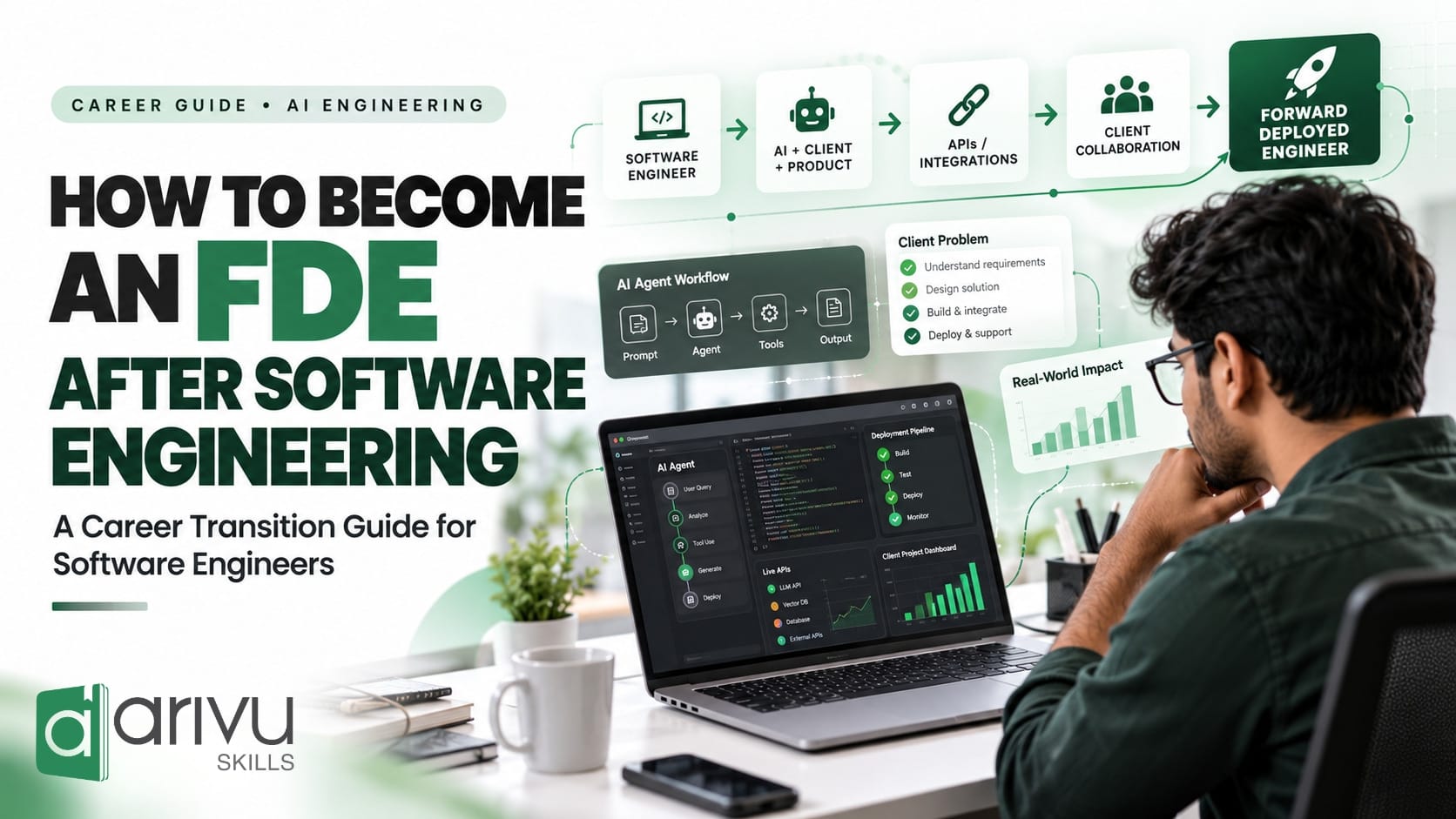

If you’re a software engineer trying to work out how to become an FDE after software engineering, start with this: the hard part is mostly behind you. Forward Deployed Engineer work is built on the same foundation you’ve spent years earning. Writing production code. Working with real systems. Shipping things that don’t fall over on a Friday night. Most people who land FDE roles come in from backend or full-stack jobs, not from scratch. So this isn’t really a career change. It’s more like adding a new gear to the career you already have.
This guide is for people who already code for a living, so we’ll skip the beginner stuff and spend our time on what actually stands between you and an FDE offer in 2026.
Quick answer: what the transition takes
The short version: keep your engineering skills, then add two things on top. First, an applied-AI layer, meaning LLM APIs, RAG, agents and evaluations. Second, a customer-facing layer, which is really about turning vague business problems into working software and owning the result. Build a few deployed projects that prove both, and you’re ready to apply.
Why Software Engineers are the #1 pipeline into FDE roles
A Forward Deployed Engineer works right alongside a customer, building and deploying a working solution (usually an AI one) inside that customer’s actual systems, instead of shipping a general product from behind a desk. Picture a mix of software engineer, solutions architect and consultant, all in one person.
Here’s why your background counts for so much. Most FDE roles lean towards engineers who’ve shipped real production work, because the job is full of messy enterprise systems and compliance rules a fresher has never had to deal with. Companies want someone who can write solid software and also hold a conversation with a customer, and that combination is genuinely hard to find. It’s a big part of why the pay is what it is. If you’re already a working engineer, you’re sitting on the right side of that gap. This role isn’t a stretch for you. You’re close to the profile hiring managers are chasing.
What actually changes when you go from SWE to FDE
The biggest change isn’t technical at all. It’s the shape of the problem someone hands you.
As a software engineer you usually get a fairly clean ticket: build this service, to this spec. An FDE gets handed an outcome instead. Something like, “the legal team needs this working before the audit in three weeks,” and it’s on you to figure out how to get there. No tidy spec. Just a customer, a pile of messy real-world data, a deadline, and someone downstream counting on the result.
The other shift is how fast you switch context. FDEs pick up a new domain quickly. You might be knee-deep in a healthcare workflow one quarter and a banking one the next. You stop being the person who guards a single codebase for years and start being the person who can drop into almost any problem and get AI working inside it.
The skill gap: what you already have vs. what you need to add
FDE hiring tends to look for T-shaped engineers: deep in one area, broad across a lot of others. Here’s how your current stack lines up against the three skill areas these roles hire for.
Area 1: Core software engineering (you probably have most of this already)
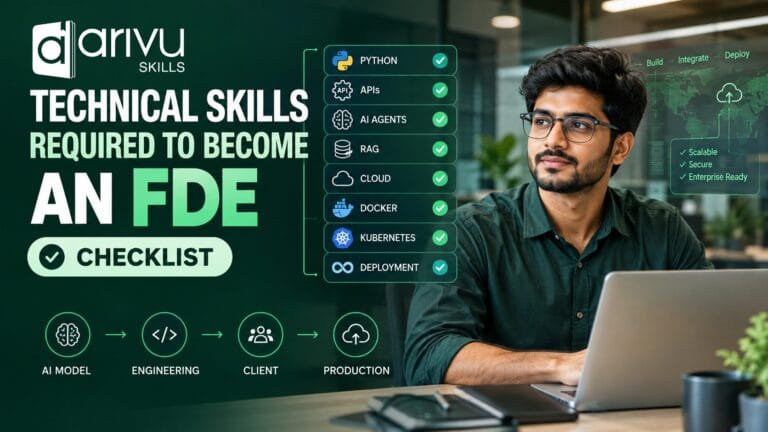
Python shows up more than any other skill in FDE job posts, so if your day-to-day language is something else, getting comfortable in Python is the first job. After that it’s the usual production kit: APIs, SQL and databases, testing, system design, Git, and cloud plus containers like Docker and Kubernetes on AWS or GCP. If you’ve been doing backend or full-stack work, most of this is already muscle memory.
Area 2: Applied AI (the 2026 non-negotiable, and the gap most engineers have to close)
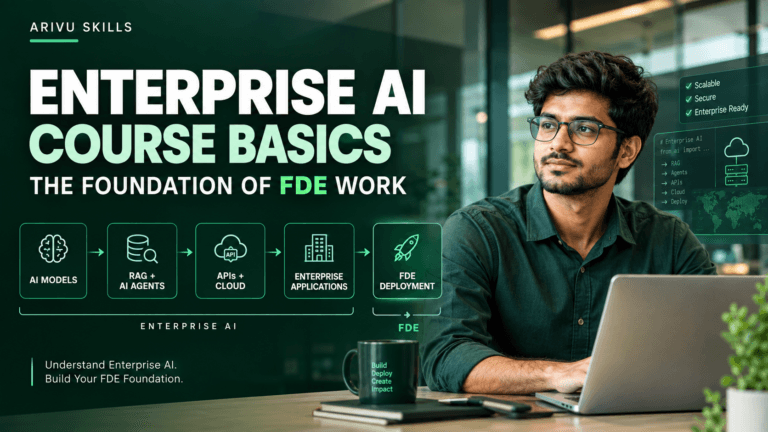
This is where the real transition happens. You’ll want a working grip on LLM APIs, prompt engineering and structured outputs, then RAG pipelines built end to end with a vector database, then agent orchestration using something like LangGraph or CrewAI. Add a bit of evaluation and some basic guardrails on top. You don’t need a research background for any of this. You need to be able to build a retrieval or agent system and talk through it properly, down to how you retrieve and how you know whether it’s any good. Honestly, that one skill moves the needle on hiring more than anything else on this page.
Area 3: Customer-facing skills (the “soft” skills that aren’t soft)
Breaking down a fuzzy problem for someone non-technical. Explaining a technical call in plain business terms. Throwing together a quick proof-of-concept so you can show what’s possible instead of just describing it. And plain ownership: staying calm and putting your hand up when something breaks in front of the client. These are the skills that rust if you don’t use them and get sharper the more you do, so it’s worth practising them early rather than leaving them until interview week.
Your step-by-step roadmap from software engineer to FDE
- Get Python and cloud solid. If they already are, skip straight to step 2.
- Learn the LLM application layer: APIs, prompt engineering, structured outputs.
- Build one proper RAG system end to end, with a vector database, and know it well enough to explain every part.
- Build one agent project on a real orchestration framework, with evaluations wired in.
- Practise on ugly data. Grab a real, messy dataset and get something working on it, not a polished tutorial demo.
- Rehearse the customer side. Do mock interviews and problem-discovery chats until you can turn a business goal into a plan out loud, on the spot.
- Package a portfolio of two or three deployed, client-style projects you can walk a hiring manager through. At this level, most employers care more about proof you can deploy than about where you studied.
FDE salary in India after software engineering
Let’s be honest, the money is a big part of why engineers make this jump. In India in 2026, FDE salaries are commonly reported at roughly ₹18–28 LPA for 0–2 years, ₹28–55 LPA for 3–6 years, and ₹55–90 LPA or more for senior and global-remote roles. Crowd-sourced numbers run lower; Glassdoor’s India sample sits around ₹13–17 LPA. The spread is unusually wide, and there’s a reason for it. The FDE label covers everything from a services-firm implementation job to an engineer embedded with a Fortune 500 client at a frontier AI lab.
One honest caveat: these are market estimates, not offers you’re guaranteed to get, and the India sample is still small, somewhere around 250–270 open roles at any given time. Even so, FDE packages usually beat a comparable SDE salary, mostly because so few people have the full skill set.
Who’s hiring FDEs in 2026
Demand is rising fast. In the US, FDE job listings went from around 643 in April 2025 to 5,330 a year later. Palantir started it all, and now OpenAI, Anthropic, Scale AI, Google Cloud and McKinsey’s QuantumBlack all run forward-deployed teams of their own. Anthropic and DXC have even said they plan to train tens of thousands of Claude-certified FDEs. Closer to home, the title is turning up at Accenture and Wipro (which posted an FDE role in Bengaluru) as well as a wave of AI-native startups. If you’re in India, Bengaluru is where most of the action is.
Common mistakes engineers make in the transition
A few traps people fall into on the way across:
- Stopping at theory. Watching videos on how transformers work won’t get you hired. A system you actually shipped will.
- Skipping the customer half. Brilliant engineers who can’t talk to a non-technical stakeholder get filtered out early.
- Only ever building clean demos. Real FDE work is messy data, so show you can handle the mess.
- Waiting until you feel ready. You already have the engineering base. The gap is smaller than it looks from where you’re standing.
How Arivu Skills‘ FDE Pro helps you make the jump
If you’d rather close both gaps with a bit of structure and a mentor instead of stitching it together on your own, that’s what our Forward Deployed Engineer (FDE Pro) program in Bengaluru is built to do. It’s practitioner-led and hands-on, focused on the things FDE hiring actually tests: enterprise AI integration, production RAG, agent engineering, deployment work and real client-style case studies. You also get 1:1 mentorship, mock FDE interviews, placement support and an FDE certificate when you finish.
If you’re already a working engineer, the program moves quickly through what you know and slows down where your real gap is: the applied-AI layer, and the customer-facing side that turns a strong coder into someone a company will actually hire as an FDE.
FAQ ( Frequently Asked Questions )
Can I become an FDE if I’m already a software engineer?
Yes, and you’re in a good spot for it. These roles favour engineers with real production experience, so your background helps rather than holds you back. What you mainly need to add is the applied-AI skills (LLMs, RAG, agents) and the customer-facing side.
Do I need to be an AI or machine-learning expert?
No. A research background isn’t the point. What matters is being able to build and deploy AI applications. A RAG or agent system you can explain clearly, down to retrieval and evaluation, counts for far more than deep ML theory.
How long does the transition take?
It depends on how solid your engineering base already is and how fast you pick up the applied-AI layer. If you know Python and cloud, you can focus only on the AI and customer-facing gaps, which is a much shorter road than starting from zero.
Is FDE a good move over a regular SDE role?
For a lot of engineers, yes. FDE roles usually pay more than a comparable SDE job because the skill mix is rare, though they come with more customer contact and more deployment work. Whether that trade is worth it really depends on what you enjoy.