
A few years ago, “forward deployed engineer” was a job title you’d only hear at Palantir. Now it shows up in postings from OpenAI, Anthropic, Anduril, Scale AI, and a growing list of AI-infrastructure startups. Something clearly changed, and it’s worth understanding why before you decide whether this role is for you.
Here’s the honest version: writing good code was never the hard part of this job. The hard part is doing it inside someone else’s office, on their timeline, with half the context you’d normally have — and still shipping something that works. That’s what this article is really about: the specific FDE skills that separate a forward-deployed engineer from a regular software engineer, and where you can actually go to build them, including the FDE course Arivu Skills runs out of Bangalore.
What Does a Forward Deployed Engineer Actually Do?
An FDE embeds inside a client’s team. You sit in on their standups, push code to their repo, and stay on a problem until it’s solved and running in production — not handed off in a slide deck. A regular software engineer usually builds one feature that serves thousands of customers. An FDE does the opposite: dozens of features, built and rebuilt for one customer at a time, often under conditions nobody planned for.
Palantir gets credit for inventing the role, and for good reason. But the pattern has spread well beyond them, mostly because AI companies ran into the same problem Palantir did years ago: a powerful product means very little if nobody can wire it into how a client actually works.
1. Full-Stack and AI/ML Engineering Chops
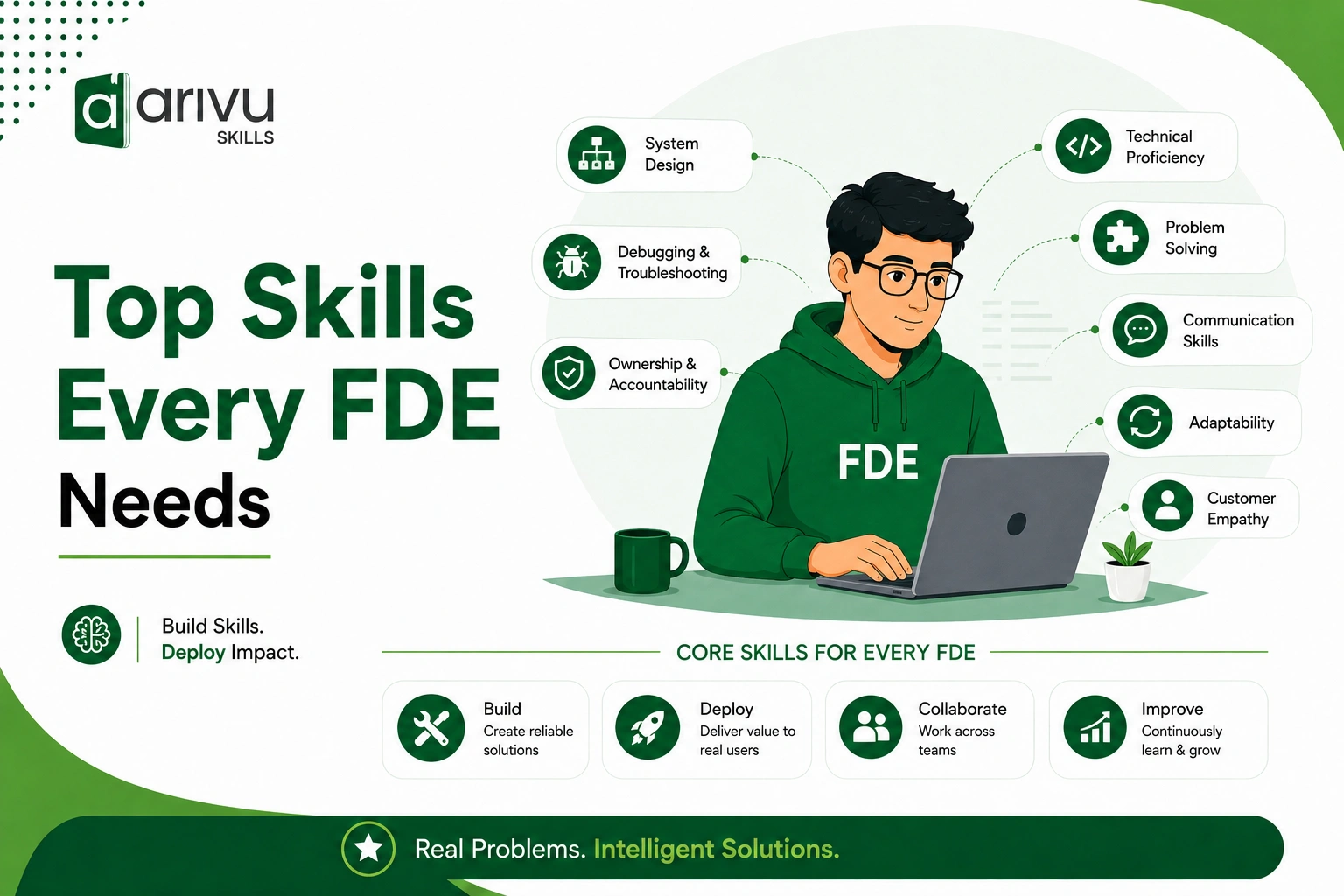
You still need to be a strong engineer first. Python, TypeScript, SQL — these show up constantly in FDE job postings, alongside comfort moving across the stack, from a data pipeline to a customer-facing dashboard in the same week. On the AI side, that now includes working with LLMs directly: building agentic workflows, wiring up evaluation pipelines, and knowing when a model’s output is actually good enough to ship.
Clients aren’t paying for a demo. They’re paying for something that survives contact with their actual data and their actual users, which means the usual shortcuts you might take on a side project don’t fly here.
2. Speed Without Losing the Plot
Ask anyone who’s done this job and they’ll tell you the same thing: you get dropped into a messy, half-defined problem with no playbook, and you’re expected to have something working in days, not months. That’s genuinely one of the harder skills to teach, because most engineering education optimises for the opposite — careful design, long review cycles, getting it “right” before you ship.
I’d argue this is the single biggest differentiator between engineers who thrive as FDEs and engineers who burn out fast. Speed of iteration is usually what decides whether a client actually adopts what you built, or quietly lets it gather dust.
3. Data Engineering and Cloud Infrastructure
Most deployments live or die on the data pipeline, not the model. Client data is almost never clean — it’s scattered across systems, half-documented, and full of edge cases nobody wrote down. So ETL/ELT work, data warehousing, and hands-on experience with at least one cloud provider (AWS shows up most often, with GCP and Kubernetes close behind) aren’t nice-to-haves. They’re the unglamorous work that makes everything else possible.
4. Talking to Humans Who Aren’t Engineers
This is where FDE work splits sharply from a typical dev role. You’ll be in a room explaining a technical trade-off to someone who’s never written a line of code, managing expectations when things slip, and sometimes shaping a client’s entire AI strategy in the process. Communication isn’t a soft skill you bolt on here — it’s treated as core engineering competency, and honestly, it should be.
A technically flawless solution the client doesn’t trust or understand is functionally the same as no solution at all.
5. Knowing What Not to Build
FDEs often end up playing a role close to a hands-on startup CTO for whichever client they’re assigned to: deciding what gets built, in what order, and why something that looks great in a demo might not be worth the engineering time. That judgment call — what actually moves the needle versus what just looks impressive — takes real experience to develop, and it’s easy to get wrong early on.
6. Getting Comfortable Being Uncomfortable
Every engagement is a different codebase, a different stack, a different industry — healthcare this quarter, logistics the next. The best FDEs get productive fast without trying to bulldoze the client’s existing systems and rebuild everything their way. That balance of moving fast while respecting how a team already works is harder than it sounds, and it’s usually learned the hard way, on the job.
7. Basic Security and Compliance Instincts
A lot of FDE work happens in genuinely sensitive environments — defence, government, finance, healthcare. You don’t need to be a security specialist, but you do need to know enough to avoid the obvious mistakes, because the cost of getting it wrong in these environments is a lot higher than in a typical startup sandbox.
Why This Skill Set Is Suddenly in Demand
FDE hiring has picked up fast, and it’s not hard to see why: AI-infrastructure and defence-tech companies need someone who can customize complex software inside security-sensitive client environments, and that’s exactly the gap this role fills. Pay reflects how rare the combination is too — it’s a wide range depending on company and seniority, but it’s consistently on the higher end for engineering roles right now.
If you’re weighing career paths in AI, this is one of the more resilient options on the table. The catch is that it takes a genuinely different mix of skills than most engineering programs teach.
Where Arivu Skills FDE Course Fits In
Most computer science degrees teach you to write code. Almost none of them teach you to write code inside a live client engagement, under real pressure, while also managing what the client expects from you. That’s the actual gap, and it’s the gap the Forward Deployed Engineer course at Arivu Skills in Bangalore is built around.
The course works through the same FDE skills covered above — full-stack and AI engineering, data pipelines, fast prototyping, and the client-facing side that most bootcamps skip entirely — so you come out with something closer to deployment experience than classroom theory. It sits alongside Arivu Skills’ other programs in Data Analytics, Data Science, Digital Marketing, and Financial Modelling, for anyone looking for a structured, mentor-led way into a high-growth tech career.
If you’re serious about becoming a forward-deployed engineer, this FDE course is one of the more practical routes toward a portfolio that actually holds up in an interview — or on a client site.
FAQs
A forward deployed engineer embeds inside a client’s team and writes, ships, and owns production code for that client’s specific problems, rather than building generic features meant for many customers.
Full-stack and AI/ML engineering, data engineering and cloud infrastructure, fast prototyping under pressure, client communication, prioritisation, and the ability to adapt to unfamiliar tech stacks quickly.
No. A solutions architect typically designs a system and hands off documentation. An FDE writes and deploys the actual code and owns the outcome end-to-end.
It helps, but it’s not the deciding factor. Companies care more about hands-on coding ability, problem-solving under pressure, and communication — which is why a focused FDE course can be a faster route in, especially for career switchers.
Palantir started it, and the role has since spread to OpenAI, Anthropic, Anduril, and Scale AI, plus a growing number of AI-infrastructure and defence-tech startups.
Start with solid full-stack development, data engineering fundamentals, and client-facing communication practice. A dedicated FDE course, like the one Arivu Skills runs in Bangalore, can help you build all three through hands-on, project-based learning rather than theory alone.