
Most engineers hear “forward deployed engineer” for the first time in a job posting and shrug it off as a fancier title for solutions engineer. It isn’t. A forward deployed engineer writes real production code, works out of the client’s world instead of a product team’s, and gets judged on whether the software actually holds up once it’s running somewhere they don’t control. No roadmap slides, no benefit of the doubt. So if you’re weighing this path, the question that matters isn’t whether it sounds exciting. It’s whether you know what to learn, in what order, and how far it can actually take you.
Thinking about making the shift? Check out the Forward Deployed Engineer Course in Bangalore to build the exact skill stack this roadmap covers, with hands-on projects instead of just theory.
What Is a Forward Deployed Engineer?
A forward deployed engineer (FDE) is a software engineer embedded directly with a client, building and adapting a company’s product to fit that client’s environment. Instead of shipping generic features to thousands of anonymous users, an FDE works on one enterprise account at a time. Often on-site. Often on a tight deadline. Almost always in direct conversation with the people who’ll actually use what gets built.
Three things tend to overlap in this role, and honestly, finding all three in one person is rare:
- Software engineering: writing production-grade code, wiring up APIs, working with real data pipelines
- Problem-solving under uncertainty: turning a half-explained client requirement into something that runs
- Client communication: going back and forth between engineering limits and business goals, on the fly
That mix is exactly why FDEs are in demand right now. Companies deploying AI-heavy or complex products into enterprise, government, or industrial settings can’t just ship software and hope. Someone has to make it work inside the client’s actual workflow, and that someone is the FDE.
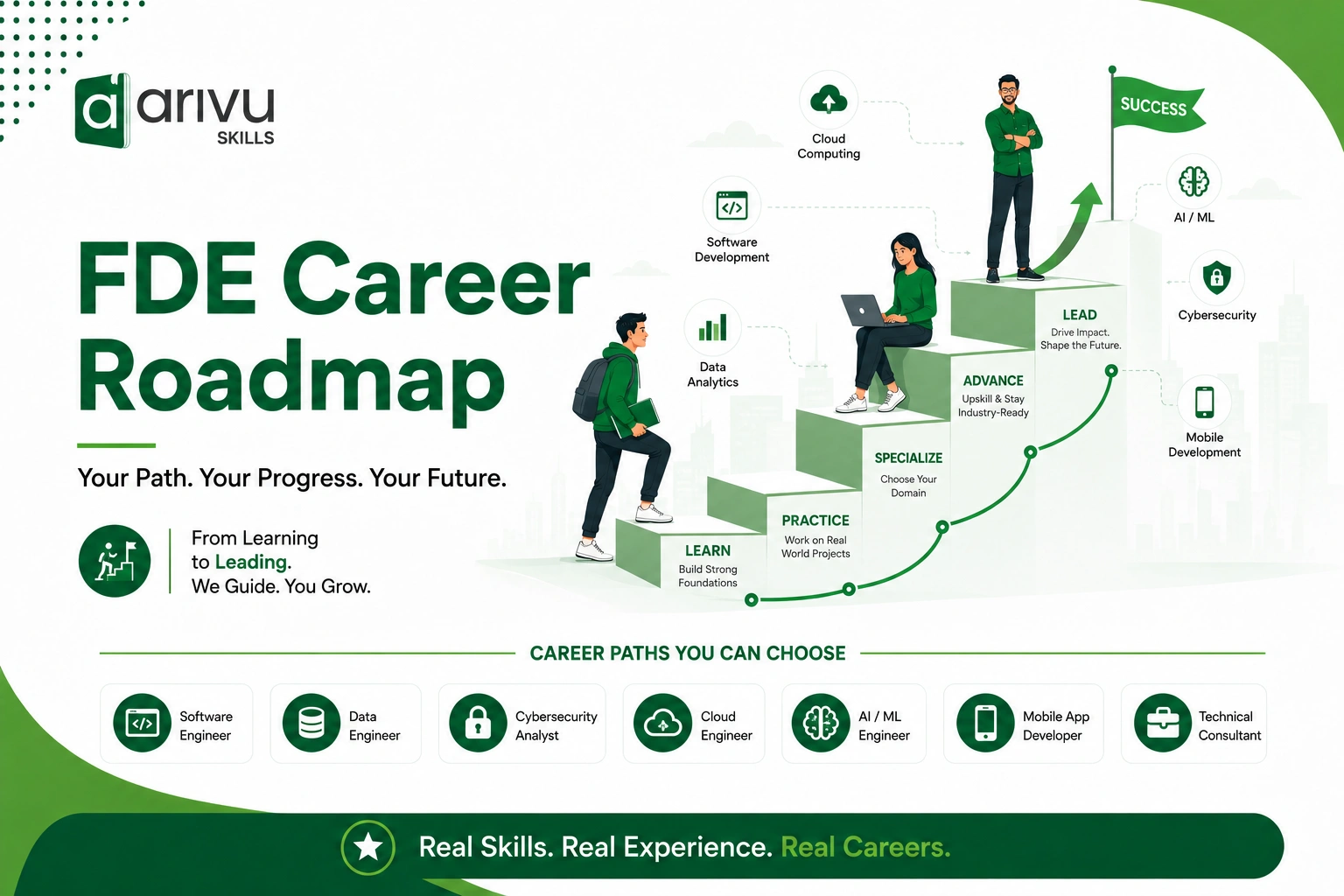
The FDE Career Roadmap: Phase by Phase
Phase 1: Build a Real Engineering Foundation (0–6 months)
Every honest version of this roadmap starts in the same place: can you actually ship code that works? Certificates don’t get you through this door. A track record does.
What to focus on here:
- One primary language, ideally Python, since most AI and data-heavy deployments lean on it
- A second language (Java, JavaScript, or Go), picked based on the kind of company you’re aiming for
- REST API design and integration, which is more or less the daily bread of this job
- Git, basic testing, and writing code someone other than you could maintain
Skip the tutorial-hopping. Build two or three small projects that are actually finished, an API, a data pipeline, a small full-stack app, and be ready to explain every call you made and why.
Phase 2: Add Data, Integration, and AI Deployment Skills (6–18 months)
Once you can ship reliably, the roadmap turns toward the stuff that makes you useful in a client’s world rather than a product team’s:
- SQL and relational databases: joins, window functions, schema design, and actually knowing why a query is slow
- System integration: connecting new software to legacy client systems, webhooks, authentication flows
- Applied AI basics: retrieval pipelines, chunking, embeddings, evaluation, because more and more FDE work now means deploying AI features into an enterprise setup
- Cloud fundamentals: deployment, environment config, troubleshooting when something breaks at 6pm on a Friday
This is also when you should start acting like an FDE instead of just training to become one. Sit in on customer calls if your current job lets you anywhere near them. Support a live implementation. Write documentation aimed at someone technical but new to the system.
Phase 3: Build Client-Facing Judgment (18–36 months)
Technical skill gets you in the room. Judgment is what keeps you useful once you’re in it. Client work rarely comes with a clean spec, requirements shift halfway through, priorities get reshuffled without warning, and you’re still expected to ship.
What this phase is really about:
- Getting comfortable operating across the engineering-business line, turning a vague ask into a scoped technical task
- Owning ambiguous problems instead of waiting for someone to hand you a ticket
- Tying every technical decision back to something the client actually cares about, not just what’s technically elegant
- Talking to non-technical stakeholders without either losing them or dumbing the work down
By the end of this phase, you should be able to point to at least one deployment you took from a rough prototype to something stable running in production, largely on your own.
Phase 4: Specialize and Move Into Senior FDE Roles (3+ years)
Once you’ve proven you can own a deployment start to finish, the path splits into leadership and specialization. A fairly typical progression:
Forward Deployed Engineer → Senior FDE → Principal FDE → Technical Solutions Architect → VP of Solutions Engineering / Engineering
Most engineers pick one of two directions from here. Either go deep into a vertical, healthcare, finance, manufacturing, security, or a specific platform, and become the person everyone calls for that kind of deployment. Or move into managing a team of FDEs and owning delivery outcomes across several accounts at once.
Who’s Hiring Forward Deployed Engineers, and What They Pay
FDE roles started as a Palantir specialty, and Palantir is still the name most people associate with the title. That’s changed. OpenAI, Anthropic, Google, and Scale AI all run forward deployed engineering teams now, alongside a growing list of enterprise AI and infrastructure companies deploying complex products into client environments. If your target list only has one company on it, you’re looking at this too narrowly.
Pay varies a lot by company, level, and location, but FDE compensation generally sits above standard software engineering pay at the same seniority, largely because the role demands both technical depth and client-facing judgment at once. Early-career FDE roles typically start in line with strong software engineering offers, and comp climbs quickly through Senior and Principal levels as ownership scope grows. Treat any specific number you see online as a rough anchor, not a guarantee. Comp shifts fast in this space, and it varies by market.
Who Makes the Switch to FDE, and How
There’s no single feeder path into this role, which is part of what makes it interesting. People land here from:
- Software engineering: usually the fastest move, since production coding is already solid. The gap to close is customer discovery and business judgment.
- Solutions engineering or consulting: client instincts are already sharp. The gap is production coding depth.
- Data or analytics roles: pipelines and data quality already feel familiar. The gap is learning how the data and models actually change a customer’s workflow, not just the dashboard.
- Domain experts in healthcare, finance, or manufacturing: deep business context already exists. Add engineering skill on top, and you can end up being a genuinely strong FDE precisely because you already know what “correct” looks like to the client.
Whatever path you’re on, you end up needing the same skill set. That’s really the whole argument for a structured forward deployed engineer course over trying to stitch it together job by job.
This roadmap rewards people who actually build things, ship real projects, and get comfortable working where engineering meets business, not people who just collect certificates. If you’d rather follow a structured path than figure it out alone, the Forward Deployed Engineer Course in Bangalore is built around this exact progression, from core engineering fundamentals to client-facing deployment skills.
Skills Checklist: Are You FDE-Ready?
You’re probably ready to start applying when most of these are true for you:
- I can ship a working feature end-to-end without someone checking in on me every day
- I’m past basic SELECT statements and actually comfortable with SQL
- I’ve built or worked on at least one real integration between two systems
- I can explain a retrieval or applied-AI pipeline I built, not one I just used
- I’ve had a real conversation with a “customer,” internal or external, about what they actually need versus what they asked for
- I can write clean, documented, production-grade code on a deadline that isn’t generous
FAQs
A forward deployed engineer is a software engineer embedded with a client to implement, customize, and integrate a company’s product for that client’s specific environment, combining hands-on coding with direct customer collaboration.
For engineers who want both technical depth and client exposure, yes. It tends to pay well, builds a broad skill set fast, and opens doors into technical architecture or engineering leadership.
It helps, but it isn’t the deciding factor. What matters more is demonstrated production coding ability and the judgment to handle messy, client-facing problems, both of which you can build through projects and structured training.
If you’re already coming from an engineering background, under a year of focused work is realistic. Starting from outside engineering, plan for a longer runway to build production coding skills first.
Solutions engineers usually support the sales cycle and pre-sales technical questions. FDEs go further: they write and deploy production code inside the client’s environment and often own the implementation long after the deal closes.
A software engineer typically builds one capability for many unseen users inside a product org. An FDE combines several capabilities to solve one client’s specific, often messy, problem, working directly with that client rather than behind a product backlog.
Palantir popularized the role and still hires heavily for it, but OpenAI, Anthropic, Google, and Scale AI now run their own FDE teams, along with a growing number of enterprise AI and infrastructure companies.