
Ask five engineers what a forward deployed engineer does and you’ll probably get five different answers — half of them wrong. Some think it’s a fancy name for a support engineer. Others assume it means working from a client’s office instead of your own. Neither is quite right, and the confusion is understandable, since this is one of the newer job titles in tech and it’s spreading fast, largely thanks to companies like Palantir putting it on the map.
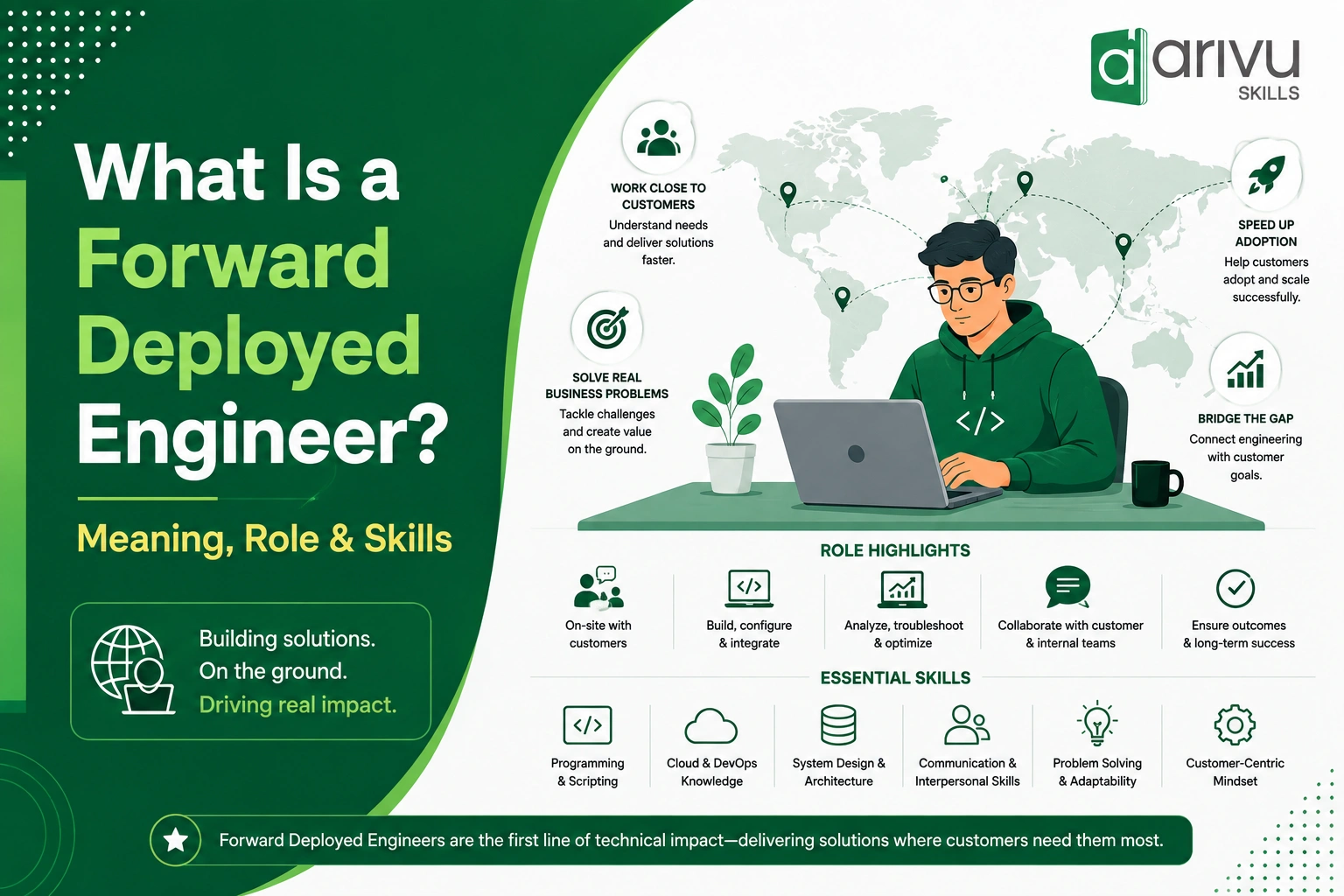
Here’s the short version: a forward deployed engineer (FDE) is a software engineer who works directly inside a client’s environment, building and adapting technology to solve that client’s specific problems — not shipping generic features from behind a desk at HQ.
Explore the Forward Deployed Engineer Course in Bangalore
What Does “Forward Deployed Engineer” Mean?
The phrase borrows its logic from the military, where “forward deployed” means troops stationed close to the action instead of sitting back at base. Apply that to software, and an FDE is the engineer who gets embedded with the customer, close to the actual problem, instead of staying back at the company’s own product team.
So when you’re asking what forward deployed engineer means in practice, think of it less as a job title and more as a way of working. A regular product engineer builds something once and ships it to thousands of users who never talk to them. An FDE builds something with one client, watches them use it, and rebuilds it on the spot when it doesn’t fit.
FDE Full Form and Where the Term Came From
The FDE full form is simply Forward Deployed Engineer — no hidden acronym trickery there. What trips people up is the “forward deployed” part, which really is a straight borrow from military terminology, as mentioned above.
Palantir gets most of the credit (or blame, depending who you ask) for turning this into a recognisable job title. They built entire teams of engineers who’d fly out, sit with intelligence analysts or defence clients, and write code that solved whatever was in front of them that week. Since then, the model has spread into fintech, healthcare, logistics, and increasingly, AI companies building custom agent workflows for enterprise clients. If you’ve searched “fde” and landed here wondering what the letters stand for, that’s the whole story — the term is young enough that it hasn’t picked up any other meaning yet.
What Does a Forward Deployed Engineer Actually Do?
Strip away the buzzwords and the job comes down to three things, done on repeat:
- Sit with the client’s team, figure out what’s actually broken (not what the sales deck said was broken)
- Build a working solution fast, often a rough version in days, not a polished one in months
- Stay close enough to the client to fix it, tune it, and rebuild it as their needs shift
That third point is what separates an FDE from a consultant. Consultants hand over a report and leave. FDEs stay attached to the outcome. If the thing they built breaks at 2am during a client’s busiest week, that’s still their problem.
A typical week might involve pairing with a client’s ops team to understand a broken workflow, writing integration code against a messy internal system nobody documented properly, and then presenting the fix back to a stakeholder who doesn’t code but needs to trust it works. It’s part engineer, part translator, part firefighter.
Skills You Actually Need to Become an FDE
Technical chops get you in the door, but they’re not what makes someone good at this job. Here’s what actually matters:
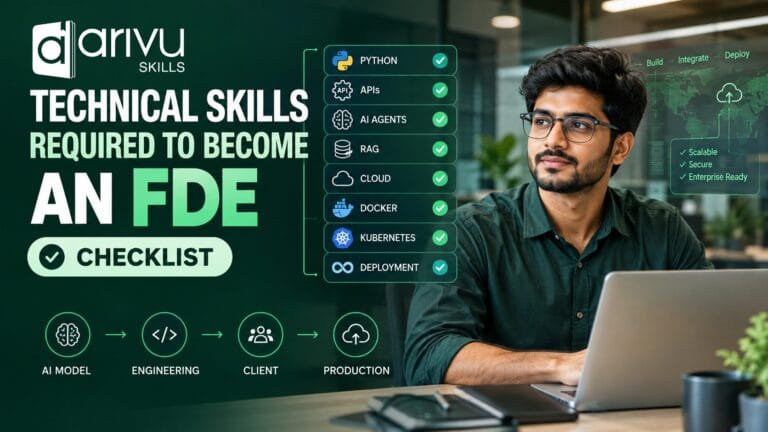
- Solid engineering fundamentals: You need to write real, working code under pressure — usually in whatever stack the client already runs, not the one you’d have picked. Python, SQL, and API integration work show up constantly.
- Comfort with ambiguity: Nobody hands an FDE a clean spec. You’re often building the spec as you go, based on a client half-explaining what they need.
- Client-facing communication: This is the one that trips up strong engineers the most. You’ll be in rooms with non-technical stakeholders, explaining trade-offs in plain language, sometimes while the thing you built is still half-broken behind you.
- Fast, scrappy building: Forward deployed work rewards a working prototype over a beautifully architected one. Perfectionists tend to struggle here; people who like duct-taping a fix together on day one and refining it later tend to thrive.
- Domain learning speed: One month you might be embedded with a logistics company, the next with a hospital network. You won’t be an expert in their industry going in — but you’ll need to fake it convincingly by week two.
None of this is exotic. It’s closer to “strong generalist engineer who doesn’t mind talking to people” than some rare unicorn skillset. That’s actually good news if you’re considering the path — it’s learnable, not innate.
Is Forward Deployed Engineering Right for You?
If you like variety over routine, don’t mind travel or client-site work, and get a kick out of watching someone use the thing you built two hours ago, this role tends to fit well. If you’d rather go deep on one hard technical problem for six months without interruptions, it probably won’t.
Ready to Build FDE Skills Hands-On?
Reading about the role only gets you so far — the actual skill sits in doing the work: sitting with a messy problem, building something rough, and iterating live with feedback. That’s exactly what Arivu Skills Forward Deployed Engineer course in Bangalore is built around. You’ll work through real client-style scenarios, build and rebuild solutions the way FDEs actually do on the job, and come out the other side with a portfolio that shows it, not just a certificate that claims it.
FAQs
A forward deployed engineer is a software engineer embedded directly with a client, building and adapting technology to solve that client’s specific problems on-site or in close ongoing contact, rather than shipping generic product features from a central office.
FDE stands for Forward Deployed Engineer. The term borrows “forward deployed” from military usage, meaning stationed close to where the problem actually is.
It means an engineer who works up close with a client rather than remotely on a shared product — building custom fixes, integrations, and tools tailored to that one client’s environment.
Not quite. A traditional software engineer usually builds product features for a broad user base from within the company. An FDE builds and adapts solutions for one client at a time, often on-site, with far more direct client contact.
Palantir popularised the role, but it’s now common across fintech, healthcare, defence, logistics, and AI companies that deploy custom software or agent workflows directly into client environments. Some job listings use adjacent titles like “solutions engineer,” “implementation engineer,” or “deployment strategist” for near-identical work, so it’s worth searching those terms too if you’re job hunting.