
What Is Financial Modelling? A Beginner’s Guide
Ever wondered how a company decides whether to launch a new product, how an investor works out what a business is worth before buying it, or how a startup predicts the month it runs out of cash? The answer usually lives inside a spreadsheet. That spreadsheet is a financial model, and the skill of building one is financial modelling.
For finance and commerce students, this has become one of the most practical skills you can pick up. This guide starts from zero: what financial modelling is, the main types of models, where it gets used, the tools involved, and how to build your first one.
What is Financial Modelling?
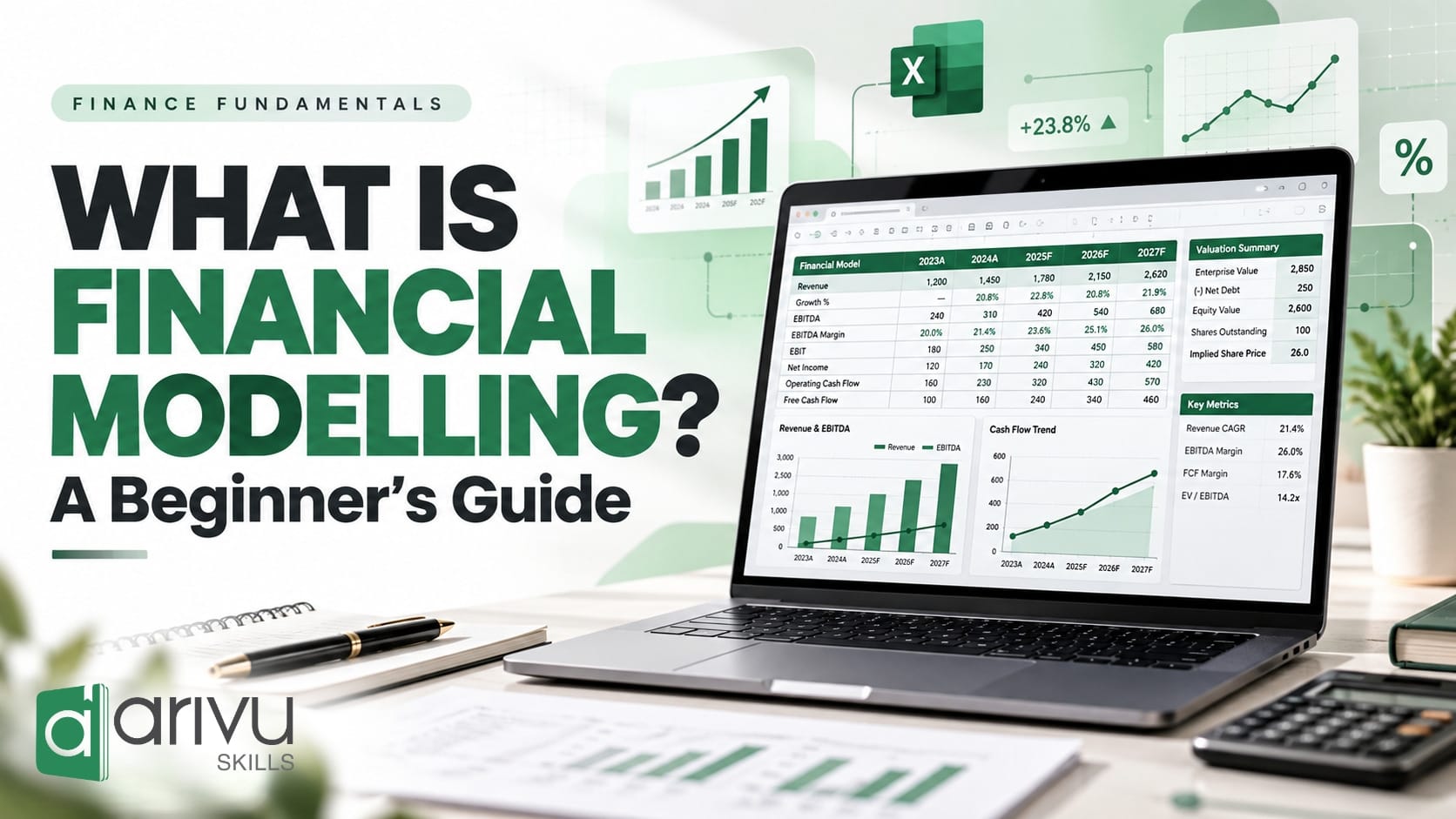
Financial modelling is the process of building a numerical picture of a company’s finances, usually in a spreadsheet, to forecast how it will perform in future. You take the company’s past financial data, add your assumptions about what happens next, and wire it all together with formulas so that every number reacts to the others.
Put simply, it’s a way to make decisions with data instead of gut feeling. Change one assumption, say revenue growing 10% instead of 5%, and a well-built model instantly recalculates the effect on profit, cash flow, and the value of the business.
Why Financial Modelling matters
A good model earns its keep in a few ways. It forecasts future revenue, costs, profit, and cash flow from past performance. It helps you value a business or an investment. It lets managers test “what if” scenarios before real money is on the line. And it shows how the business would cope if costs climbed, sales dropped, or interest rates moved.
That’s why financial modelling sits at the heart of most serious business and investment decisions.
Types of Financial Models
There are many models, each built for a different job. You don’t need all of them as a beginner, but it helps to know the landscape.
The three-statement model is the foundation. It links the income statement, balance sheet, and cash flow statement into one connected, dynamic model, and almost everything else builds on top of it. Learn this one first.
The discounted cash flow (DCF) model values a business by estimating its future cash flows and discounting them back to what they’re worth today. It’s one of the most widely used valuation methods.
Comparable company analysis, or “comps,” is a relative valuation method. It values a company using the financial ratios of similar firms in the same industry.
The merger and acquisition (M&A) model works out the financial impact of one company buying another, including whether the deal actually creates value.
The leveraged buyout (LBO) model is mostly a private-equity tool. It structures an acquisition funded largely by borrowed money, built around a target return over a set period.
A sensible path is to start with the three-statement model, move on to DCF, and only later take on M&A and LBO models.
Who actually uses it?
Financial modelling shows up across banking, private equity, and corporate analysis, wherever people need to value businesses, structure deals, or decide strategy. You’ll find it in:
Investment banking
1) Equity research
2) Private equity and venture capital
3) Corporate finance and FP&A (financial planning and analysis)
4) Consulting
5) Credit analysis and commercial banking
6) Startups, for planning fundraising and runway
And it’s no longer the private language of investment bankers. Students from B.Com, BBA, MBA, ACCA, CMA, CPA, and even engineering are learning financial modelling to land better analyst roles and stronger pay.
What tools do you need?
For most models, the answer is Excel (or Google Sheets). Excel is the industry standard because it’s flexible, transparent, and understood everywhere in finance. A few well-organised sheets, one for assumptions, one for calculations, one for outputs, will carry you a long way. Advanced users bring in Python or specialist software later, but Excel is where every beginner should start.
How to build your first financial model
- Gather historical data. Pull the company’s past financial statements: income statement, balance sheet, cash flow.
- Set your assumptions. Decide on growth rates, margins, and costs, and keep them in a separate, clearly labelled section so they’re easy to change.
- Build the income statement. Project revenue and expenses forward.
- Add the balance sheet and cash flow. Link them to the income statement so the whole thing stays connected.
- Layer in analysis. Once the three statements work together, add a DCF or run a few scenarios.
- Test and refine. Change your assumptions and check that the model still behaves logically.
One rule matters above the rest: keep your assumptions, calculations, and outputs separate. And financial modelling is a skill you build by doing, not something you master in a weekend.
Skills you’ll need
Beyond Excel, good modelling rests on a solid grasp of accounting and financial statements, clear logical thinking, and real attention to detail. You also need to translate a messy real business into clean numbers. Don’t underrate communication either. A model is only useful if you can explain what it’s telling you.
Career scope and salary in India (2026)
Financial modelling is now one of the most sought-after finance skills in India, and pay reflects that. Here’s a useful reframe: almost nobody is hired with the job title “financial modeller.” Companies hire financial analysts, equity research associates, FP&A analysts, and investment banking analysts, and financial modelling is the core skill those roles test for.
On the numbers, salaries in India generally run from about ₹5–8 LPA for freshers up to ₹20–40 LPA or more for experienced professionals, across investment banking, corporate finance, private equity, consulting, and fintech. Even at entry level, ₹6–10 LPA is realistic with the right certifications and skills. The demand backdrop helps too: Michael Page’s India Salary Guide 2026 points to strong hiring in corporate banking, fintech, and investment banking.
For a beginner, the real lesson is this: financial modelling works best alongside a professional qualification. If you’re already doing CA, ACCA, or CMA, or Any Other Basic roles in current job adding it turns your theory into a job-ready, better-paid skill set.
How to learn financial modelling with Arivu Skills
You can teach yourself the basics, but the quickest way up is a structured programme that pairs Excel technique with real business understanding and plenty of hands-on model building.
That’s the gap Arivu Skills, the skilling arm of ArivuPro Academy, is built to fill. Alongside coaching for qualifications like CA, ACCA, CMA-USA, and CS, Arivu Skills concentrates on the practical, job-ready abilities employers hire for, so finance and commerce students can move from a certificate to an actual career.
With campuses in Bengaluru (Malleshwaram and Koramangala), Chennai (Tambaram and Nungambakkam), and Coimbatore, you get the mentorship, structure, and placement support to learn financial modelling properly and use it.
Frequently asked questions
Is financial modelling difficult for beginners?
Not if you start in the right order. Get comfortable with financial statements and basic Excel, build a simple three-statement model, then move on to valuation.
Which financial model should I learn first?
The three-statement model. Everything else builds on it.
Do I need a finance degree?
It helps, but it isn’t required. Students from commerce, engineering, and management backgrounds all learn financial modelling successfully. Practice matters more than your degree.
Is financial modelling a good career in India?
Yes. Demand keeps growing across investment banking, corporate finance, consulting, and fintech, and pay rises quickly as your skill and experience grow.