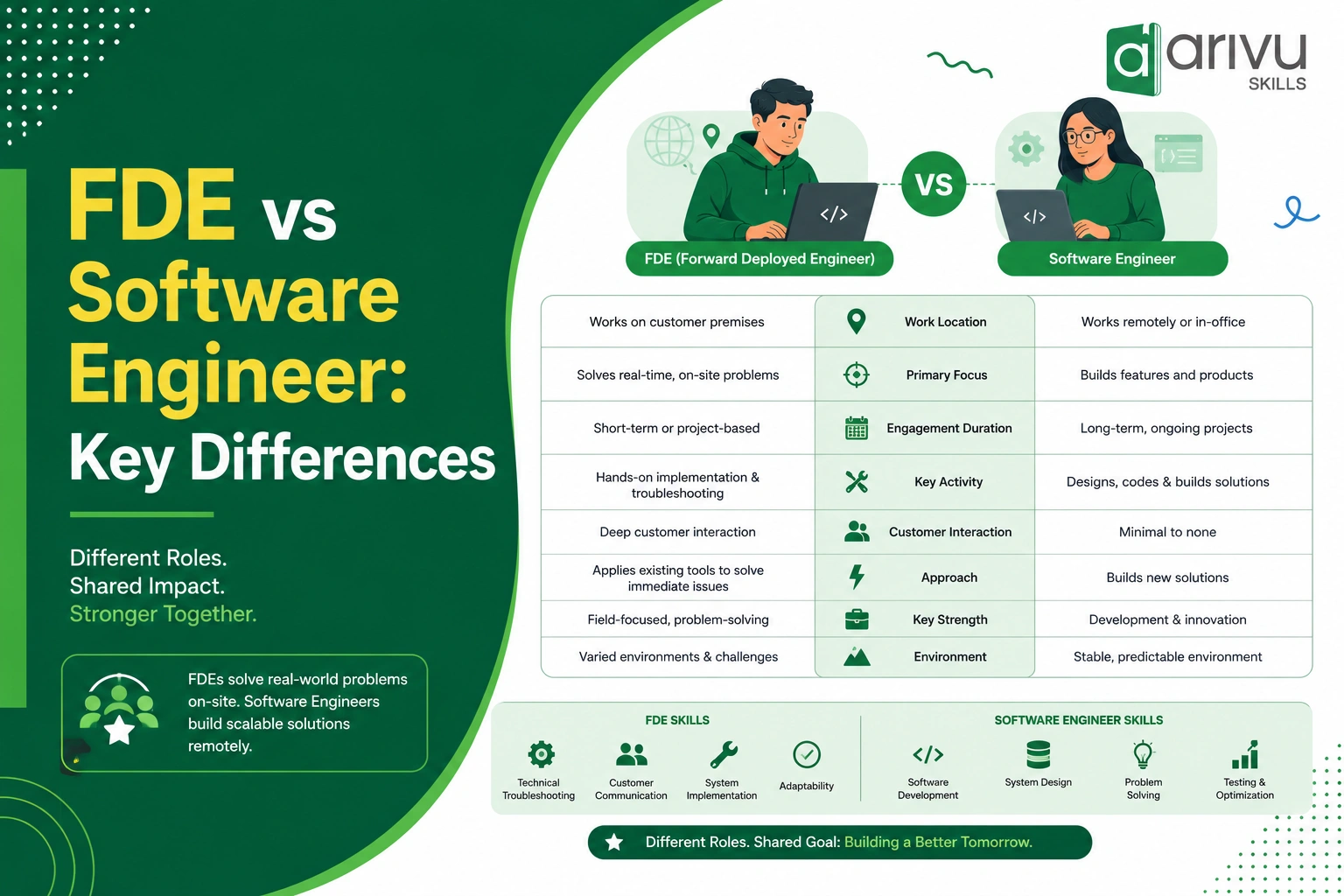

I get asked some version of this question a lot: “isn’t a forward deployed engineer just… a software engineer?” Fair question. Both write code. Both debug things at 11pm sometimes. Both probably own more hoodies than they’d like to admit. But once you look past the shared job title energy, a forward deployed software engineer and a regular software engineer are solving completely different problems, in completely different ways.
If you’re comparing forward deployed software engineer vs software engineer as a career decision, or just trying to figure out which one a job posting is actually describing, here’s the breakdown that actually matters.
Ready to move from theory to practice? Explore the Forward Deployed Engineer Course in Bangalore at Arivu Skills
The Core Difference in One Line
A software engineer builds a product for many users they’ll likely never meet. A forward deployed engineer (also written as forward deployment engineer in some job listings) builds and adapts a solution for one client, sitting close enough to that client to watch it break and fix it on the spot.
That’s it. Everything else follows from that one distinction.
Where the Work Actually Happens
A software engineer usually works from inside the company’s own product org, shipping features that get released to thousands or millions of users at once through a normal release cycle. They rarely, if ever, talk to an actual end user.
A forward deployed software engineer works embedded with a client — sometimes literally on-site, sometimes just in constant contact with their team. The “customer” isn’t an abstract user persona in a slide deck; it’s a person on a call asking why the dashboard broke ten minutes ago.
Comparing the Two Roles Side by Side
| Software Engineer | Forward Deployed Engineer | |
| Builds for | Broad user base, one product | One client at a time |
| Works from | Company office / product team | Embedded with the client, on-site or remote |
| Typical output | Polished, tested features on a release cycle | Fast, working solutions, iterated live |
| Client contact | Rare or none | Constant, often daily |
| Spec | Usually defined by product managers | Often half-defined, built alongside the client |
| Success measured by | Adoption metrics, uptime, code quality | Whether the client’s specific problem actually got solved |
Skills That Actually Diverge
Both roles need solid engineering fundamentals — that part doesn’t change. Where they split is everything around the code.
A software engineer is rewarded for depth: knowing one codebase, one system, one set of edge cases extremely well. Architecture decisions matter because thousands of users depend on them holding up for years.
A forward deployed engineer is rewarded for range and speed. You might be pulling data out of a client’s fifteen-year-old internal system on Monday and presenting a working fix to their ops director on Wednesday. Communication skills stop being a “nice to have” here — they’re closer to half the job. If you can write great code but freeze up explaining a trade-off to a non-technical stakeholder, forward deployed work will be a rough fit until that improves.
Career Path and Progression
Software engineering has a well-worn ladder: junior, mid, senior, staff, and so on, usually within one company or one product area. It’s predictable, and that’s part of the appeal for a lot of people.
The forward deployed path is younger and messier. There’s no fifty-year-old textbook definition of “senior FDE.” Progression tends to look more like: broader client accounts, harder problems, more autonomy to make judgment calls without a manager in the room. People who like a clear rung-by-rung ladder sometimes find this frustrating. People who’d rather be judged on outcomes than tenure tend to prefer it.
So Which One Should You Go For?
Neither is objectively better, they just fit different people. If you like going deep on one hard technical problem, working mostly heads-down, and building something that scales to millions of users, traditional software engineering is probably the better fit. If you like variety, don’t mind client-facing pressure, and get energy from watching someone use the thing you built an hour ago, forward deployed work tends to suit you more.
Build FDE Skills With Real Client-Style Practice
Understanding the difference on paper is one thing. Actually building the muscle for embedded, client-facing engineering work is another — and it’s not something a normal computer science curriculum really teaches. ArivuSkills’ Forward Deployed Engineer course in Bangalore is built specifically around that gap: real client-style scenarios, fast iterative builds, and the kind of stakeholder communication practice most engineers only get by accident, three years into a job.
Related reading: What Is a Forward Deployed Engineer? (Meaning, Role & Skills)
FAQs
A software engineer builds product features for a broad user base from within the company, with little direct client contact. A forward deployed software engineer works embedded with one client at a time, building and adapting solutions on-site or in close ongoing contact, with much heavier client interaction.
Yes. “Forward deployment engineer” and “forward deployed engineer” refer to the same role — the terms are used interchangeably across job listings, with “forward deployed engineer” (FDE) being the more common phrasing.
They share the same core engineering fundamentals, but forward deployed engineers additionally need strong client-facing communication, comfort with ambiguous specs, and the ability to build and iterate fast under direct client pressure.
Both offer strong growth, but the paths look different. Software engineering has a well-established ladder within a company or product area. Forward deployed engineering progression tends to come from handling broader, harder client accounts with more autonomy, rather than a fixed title ladder.
Yes, and it’s a common move. The core coding skills transfer directly; the main gap to close is usually client-facing communication and getting comfortable building fast, imperfect solutions under live feedback rather than a full product spec.