
Forward deployed engineer jobs have grown well beyond the companies that popularised the title. This article covers where the openings come from, what employers typically screen for, what the role pays, and what a realistic career path looks like.
Who Hires Forward Deployed Engineers
Palantir remains the company most associated with the role, and its FDE postings are consistently among the most competitive in tech. But the hiring pool has broadened considerably. Fintech companies rolling out custom onboarding or compliance tooling for enterprise clients hire forward deployed engineers regularly. Healthcare platforms adapting software per hospital system, logistics companies building client-specific tracking tools, and AI companies deploying custom agent workflows for enterprise clients all maintain similar functions.
Job seekers searching for the exact phrase “forward deployed engineer” should widen their search. Postings for “solutions engineer,” “implementation engineer,” “deployment engineer,” or “technical consultant” frequently describe near-identical work under a different title.
What Employers Screen For
Job listings for forward deployed engineers converge on a similar profile, regardless of the exact title used:
- Solid engineering fundamentals — Python and SQL appear consistently, alongside whatever stack the hiring company’s clients run
- Comfort working directly with non-technical stakeholders, often daily
- Willingness to travel or work on-site with clients, at least occasionally
- A demonstrated ability to ship working solutions under ambiguous requirements, rather than a fixed specification
Notably, most postings do not require a narrow list of specific frameworks. Employers tend to prioritise how a candidate reasons under pressure over which particular tools they’ve used previously.
Compensation for Forward Deployed Engineer Roles
Compensation varies by company, region, and experience level, so figures from any single source should be treated as directional rather than definitive. That said, a few patterns are consistent: at well-funded companies, forward deployed engineer compensation tends to match or exceed standard software engineering bands at the same experience level, with the gap often widening at senior levels, since client-facing trust becomes harder to replace than raw coding output alone. At smaller companies and startups building out their first FDE function, compensation is typically closer to standard engineering rates, with earlier exposure to larger and more complex client problems as a trade-off.
Candidates for whom compensation is a deciding factor should ask directly, during the interview process, how a given company structures FDE pay relative to its core engineering track, since the answer varies enough between companies that assumptions aren’t reliable.
A Realistic Career Path
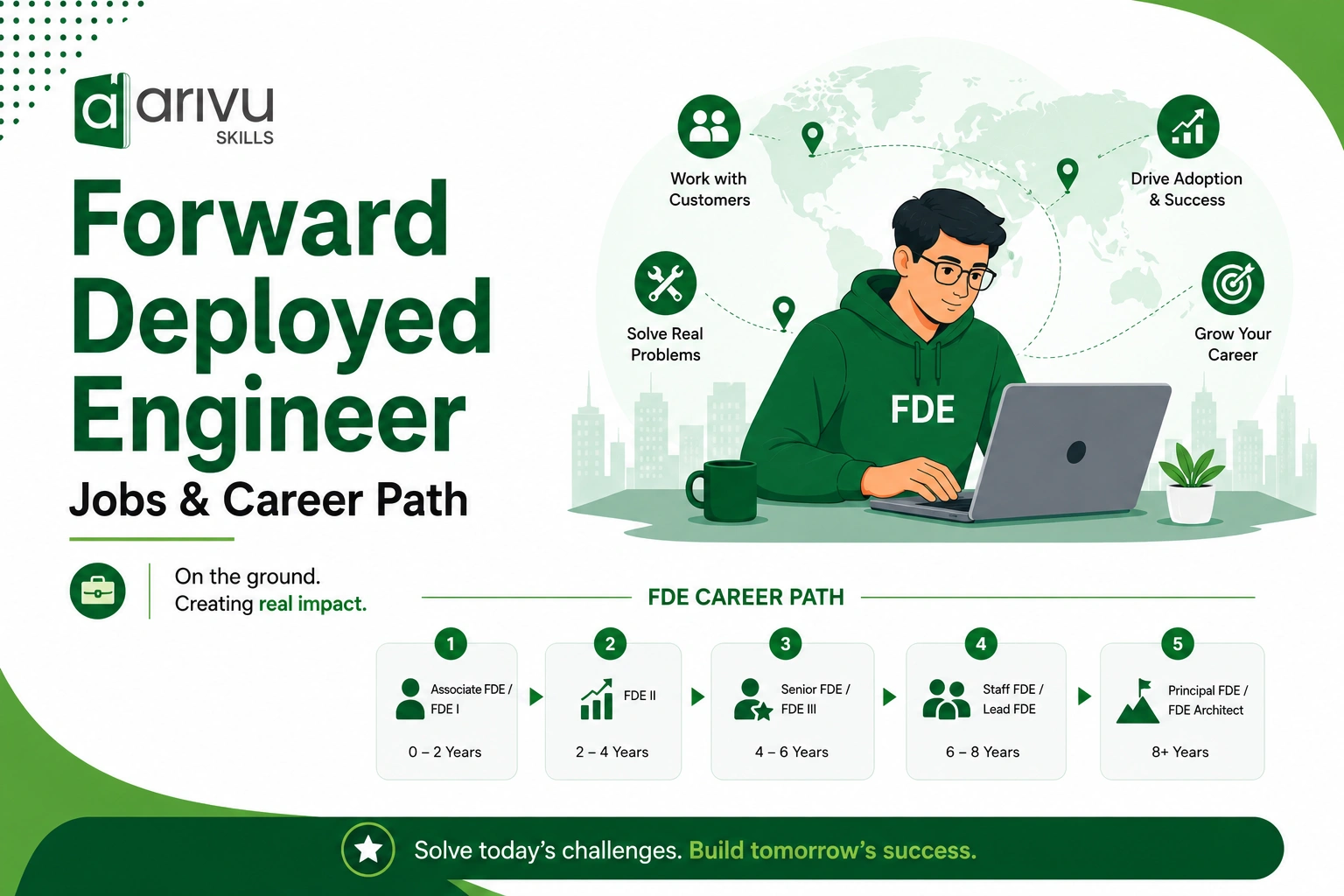
Most forward deployed engineers do not start in the role directly. A common entry point is two to three years as a general software engineer, building technical fundamentals, before moving into an FDE position once a candidate has enough range to operate with limited supervision.
Early in an FDE career, engineers are typically paired with a more senior FDE on client accounts, handling implementation work while the senior engineer manages the more complex client conversations. With experience, engineers move to owning smaller accounts independently, then progressively larger and more complex ones, eventually mentoring newer FDEs or specialising in a domain such as fintech, healthcare, or defence, where accumulated context becomes a distinct advantage.
Progression from there varies more than in a traditional engineering ladder. Some forward deployed engineers move into technical account leadership, some return to product engineering with a stronger understanding of real user needs, and others move into pre-sales or solutions architecture roles that lean further into the client-facing side of the work.
Preparing for a First Forward Deployed Engineer Role
For most candidates, the primary gap is not technical skill but evidence of an ability to handle ambiguity and client-facing pressure, which is difficult to demonstrate through a resume alone. Useful preparation includes:
- Building something end-to-end for a real external stakeholder, rather than a personal project with no outside audience
- Practising the explanation of technical trade-offs to non-technical audiences until it is a routine skill, not a rehearsed one
- Developing comfort with shipping a rough, working solution first and refining it based on live feedback, rather than polishing before release
Structured, scenario-based practice closes this gap more reliably than reviewing job descriptions alone.
Ready to move from theory to practice? Explore the Forward Deployed Engineer Course in Bangalore at Arivu Skills
FAQs
Palantir is the best-known hirer, but forward deployed engineer jobs now exist across fintech, healthcare, logistics, defence, and AI companies deploying custom software or agent workflows directly into client environments. Related titles like “solutions engineer” and “implementation engineer” often describe the same work.
Most postings look for solid engineering fundamentals (commonly Python and SQL), comfort working directly with non-technical stakeholders, willingness to work on client sites when needed, and a demonstrated ability to build under ambiguous requirements, rather than a fixed list of required frameworks.
It varies by company. At well-funded firms, forward deployed engineer pay often matches or exceeds standard software engineering bands at the same level, with the gap sometimes widening at senior levels. At smaller companies, pay is typically closer to standard engineering rates.
It suits candidates who prefer variety, client interaction, and fast iterative building over deep, focused work on a single system. Career progression tends to come from handling larger and more complex client accounts rather than a fixed title ladder, and can lead into technical account leadership, solutions architecture, or product engineering.
Most candidates enter the role with two to three years of general software engineering experience. To stand out, candidates should build something end-to-end for a real external stakeholder, practise explaining technical trade-offs to non-technical audiences, and develop comfort shipping rough, iterative solutions rather than fully polished ones.