Big Data vs Data Analytics:Key Differences
TL;DR: Big data and Data analytics are related, but they are not the same. Big data is the huge, fast, and varied raw data itself. Data analytics is the work of studying data to find useful insights. Put simply, big data is the material, and data analytics is the activity. Most people should learn core data analytics first (Excel, SQL, Python, Power BI), and then move into big data tools like Hadoop and Spark as the data gets bigger.
Big data and data analytics are two of the most mixed-up terms in the data world, and you will spot both in almost every analytics job ad. The short answer is this: big data is the large and complex data itself, while data analytics is the process of studying data to find answers. One is the raw material. The other is what you do with it.
This guide explains both terms in plain words, shows the differences side by side, clears up where data science fits, and helps you pick which one to learn first.
What Is the Difference Between Big Data and Data Analytics?
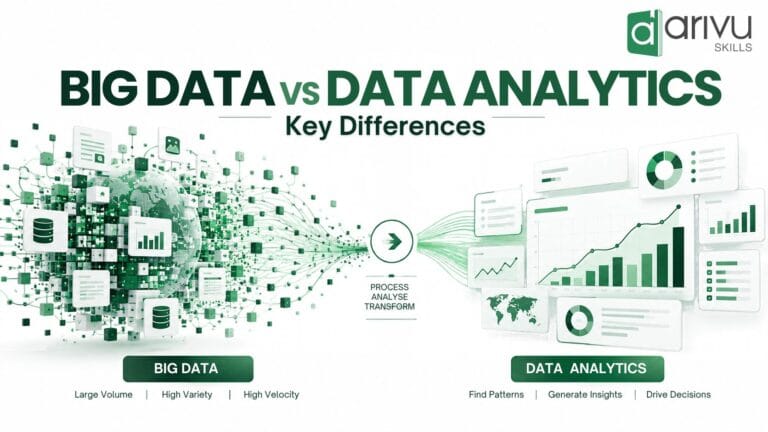
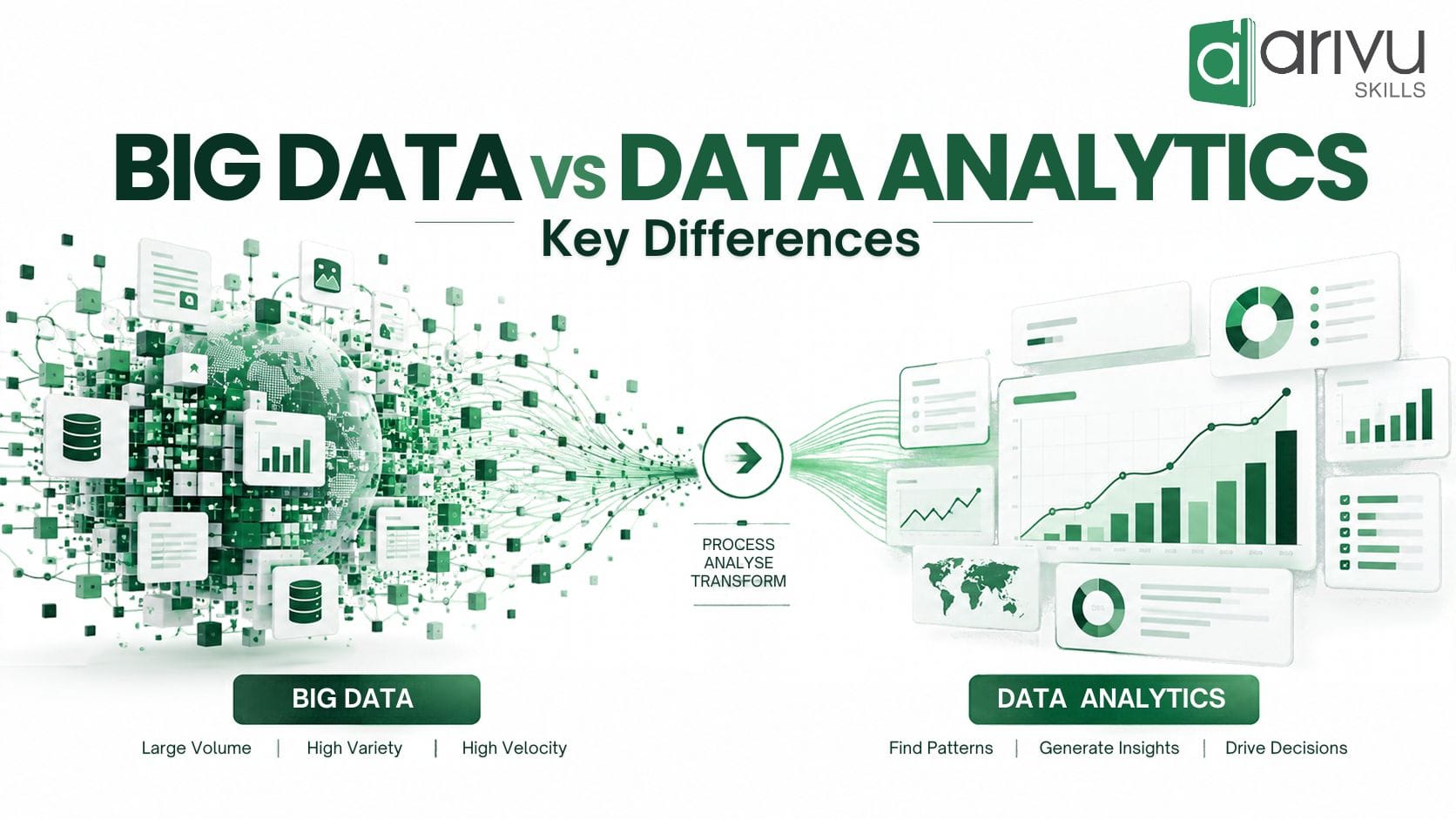
The difference is simple. Big data is the raw material, and data analytics is the work that turns that material into insight. You can do data analytics on small data, and you can store big data without studying it at all. The two often go together, but they are not the same thing.
Think of it like cooking. Big data is the big pile of ingredients. Data analytics is the cooking that turns those ingredients into a meal. You need skill to cook even a small amount of food, and a pile of ingredients does nothing until someone actually cooks it.
What Is Big Data?
Big data means sets of data that are too large, too fast, or too varied for normal tools like spreadsheets to handle. It is usually described by the 5 Vs: Volume (how much), Velocity (how fast), Variety (different formats), Veracity (how trustworthy), and Value (how useful).
On its own, big data is just stored information. Think of millions of daily payments, live clicks on a shopping app, years of sensor readings, or billions of social media posts. This kind of data needs special systems like Hadoop, Spark, and cloud platforms just to store and move it. Until someone studies it, it holds no real insight.
What Is Data Analytics?
Data analytics is the practice of studying data to find patterns, answer questions, and support decisions. It works on data of any size, from a small Excel sheet to a huge database. The goal is to turn plain numbers into something useful that a person can act on.
Data analytics answers four kinds of questions: what happened, why it happened, what will likely happen next, and what to do about it. A data analyst might use Excel, SQL, Python, and tools like Power BI or Tableau to clean the data, study it, and present clear results. The size of the data does not change what analytics is for. It only changes the tools you need.
Big Data vs Data Analytics: Side-by-Side Comparison
Here is the clearest way to see how the two differ
| Feature | Big Data | Data Analytics |
| What it is | The large, raw data itself | The process of studying data |
| Role | The raw material | The activity that creates insight |
| Data size | Always very large (terabytes to petabytes) | Any size, from small to very large |
| Main focus | Storing and managing huge data | Finding patterns and answers |
| Common tools | Hadoop, Spark, Kafka, cloud platforms | Excel, SQL, Python, Power BI, Tableau |
| Main skill | Data engineering and systems | Analysis, statistics, and visualisation |
| Output | A ready, usable store of data | A report, dashboard, or decision |
| Who works on it | Data engineers, big data specialists | Data analysts, business analysts |
So the simplest way to remember it: big data is about handling the data, while data analytics is about understanding it. In real projects, big data teams prepare and store the data, and analytics teams study it. That is why many people learn data analytics first and add big data skills later.
Where Does Data Science Fit In?
People often mix in a third term, data science, with the other two. Here is the simple view. Data analytics mostly studies past and present data to answer known questions. Data science goes further. It builds models and machine-learning systems to predict outcomes and answer new questions. Big data is the large data that both can work on.
| Term | Simple meaning | Main goal |
| Big Data | Very large and complex data | Store and manage huge data |
| Data Analytics | Studying data for insights | Answer known business questions |
| Data Science | Advanced modelling and prediction | Build models and predict outcomes |
For most beginners, the order that makes sense is data analytics first, then big data tools, and then data science if you want to go deeper into machine learning.
Big Data vs Data Analytics: Which Should You Learn First?
Most beginners should learn data analytics first, and move into big data later. Data analytics teaches the core skills (Excel, SQL, Python, and visualisation) that nearly every data job needs. Big data tools like Hadoop and Spark make far more sense once you already know how to work with and study data.
Start with data analytics if you:
-
- Are new to data and want a clear entry point.
-
- Come from commerce, management, or a non-technical background.
-
- Want to become a data analyst or business analyst.
-
- Like seeing quick results with tools like Power BI.
Move into big data if you:
-
- Already know the basics of data analytics.
-
- Enjoy the technical side of building and managing systems.
-
- Want to become a data engineer or big data specialist.
-
- Need to work with data that is too large for normal tools.
The two are not rivals. In most careers, you learn analytics first and pick up big data skills as your data grows.
Skills and Tools for Each
| Area | Data Analytics path | Big Data path |
| Core skills | SQL, Excel, statistics | Distributed systems, data pipelines |
| Programming | Python, R | Python, Java, Scala |
| Key tools | Power BI, Tableau, SQL | Hadoop, Spark, Kafka |
| Mindset | Ask questions, find answers | Build and manage data systems |
| Good first job | Data analyst, business analyst | Data engineer, big data developer |
Notice that SQL and Python show up on both sides. That is exactly why they are the best skills to learn first, no matter which path you pick later.
Common Mistakes People Make
A few common mix-ups worth avoiding:
-
- Thinking they are the same thing. Big data is the data. Data analytics is the work. Keeping them apart makes job ads and courses much easier to follow.
-
- Learning big data tools too early. Hadoop and Spark feel hard without basic data skills first. Start with Excel, SQL, and Python.
-
- Chasing tools instead of thinking. Tools change often. The real skill is asking the right question and reading the data correctly.
-
- Forgetting business sense. Both paths need you to explain your findings clearly to people who are not technical.
How to Start Learning in India
A simple path that works for most Indian learners:
-
- Build the basics with Excel and SQL.
- Learn Python and its data tools.
- Practise visualisation with Power BI or Tableau.
- Do real projects to build a portfolio.
- Add big data tools like Hadoop and Spark once you are comfortable.
- Specialise in analytics, engineering, or data science.
- You do not need an IT degree to begin. Many analysts come from commerce, management, or engineering and learn step by step. The fastest way to move ahead is with guided learning and real projects, rather than studying on your own. Arivu Skills runs structured data analytics programmes for Indian students and working professionals. They combine these core skills with hands-on, project-based practice, which is a good next step if you want to turn this comparison into a real career plan.
FAQ Section
Q: What is the main difference between big data and data analytics?
Big data is the large, raw data itself. Data analytics is the process of studying data to find insights. One is the material, the other is the activity.
Q: Is big data the same as data analytics?
No. Big data describes very large and complex data. Data analytics is the work of studying data of any size to answer questions.
Q: Which is better to learn first, big data or data analytics?
Data analytics is usually better first. It teaches core skills like SQL and Python that nearly every data job needs, before you move into big data tools.
Q: Do big data and data analytics use the same tools?
They share some, like Python and SQL. Big data adds tools like Hadoop and Spark, while data analytics leans on Excel, Power BI, and Tableau.
Q: Where does data science fit in?
Data science goes beyond analytics by building models to predict outcomes. Big data is the large data, analytics studies it, and data science models it.
Q: Can I do data analytics without big data?
Yes. Data analytics works on data of any size. You can study a small Excel sheet without any big data tools at all.
Q: Do I need coding for either one?
Some coding helps for both. SQL and Python are the most useful skills, and you can start with Excel before you learn to code.
Q: Which career needs which skill?
Data analysts and business analysts focus on analytics skills. Data engineers and big data specialists focus on big data systems.
Q: Can I learn both?
Yes, and many people do. The common path is to learn data analytics first, then add big data skills as your data and career grow.
Q: Is big data or data analytics better for a beginner in India?
Data analytics is the easier entry point for most beginners, including those from non-technical backgrounds. Big data skills can be added later.