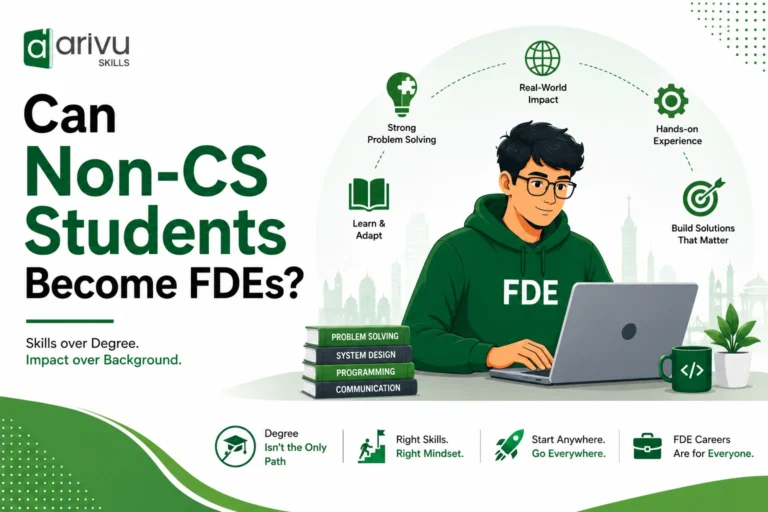
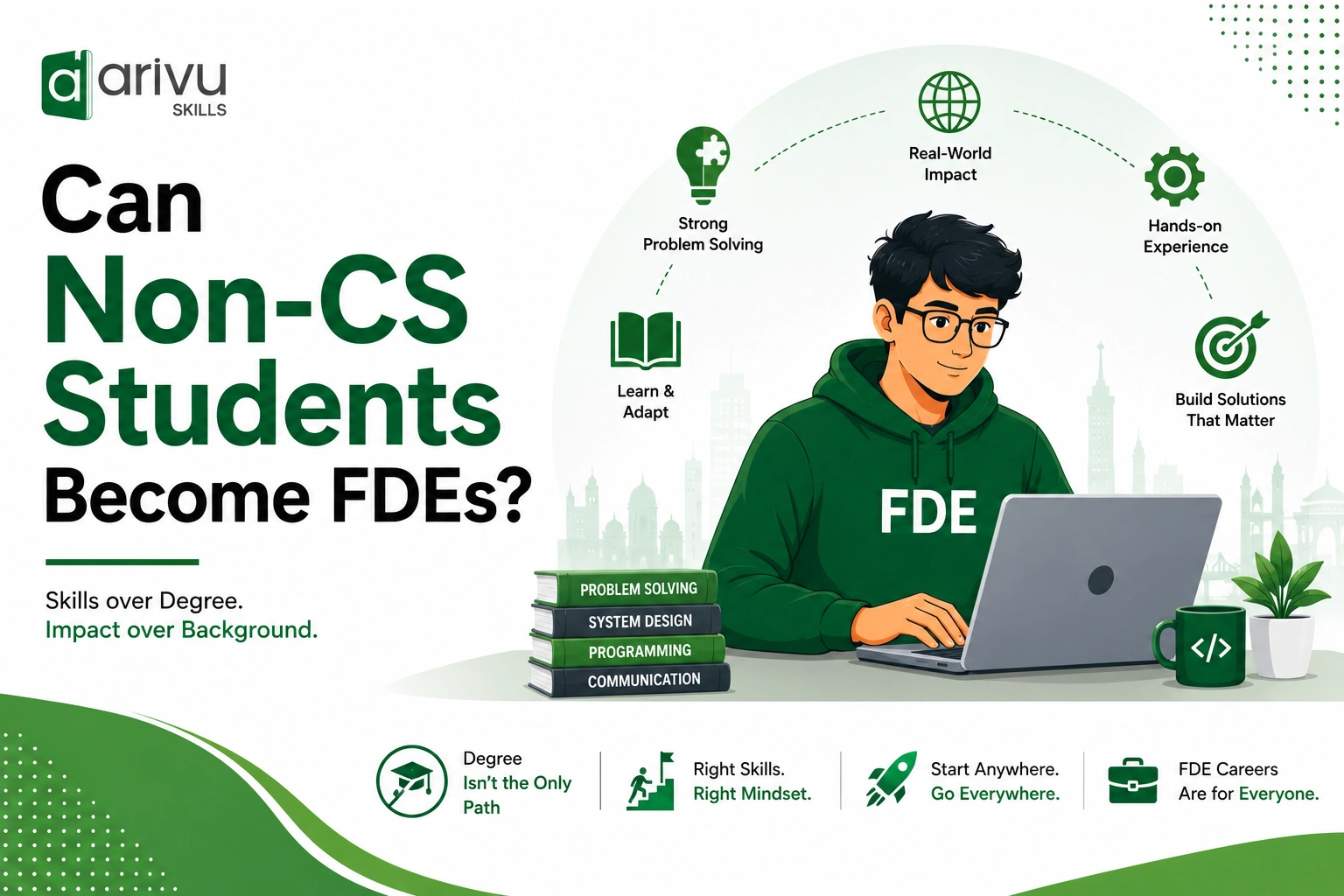

Yes, non-CS students can become forward deployed engineers. A computer science degree can make the first few steps easier, but it is not the only route into the role.
There is an important catch. Forward deployed engineering is still engineering. Employers will expect you to write code, understand systems, work with data and solve production problems. A commerce, mechanical engineering, mathematics or arts degree will not automatically disqualify you, but enthusiasm alone will not replace technical ability.
The real question is not, “Do I have a CS degree?” It is, “Can I show that I can build software, learn a business problem and deploy a reliable solution for a customer?”
This guide explains what non-CS students need to learn, which backgrounds can become useful and how to build evidence for an FDE job.
Need a structured route into this career? Explore the Forward Deployed Engineer Course in Bangalore at Arivu Skills to develop coding, integration, AI deployment and client problem-solving skills through practical projects.
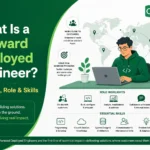
What Is a Forward Deployed Engineer?
A forward deployed engineer is a software engineer who works directly with customers to understand their problems and deploy technology inside their actual business environment. The role can include requirement discovery, architecture, coding, API integration, data work, testing, cloud deployment and support after launch.
The FDE full form is Forward Deployed Engineer. In simple terms, the forward deployed engineer meaning is an engineer placed close to the customer and the problem being solved. An FDE combines software development with product thinking and client communication.
The title varies between companies. Similar jobs may be called forward deployed software engineer, applied AI engineer, deployment engineer, customer engineer or solutions engineer. Read the responsibilities carefully because some roles are deeply technical while others lean towards consulting or implementation.
Can Non-CS Students Really Become Forward Deployed Engineers?
Yes, but eligibility depends on the employer and the strength of your practical experience.
Current job descriptions show both sides of the market. Some FDE listings ask for a degree in computer science, software engineering, information systems or a related field. Others accept an equivalent combination of education and experience, and some focus their qualification sections on production coding, cloud systems, data engineering and AI deployment without naming a specific degree.
That means a non-CS student should not assume every vacancy is open to every academic background. You will find companies with strict degree filters. You will also find employers more interested in what you have built and operated.
Your best strategy is to develop enough skill and project evidence that the degree becomes one part of your profile rather than the main reason to accept or reject you.
Why a CS Degree Helps but Is Not Everything
A good computer science programme introduces data structures, algorithms, operating systems, databases, networks and software design. These subjects matter in FDE work. CS students also spend several years around code, assignments and technical peers.
But a degree does not prove that someone can handle a client conversation, investigate an unclear workflow or deploy a system safely. Many graduates still need practical experience before they are ready for forward deployed engineering.
Non-CS students begin with a theory and practice gap, but some bring strengths that CS graduates may need to develop later. A finance student may understand lending or risk workflows. A mechanical engineer may be comfortable with manufacturing systems. A life-sciences graduate may recognise the consequences of using unreliable data in healthcare.
The goal is to keep that domain advantage while adding solid engineering skills.
Which Non-CS Backgrounds Can Be Useful for FDE Roles?
Electronics and electrical engineering
Students from electronics or electrical engineering often have experience with logic, systems, mathematics and basic programming. They may be well suited to FDE work involving IoT, manufacturing, energy, edge devices or industrial systems.
Their main gap is usually production software development. Learning web services, databases, cloud deployment and testing can make the transition much smoother.
Mechanical and civil engineering
These students understand physical systems, operations and project constraints. That knowledge can help in manufacturing, construction technology, logistics and asset-management projects.
They need to build coding confidence and learn how software systems communicate. A project that combines operational data with a deployed application can connect the old background to the new career.
Mathematics and statistics
Maths and statistics students often have strong analytical thinking and may already use Python or R. They can move towards data-heavy FDE work, AI applications or decision systems.
Their challenge is often software engineering. A model inside a notebook is not a production application. They should learn APIs, version control, testing, databases and cloud deployment.
Commerce, finance and economics
These backgrounds can be useful in fintech, banking, accounting, risk, compliance and enterprise operations. Understanding a business process gives an FDE a better starting point for client discovery.
The technical learning curve is steeper if the student has never programmed. It is still manageable with consistent practice, but the first goal should be basic software development rather than advanced AI.
Life sciences and healthcare
Biology, pharmacy, biotechnology and healthcare graduates can bring useful domain knowledge to health-tech and life-sciences deployments. They may understand research processes, patient privacy or the risk of an incorrect result better than a generalist engineer.
They will need to learn programming, data handling and secure application design. Domain knowledge becomes valuable only after they can contribute technically.
Business and management
Management students may be comfortable with presentations, stakeholders and business analysis. Those skills help in the client-facing side of FDE work.
However, communication without engineering ability usually leads to consulting, customer success or pre-sales rather than an FDE position. A management student aiming for FDE must build and deploy real software.
Arts and humanities
An arts or humanities student can transition, although the path is longer when there is no prior exposure to mathematics or programming. Strong writing, research and communication can help with discovery and documentation.
The student should follow a structured technical plan and avoid jumping straight into complex AI frameworks. Learning to write dependable software comes first.
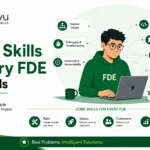
Core Skills Non-CS Students Need for an FDE Career
Programming
Choose one language and become comfortable using it. Python is a practical option because it is widely used in backend development, data work and AI applications. TypeScript is also useful for full-stack development.
You should be able to write functions, work with files and APIs, handle errors, debug code and organise a small application. Copying generated code without understanding it will become obvious during technical interviews and production failures.
Data structures and algorithms
You do not need to begin with the hardest competitive-programming problems. Learn arrays, lists, maps, stacks, queues, trees, graphs, sorting, searching and basic complexity analysis.
These concepts help you reason about performance and pass coding interviews. Study them alongside projects so they do not remain abstract.
Databases and SQL
Most client systems depend on structured or unstructured data. Learn relational database concepts, SQL queries, joins, indexes and transactions. Understand when a document or vector database is useful, but do not skip relational fundamentals.
APIs and backend development
FDEs connect systems. You should know how HTTP works, how to build and consume REST APIs, and how authentication methods such as API keys, OAuth and tokens are used.
Build a backend service with validation, error handling and clear API documentation. This is more useful than completing many isolated coding exercises.
Git and collaborative development
Learn version control early. Use branches, commits, pull requests and code reviews. Employers need evidence that you can work in an engineering team, not only produce code on your laptop.
Cloud and deployment
Deploy at least one application to a cloud platform. Learn basic Linux, environment variables, containers, CI/CD and logs. You should be able to explain how a request reaches your application and what you would check if it failed.
Testing and reliability
Write unit and integration tests. Learn how retries, timeouts, monitoring and rollback plans protect a production system. FDE work happens in client environments where a quick hack can become a costly failure.
AI application development
After you can build ordinary software, learn LLM APIs, retrieval-augmented generation, embeddings, tool calling, agents and model evaluation. AI skills are increasingly common in FDE listings, but they sit on top of software and data foundations.
Client communication and discovery
An FDE must ask useful questions, map a workflow and explain trade-offs. Practise turning statements such as “we need a chatbot” into a clearer problem with users, data sources, constraints and success measures.
A Step-by-Step FDE Roadmap for Non-CS Students
Step 1: Learn Programming Fundamentals
Spend the first stage learning one language properly. Write small programs without relying on a tutorial for every line. Practise variables, functions, collections, file handling, modules and error management.
Build small tools connected to your original field. A commerce student could automate invoice categorisation. A mechanical student could analyse equipment readings. Familiar subject matter leaves more mental space for learning the code.
Step 2: Study Essential Computer Science Concepts
Cover data structures, algorithms, databases, operating-system basics and networking. You do not need another three-year degree, but you do need the concepts that help engineers reason about systems.
Make a checklist and connect each subject to a project. For example, learn database indexing while measuring a slow query rather than memorising a definition.
Step 3: Learn Full-Stack or Backend Development
Build an application with a user interface or API, database and authentication. Backend depth is especially useful for integrations, but basic frontend knowledge helps an FDE deliver a complete prototype.
Your application should handle bad input and show useful error messages. Clean demonstration data can hide weaknesses, so test the awkward cases too.
Step 4: Learn Cloud Deployment and DevOps Basics
Put the application online. Use Docker, create a deployment pipeline and add logs. Set up separate development and production configurations.
This stage teaches lessons that local coding cannot. Permissions fail, environment variables go missing and network behaviour changes. Learning to diagnose those problems is part of becoming an engineer.
Step 5: Add Data and AI Skills
Learn how to clean data, build a retrieval pipeline and evaluate an AI feature. Avoid creating another generic chatbot. Connect the feature to a specific workflow and explain why AI is better than a standard search or rules-based system.
Create a test set with expected results. Record incorrect outputs and improve the system based on evidence.
Step 6: Build a Client-Style Project
Choose a real user, small business, student group or non-profit and learn how they work. Do not begin by pitching a technology. Ask where time is wasted, where errors occur and what information is difficult to access.
Then build the smallest solution that improves one measurable part of the workflow. Document the discovery, constraints, architecture and result.
Step 7: Gain Team Experience
Contribute to an open-source project, join a hackathon team, take an internship or work on a serious group project. Learn how to review code, communicate blockers and work with somebody else’s implementation.
Solo projects matter, but an FDE rarely works alone.
Step 8: Prepare for FDE Interviews
Expect a mix of coding, system design and client scenarios. You may be asked to debug an application, design an integration or respond to an unclear customer request.
Practise explaining your thought process. Ask clarifying questions before proposing a solution. A current FDE interviewed by Business Insider described the role’s interview process as a mix of technical coding rounds and consulting-style problem solving.[4]
How Long Does It Take for a Non-CS Student to Become FDE-Ready?
There is no honest universal timeline. A student with prior Python and engineering coursework may progress much faster than someone writing code for the first time.
As a rough planning guide, a beginner studying consistently may need:
- Three to four months for programming and basic CS concepts
- Three to five months for backend or full-stack development
- Two to three months for cloud, deployment and testing
- Two to four months for AI applications and a client-style capstone
These stages overlap, and completing them does not guarantee an FDE offer. Many employers ask for two or more years of software experience, while senior roles expect much more. Your first position may be software developer, implementation engineer, data engineer or solutions engineer rather than FDE.
The Best Portfolio Projects for Non-CS FDE Candidates
Domain-specific workflow application
Use your academic background. A finance graduate could build a secure document-review workflow. A life-sciences student could create a research knowledge system with source citations and human approval.
Enterprise integration project
Connect a CRM-style application, database, email service and analytics dashboard through APIs. Add authentication, audit logs and failure handling.
AI knowledge assistant with evaluation
Build a retrieval system over approved documents. Include access rules, citations, an evaluation dataset and a fallback when the system cannot answer confidently.
Operations dashboard with alerts
Process live or simulated operational data, detect exceptions and notify the right user. Explain data quality issues and how the system recovers when an input source fails.
For every project, include a readable README, architecture diagram, setup instructions, tests and a deployed version when possible. The explanation of your choices matters as much as the feature list.
How Non-CS Students Can Use Their Background as an Advantage
Do not hide your original degree. Connect it to the problems you want to solve.
A generic candidate may know how to call an AI API. A finance graduate who understands reconciliation and can build production software can ask better questions in a banking deployment. A mechanical engineer who understands downtime can design a more useful maintenance workflow.
Domain knowledge does not excuse weak code, but it can make your technical work more relevant. The strongest profile is T-shaped: broad engineering ability with deeper knowledge of one industry or problem area.
Common Mistakes Non-CS Students Should Avoid
Starting with advanced AI before basic programming
An AI framework can produce a quick demo, but it will not teach you how to debug authentication, data or deployment failures. Build ordinary applications first.
Collecting certificates without building projects
Certificates can structure your learning. They do not prove that you can ship software. Each course should lead to a project or a clear improvement in an existing one.
Copying code without understanding it
AI coding tools are useful, but you remain responsible for the output. Read generated code, test it and learn why it works.
Ignoring communication skills
Technical ability gets tested, but so does your behaviour with a customer. Practise listening, asking follow-up questions and documenting decisions.
Applying only to jobs titled FDE
The first relevant opportunity may be backend engineer, implementation engineer, data engineer, applied AI engineer or solutions engineer. These roles can provide the production experience needed for a later FDE move.
Pretending the degree never matters
Some companies use strict education filters. Apply where the requirements allow flexibility and continue building experience. Rejection from one employer does not define the whole market.
Can Freshers From Non-CS Backgrounds Get FDE Jobs?
It is possible, but many direct FDE openings ask for previous production experience. Current listings range from roles requiring a few years of full-stack development to senior positions asking for substantial enterprise AI experience.
Freshers should widen the entry path. Junior software, data, cloud, implementation and customer engineering roles can all build relevant experience. A smaller startup may give a beginner more end-to-end ownership than a narrowly defined role at a large company.
Look for work where you can code, speak with users and see a system reach production. That combination prepares you for FDE better than a title with little technical ownership.
Do You Need a Master’s Degree or MCA to Become an FDE?
No single postgraduate degree is required across the market. An MCA, MSc Computer Science or related programme can provide structured learning and may help with employers that filter by qualification. It is not automatically necessary for someone who can build strong technical experience through another route.
Before enrolling, compare the cost and time with the actual gaps in your profile. If you need a recognised technical credential and campus placements, a degree may make sense. If you already have engineering experience but lack cloud or AI deployment skills, focused training and projects may be more efficient.
FAQs
Yes. Non-CS students can become FDEs by developing strong programming, software engineering, deployment and client-facing skills. Some employers accept related degrees or equivalent experience, while others have stricter education requirements.
FDE stands for Forward Deployed Engineer. It is a customer-facing software engineering role focused on adapting and deploying technology in real business environments.
Computer science and software engineering are the most direct degrees, but electronics, mathematics, statistics and other engineering backgrounds can also provide useful foundations. Students from business, science or humanities can transition with additional technical training.
Yes. A commerce student can use finance or business knowledge in fintech and enterprise projects, but must learn programming, databases, APIs, cloud deployment and software testing.
Yes. Mechanical engineers can target manufacturing, logistics, IoT or industrial software projects. They need to add production programming, web services, databases and cloud skills.
Coding is compulsory for genuinely technical FDE roles. The expected depth varies, but current job descriptions commonly ask for production coding and experience with languages such as Python, TypeScript, Java or .NET.