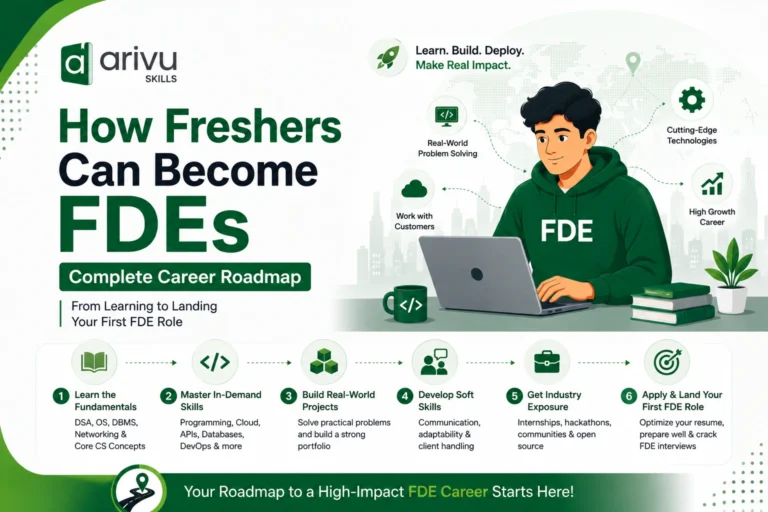

A fresher trying to become a forward deployed engineer faces a slightly odd problem: the role expects you to code like an engineer, understand problems like a consultant and communicate with customers like someone who has already handled real projects.
That sounds like an experience trap. It is not.
Some companies hire new graduates directly into forward deployed software engineering roles. Others reserve the FDE title for experienced engineers. In that case, a fresher can start in software engineering, solutions engineering, implementation engineering or technical consulting and move into FDE work after gaining hands-on delivery experience.
The real goal is not to collect the title as quickly as possible. It is to become the kind of engineer who can enter an unfamiliar business, understand what is broken and ship a working solution.
If you want a guided path, explore the Forward Deployed Engineer Course in Bangalore from Arivu Skills. The course is designed around practical tools and client-style projects that help learners prepare for customer-facing engineering work.
Can a fresher become a forward deployed engineer?
Yes. Freshers can become FDEs through new-graduate roles, internships or an adjacent technical role followed by an internal or external move.
Palantir, the company most closely associated with the forward deployed software engineer role, has advertised new-grad FDSE opportunities and describes its early-talent recruitment separately from experienced hiring. At the same time, current FDE openings at companies such as OpenAI often ask for several years of engineering and customer-facing delivery experience. That difference matters: “FDE” is not a standardised entry-level job across the industry.
For a fresher, there are two sensible routes:
- Apply directly to new-grad FDSE and deployment engineering roles.
- Build relevant experience in an adjacent role, then move into FDE work.
Both routes can lead to the same career. The second is not a compromise. It is how many engineers develop the judgement and confidence needed to work directly with customers.
What does an FDE actually do?
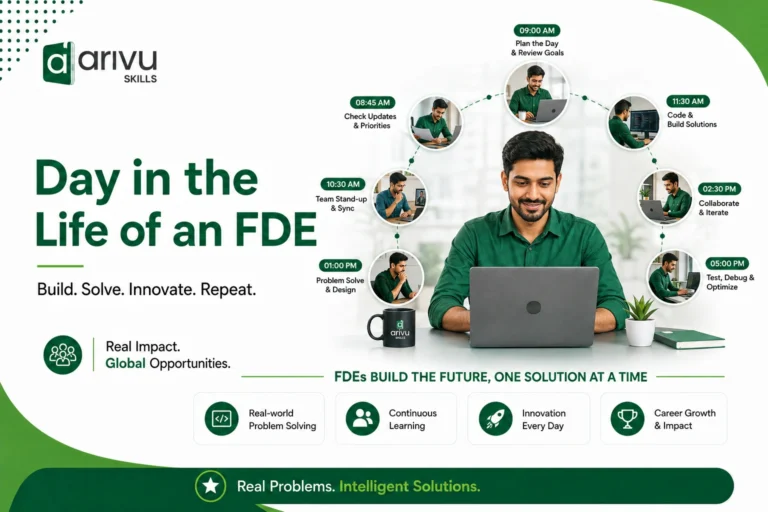
A forward deployed engineer works closely with a customer to turn an unclear business problem into software that runs in the customer’s environment.
The work usually includes:
- speaking with users and technical stakeholders;
- converting business needs into technical requirements;
- working with APIs, databases and existing enterprise systems;
- building prototypes and production-ready applications;
- deploying, testing and monitoring the solution;
- explaining trade-offs to both technical and non-technical people; and
- sending lessons from the field back to the product and engineering teams.
Palantir describes FDSEs as engineers who configure and extend its platforms for individual customers. More recent FDE job descriptions in the AI sector add model evaluation, enterprise integrations, security and production deployment to that mix.
This is why a polished coding profile alone is rarely enough. An FDE must also show that the code solves a real operational problem.
Skills freshers need to become FDEs
1. Strong programming fundamentals
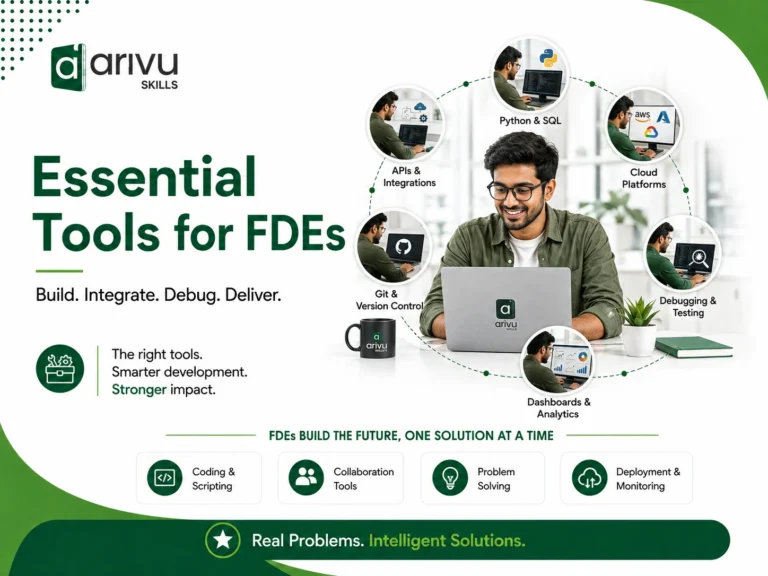
Start with one language you can use confidently. Python is useful for data, automation, APIs and AI applications. JavaScript or TypeScript is valuable when you need to build a complete web interface. Java, Go or C++ may be relevant for particular employers, but learning five languages badly will not improve your chances.
You should be comfortable with:
- data structures and basic algorithms;
- object-oriented or modular program design;
- debugging unfamiliar code;
- Git and collaborative development;
- writing tests; and
- reading technical documentation without waiting for a tutorial.
Interviewers are less interested in whether you remember every syntax rule than in how you reason when the requirements are incomplete.
2. Full-stack and API development
FDEs often need to connect an interface, backend service, database and third-party system. A fresher should know how these pieces communicate.
Build at least one application with:
- a usable frontend;
- a backend API;
- authentication and role-based access;
- a relational database such as PostgreSQL or MySQL;
- error handling and logs; and
- a public or recorded deployment.
A small system that works end to end is more persuasive than a large unfinished clone.
3. SQL and data handling
Customer problems are often data problems in disguise. The information may be duplicated, incomplete, stored in several systems or difficult for teams to use.
Learn to write joins, aggregations, common table expressions and window functions. You should also understand schema design, data validation and basic ETL or ELT workflows. Practice explaining why a number in a dashboard differs from a number in the source system. That conversation is surprisingly close to real deployment work.
4. Cloud and deployment basics
You do not need to become a cloud architect before applying. You should, however, be able to move an application from your laptop to a working environment.
Learn the purpose of containers, environment variables, CI/CD, cloud storage, managed databases, permissions, monitoring and rollback. Deploy one project on AWS, Azure, Google Cloud or another credible platform. Document the choices you made and what failed along the way.
5. Customer discovery and communication
This is the skill many fresher portfolios ignore.
Practise asking questions before writing code:
- Who uses the current process?
- What decision are they trying to make?
- Where does the data come from?
- What would make the new system unusable?
- How will the customer know the project has worked?
Then write a one-page project brief in plain language. Include the problem, users, constraints, proposed solution and success measure. If a non-technical reader cannot understand it, rewrite it.
6. Comfort with ambiguity
College assignments normally define the input and expected output. Customer work rarely does.
An FDE may hear, “Our reporting is too slow,” and need to discover whether the real issue is data quality, approval delays, a poor interface or a process nobody owns. Build the habit of forming a hypothesis, testing it quickly and changing direction when the evidence disagrees.
Build an FDE portfolio, not a collection of tutorials
Recruiters need evidence that you can own a problem from discovery to deployment. Three thoughtful projects are enough if each one has a clear user, realistic constraints and a working result.
Project idea 1: operations dashboard with messy data
Create a dashboard for a fictional logistics, retail or education business. Use multiple raw data sources with missing and inconsistent fields. Clean the data, document your assumptions and show how the dashboard helps a manager make one specific decision.
Project idea 2: workflow automation tool
Choose a repetitive process such as lead assignment, invoice approval or support-ticket triage. Interview a small-business owner, college club or nonprofit volunteer to understand the current workflow. Build an application that reduces manual steps, then measure time saved during a test run.
Project idea 3: production-minded AI application
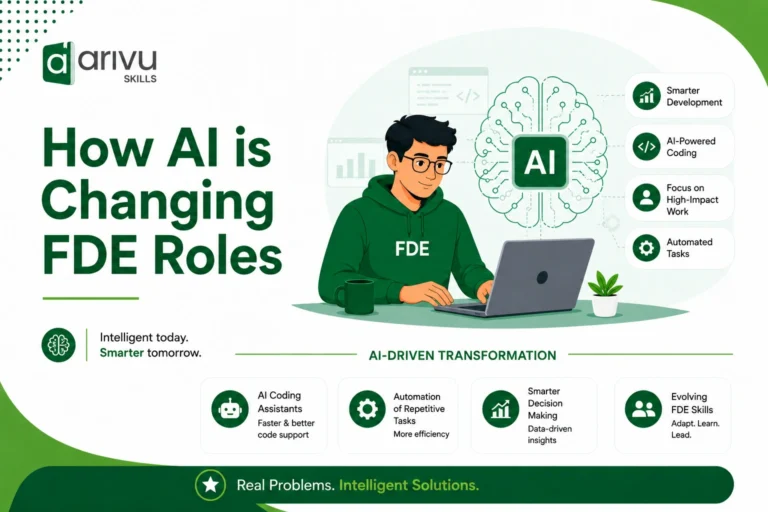
Build an AI assistant that works with a controlled knowledge base. Do more than connect a model API to a chat window. Add evaluations, citations, access controls, error handling, feedback collection and a clear fallback when the system is uncertain.
For every project, publish a short case study covering:
- the user and problem;
- constraints and rejected options;
- architecture and technology choices;
- screenshots or a short demo;
- deployment and monitoring;
- results, limitations and the next improvement.
That case study is often more useful in an FDE interview than another certificate.
A 90-day FDE roadmap for freshers
Days 1-30: strengthen the engineering base
Pick a primary language and build a small API-backed application. Revise SQL, Git, testing and debugging. Solve a modest number of coding problems, but do not let interview preparation consume all your project time.
By day 30, you should have one application running locally and a clear README that another developer can follow.
Days 31-60: deploy and add real-world constraints
Containerise the application and deploy it. Add authentication, logs, monitoring and basic tests. Ask two people to use it without your help. Watch where they struggle and fix the problem instead of explaining the interface.
Write a short technical decision record for one trade-off, such as choosing a managed database over hosting your own.
Days 61-90: practise customer-facing delivery
Find a real user with a small operational problem. This could be a local business, student organisation, family-run company or nonprofit. Scope a solution you can finish in two to three weeks.
Run a discovery call, send a written summary, build a prototype, collect feedback and present the result. Record a three-minute demo that explains the business problem before the technology.
At the end of 90 days, update your resume and LinkedIn profile around outcomes. “Built a support dashboard used by five volunteers to track 300 requests” says more than “worked on React and Python.”
Which entry-level roles can lead to FDE work?
Do not search only for “forward deployed engineer.” Companies use different titles for similar work.
Useful entry points include:
- forward deployed software engineer, new grad;
- software engineer in a customer-facing product team;
- solutions engineer or associate solutions engineer;
- implementation engineer;
- technical consultant;
- integration engineer;
- data engineer on client projects;
- customer engineer; and
- technical support engineer with coding and deployment responsibilities.
Read the job description, not just the title. Look for ownership of implementation, customer discovery, integration, deployment and feedback to product teams.
How to write an FDE resume as a fresher
Keep the resume to one page unless you have substantial relevant experience. Put your strongest deployment-focused project near the top.
Each bullet should show what you built, the environment in which it ran and the result. Use numbers only when they are real and easy to defend.
Weak bullet:
Developed a full-stack project using modern technologies.
Stronger bullet:
Built and deployed a role-based inventory tracker with React, FastAPI and PostgreSQL; tested it with three shop staff and reduced duplicate stock entries during the pilot.
Also include links to the live project, source code and case study. Remove long lists of beginner certificates if they push relevant evidence off the page.
How to prepare for FDE interviews
An FDE interview may test coding, system design, problem decomposition and communication. Some employers also use a case study or ask candidates to discuss a past project in depth.
Prepare to answer questions such as:
- How would you clarify an unclear customer request?
- What would you build first if the deadline were one week?
- How would you integrate with a system that has poor documentation?
- When would you customize a solution, and when would you push back?
- How would you respond if users rejected a technically correct product?
- What would you monitor after deployment?
When solving a case, state your assumptions and ask clarifying questions. Define the user, desired outcome and constraints before suggesting an architecture. A technically impressive answer to the wrong problem is still the wrong answer.
Common mistakes freshers should avoid
Applying only to jobs with the exact FDE title
The title is still relatively uncommon. Broaden the search to adjacent roles that combine engineering and customer delivery.
Building clones without a real user
A familiar ecommerce or streaming clone may demonstrate coding, but it says little about discovery and deployment. Add a real workflow, user test or external system integration.
Treating communication as a soft extra
For an FDE, communication changes the technical outcome. Poor discovery leads to the wrong build. Vague status updates create project risk. Practise writing and presenting as deliberately as you practise coding.
Claiming production experience you do not have
Be honest about a project’s scale. A well-run pilot with five users is useful evidence. Calling it an enterprise deployment invites questions you may not be able to answer.
Collecting tools without learning delivery
Knowing the names of Kubernetes, Terraform and ten AI frameworks is not the same as shipping a dependable application. Learn new tools when the project needs them.
Is an FDE career right for you?
FDE work suits people who enjoy technical depth but do not want every problem neatly specified before they begin. You may enjoy it if you like speaking with users, moving between business and engineering discussions, travelling when a project requires it and taking responsibility for whether the solution is adopted.
A conventional software engineering role may suit you better if you prefer longer product cycles, a stable technical domain or limited customer interaction. Neither path is more advanced. They reward different working styles.
Start preparing for an FDE career
Freshers do not need years of experience before they can begin doing FDE-shaped work. They need proof that they can understand a user, build a sound solution, deploy it and learn from what happens next
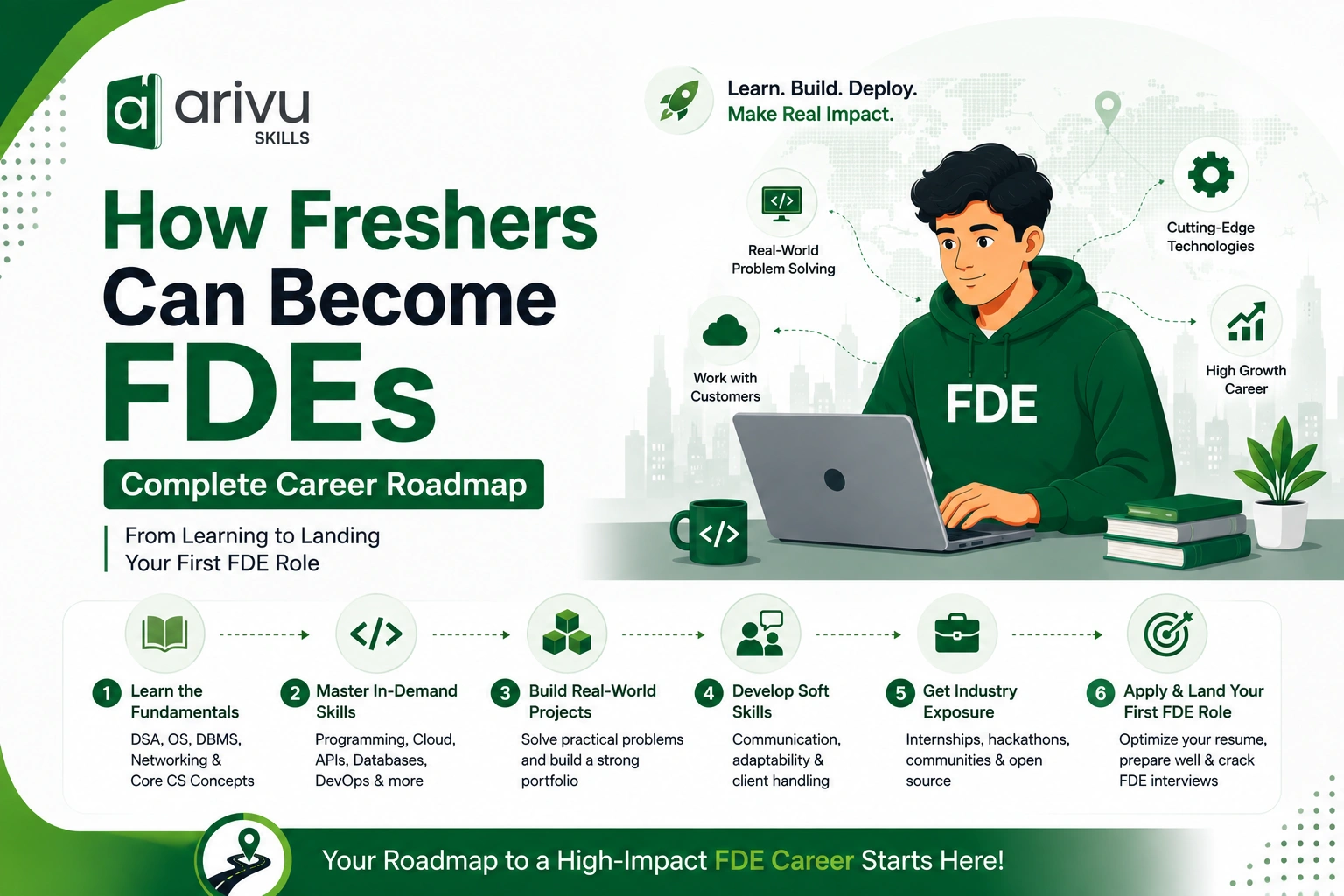
Planning your FDE career? Explore our FDE Career Roadmap to understand the skills, experience, and steps needed to grow in this field. .
Start with one real problem. Keep the scope small enough to finish. Write down your decisions, show the working result and explain what you would change with more time. Repeat that process, and your portfolio will begin to look less like coursework and more like delivery experience.
FAQs
Yes, if the company hires new graduates into FDSE or similar roles. Where the FDE title requires experience, freshers can begin in software engineering, solutions engineering, implementation or technical consulting and move after building customer-facing delivery experience.
Computer science, information technology and related engineering degrees provide a useful foundation, but the title of the degree is not the deciding factor. Employers care about programming ability, problem-solving, deployed projects and communication. Candidates from other degrees need stronger proof of those skills.
Often, yes. Many FDE roles include a coding round, so candidates should understand core data structures, algorithms and complexity. FDE interviews may also test system design, customer scenarios and project judgement.
Not for every role. Data-platform and enterprise-software FDE jobs may focus more on integrations, backend systems and deployment. AI companies may expect experience with model APIs, evaluations, retrieval, safety and production monitoring. Follow the requirements of the employers you want to target.
Complete a small project for a real user. Run a discovery conversation, define a measurable outcome, build and deploy the solution, collect feedback and publish a case study. This produces evidence of both engineering and customer delivery.
There is no fixed timeline. A fresher with solid programming fundamentals may build an interview-ready portfolio in a few focused months. Someone starting from zero will need longer. Use project milestones, not an arbitrary deadline, to judge readiness.