
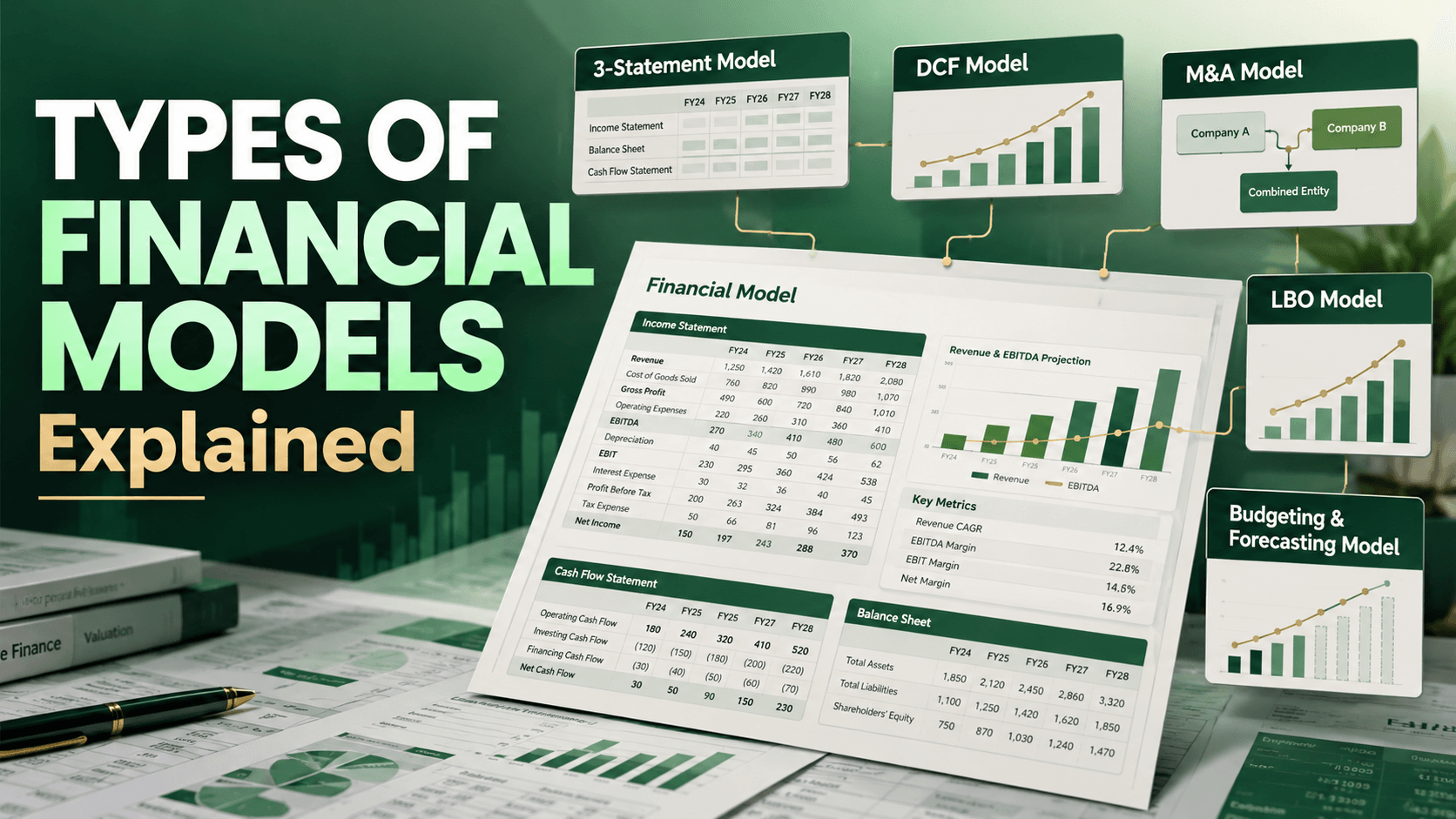

A financial model is a spreadsheet that uses a company’s numbers to predict its financial future. The main types of financial models are the three-statement mode, discounted cash flow (DCF) model, comparable company analysis, precedent transaction analysis, merger (M&A) model, leveraged buyout (LBO) model, budget model, forecasting model, and sum-of-the-parts model.
Each one answers a different business question. Some tell you what a company is worth. Others test whether a deal can be afforded, or how next year’s budget should look. This guide walks through every major type in plain words, with simple examples, so you know what each model does and when it gets used.
What is a Financial Model?
A financial model is a tool, usually built in Excel, that turns a company’s past numbers and future assumptions into a picture of how it will perform. You feed in inputs like sales growth, costs, and prices. The model gives back outputs like profit, cash flow, or the company’s value.
The easiest way to picture it is as a what-if machine. Ask it “what if sales grow 20% instead of 10%?” and every connected number updates at once. That instant feedback is why businesses, banks, and investors lean on models when real money is on the line.
Why do financial models matter?
Big decisions need more than a gut feeling. Before a company raises money, buys a rival, or launches a product, somebody builds a model to check whether the numbers actually hold up.
A quick look at who relies on them:
- Investment bankers value companies and put deals together.
- Private equity and venture capital firms decide where to invest.
- Corporate finance teams plan budgets and forecasts.
- Equity research analysts judge whether a stock will rise or fall.
- Startup founders show investors how the business will grow.
If you are aiming for a finance career in India or abroad, building these models is one of the most practical skills you can pick up, and one employers actively look for.
The main types of financial models
There is no single best model. Each one exists to answer a particular question. Here are the most common, explained simply.
1. Three-statement model
The three-statement model is the foundation of almost every other model. It links the three core financial statements, the income statement, the balance sheet, and the cash flow statement, so they move together automatically. Change one figure, say revenue, and all three statements react in a connected way. The model gives you a clear read on a company’s overall financial health, and it becomes the base layer that DCF, LBO, and M&A models sit on top of. If you only learn one model to start, make it this one.
2. Discounted cash flow (DCF) model
A DCF model values a company based on the cash it is expected to earn in the future, then brings that cash back to what it is worth today.
The idea behind it is simple. ₹100 in your hand now is worth more than ₹100 a year from now, because today’s money can be invested and grow. A DCF works out the present value of all the cash a company will generate, which gives you its intrinsic worth, the “true” value rather than the current market price. Investors use it to spot companies trading below or above what they are really worth.
3. Comparable company analysis (Comps)
Comparable company analysis values a company by comparing it with similar companies already listed on the stock market, using ratios like Price-to-Earnings (P/E) and EV/EBITDA.
Think of how you would price a flat: you check what similar flats in the same area recently sold for. Comps does the same for a business. It finds comparable listed companies and applies their valuation ratios. It is quick and grounded in real market prices, which is why it is one of the most widely used methods in practice.
4. Precedent transaction analysis
Precedent transaction analysis values a company by looking at the prices buyers actually paid in past deals for similar businesses. Rather than comparing against listed companies, it compares against real acquisitions. If three similar companies were bought last year at a certain price, that gives you a rough idea of what someone might pay for a fourth. It shows up mostly in mergers and acquisitions, and it usually lands on a higher value than Comps, because buyers often pay extra to take full control of a business.
5. Merger and acquisition (M&A) model
An M&A model tests whether combining two companies is a smart financial move. It pulls the numbers of a buyer and a target company into a single view. The headline output is whether the deal is accretive, meaning it adds to the buyer’s earnings per share, or dilutive, meaning it drags earnings down. Put simply, it checks whether 1 plus 1 ends up worth more than 2. Bankers and corporate teams run it before they recommend any large buyout.
6. Leveraged buyout (LBO) model
An LBO model shows what happens when a company is bought mostly with borrowed money, and works out the returns an investor could make. Picture buying a house with a big home loan, fixing it up over a few years, then selling it for a profit while the rent covers the loan payments. Private equity firms do a version of this with whole companies. The LBO is one of the more technical models, and it comes up again and again in finance job interviews.
7. Budget model
A budget model plans a company’s expected income and expenses for a set period, usually the year ahead. It is a tool for internal planning and keeping costs in check. It works like a household monthly budget, just scaled up to a company and split across departments. Once set, the budget becomes the target everyone is expected to work towards.
8. Forecasting model
A forecasting model predicts how a company will actually perform, based on current trends and assumptions. It looks ahead and estimates revenue, costs, or cash. The gap between a budget and a forecast is worth understanding. A budget is what you plan to achieve. A forecast is what you honestly expect to happen as the year plays out. Companies compare the two through the year to see whether they are on track.
9. Sum-of-the-parts (SOTP) model
A sum-of-the-parts model values each business division on its own, then adds the pieces together. It fits large companies that run very different businesses under one roof. Take a big group like Tata or Reliance, with arms in retail, telecom, energy, and more. Valuing all of that with one method rarely works, so SOTP prices each business separately and totals them up.
Other specialised models
A few more models exist for specific jobs. The consolidation model combines many business units or subsidiaries into one financial picture. The option pricing model values financial options and similar instruments. Both are more advanced, and they usually come later once the basics are solid.
Quick comparison of common financial models
Model | Main purpose | Best for | Difficulty |
Three-statement | Show overall financial health | Beginners, as the base model | Easy–Medium |
DCF | Show overall financial health | Long-term investing, valuation | Medium |
Comparable company (Comps) | Value using market ratios | Fast, market-based valuation | Easy–Medium |
Precedent transactions | Value using past deal prices | Mergers and acquisitions | Medium |
M&A | Check if a deal makes sense | Buyouts and mergers | Hard |
LBO | Measure returns on a debt-funded buyout | Private equity deals | Hard |
| Budget / Forecast | Plan and predict performance | Internal company planning | Easy |
Which financial model should a beginner learn first?
Start with the three-statement model. Nearly every other model builds on it, so once it clicks, the DCF, LBO, and M&A models get much easier to follow. A sensible order after that: DCF next, then comparable company analysis, and finally the deal-focused models, M&A and LBO. Take each one properly before moving on. Rushing through all of them at once tends to leave gaps.
What skills do you need to build financial models?
You do not need to be a maths genius. What actually matters:
- Excel or Google Sheets, where the models get built.
- Basic accounting, enough to understand the three financial statements.
- Clear logic, so your assumptions stay flexible and easy to change.
- Attention to detail, because one wrong formula can throw off everything.
- Business sense, to know when a number looks unrealistic.
Most of this is learnable step by step, especially with practice and a structured course.
Common mistakes beginners make
- Hardcoding numbers instead of linking formulas, which kills the what-if power of the model.
- Building something far too complex when a simple version would do the job.
- Leaning on unrealistic assumptions, like sales growing 50% every year forever.
- Skipping past the cash flow statement, which is often where the real problems hide.
- Forgetting to check that the balance sheet actually balances.
Why financial modelling is a strong career skill in India ?
Financial modelling is a hands-on skill that commerce and finance employers genuinely value. It turns up across investment banking, equity research, corporate finance, private equity, consulting, and startups. For Indian students and professionals, especially those doing B.Com, BBA, MBA, or CA and ACCA, it adds a job-ready skill on top of the qualification and gives you something concrete to show in interviews, where modelling questions are common. And because it rests on logic and Excel rather than any one industry, the skill moves with you from company to company.
Start learning financial modelling
Now that the main types make sense, the real learning starts when you build one yourself. Open a spreadsheet, pick a company you know, and put together a simple three-statement model. Doing beats reading every time. If you want a structured path from the basics to job-ready skills, take a look at the financial modelling course from Arivu Skills, which walks you through these models step by step with practical examples.
FAQ
What is a financial model in simple words?
A financial model is a spreadsheet that uses a company’s numbers and assumptions to predict its financial future. You change the inputs, and it shows how profit, cash, and value would change.
What are the main types of financial models?
The main types are the three-statement model, DCF model, comparable company analysis, precedent transaction analysis, M&A model, LBO model, budget model, forecasting model, and sum-of-the-parts model.
Which financial model is most important?
The three-statement model is the most important to learn first, because almost every other model is built on top of it.
What is the difference between a budget and a forecast?
A budget is what a company plans to achieve for a period, while a forecast is what it realistically expects to happen as the period progresses.
Is financial modelling hard for beginners?
No. The basics are approachable if you know Excel and simple accounting. Models like three-statement and budget are beginner-friendly; M&A and LBO are more advanced.
Do I need to be good at maths for financial modelling?
Not advanced maths. You mainly need comfort with Excel, basic arithmetic, clear logic, and attention to detail.
What software is used for financial modelling?
Microsoft Excel is the standard tool, though Google Sheets is also used. The skill is mostly about structuring logic, not the software itself.
Who uses financial models?
Investment bankers, private equity and venture capital firms, equity research analysts, corporate finance teams, and startup founders all use financial models to make decisions.
What is a DCF model used for?
A DCF (discounted cash flow) model is used to value a company based on the future cash it is expected to generate, discounted back to today’s value.
Is financial modelling a good career skill in India?
Yes. It is a practical, in-demand skill across banking, research, corporate finance, and startups, and it adds job-ready value to qualifications like B.Com, MBA, CA, and ACCA.