Machine learning is changing the way you work. From Netflix recommending your next favorite show to banks detecting fraudulent transactions, machine learning is quietly powering many of the digital experiences that you use every day. If you’re just starting your journey in data science or artificial intelligence one of the first concepts that you will come across is supervised versus unsupervised learning. No doubt both are important machine learning types; they solve different kinds of problems and use different approaches to learn data.
What is machine learning?
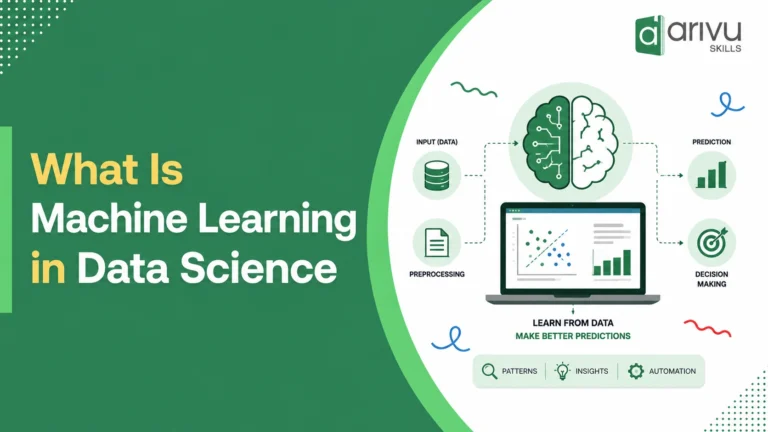
Machine learning is a branch of artificial intelligence that enables computers to learn from data without being explicitly programmed. Instead of following fixed rules machines identify patterns in data and improve predictions with time. Today you can see machine learning is used in different industries like healthcare banking finance e-commerce manufacturing education and transportation. Among the different machine learning types supervised learning and unsupervised learning are two of the most widely used techniques.
Launch your tech career with our Data Science Course in Bangalore and gain in-demand AI and analytics skills.
What is supervised learning?
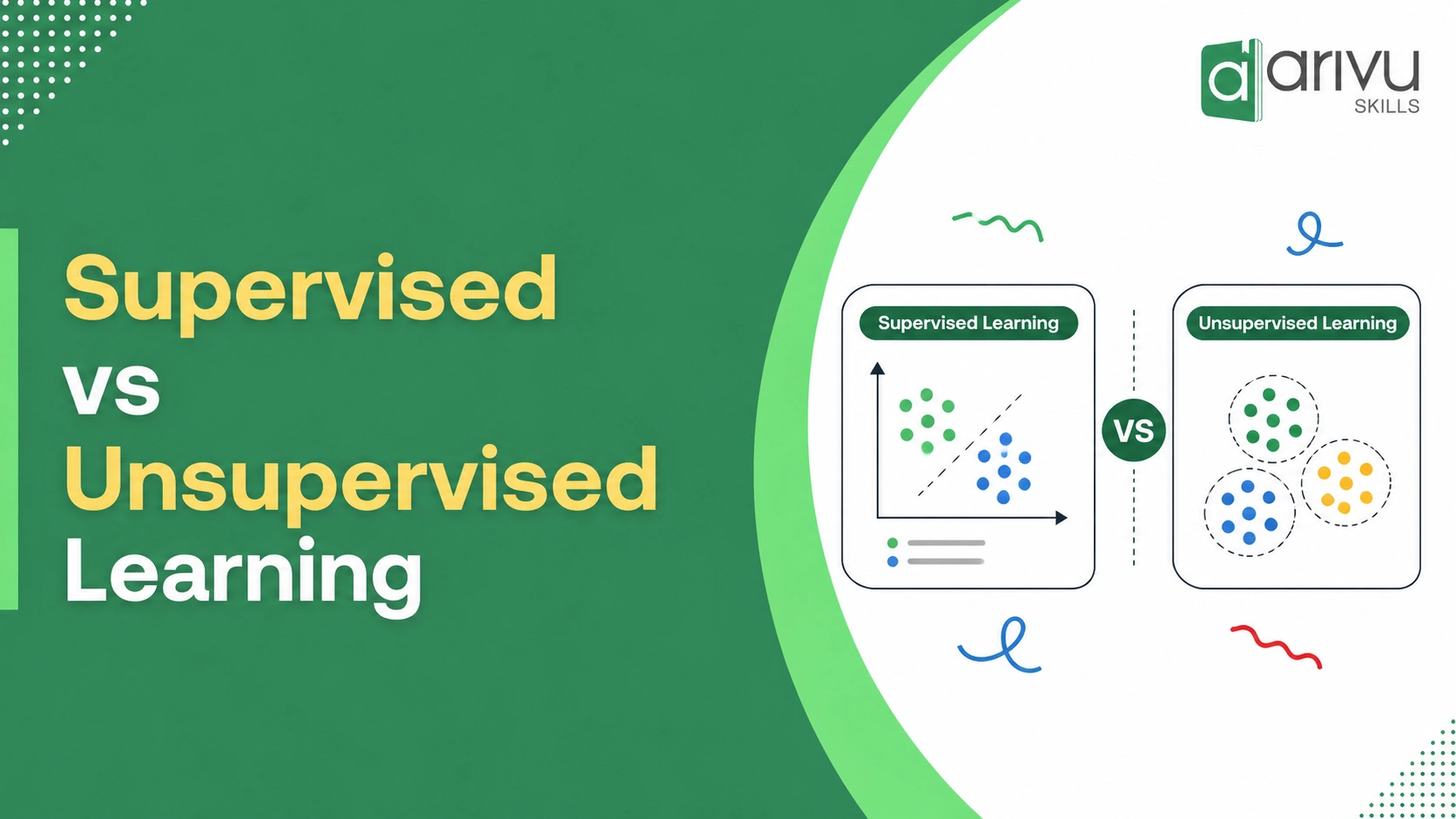
When it comes to supervised versus unsupervised learning it’s very important for you to start with supervised learning because it’s often easier to understand. Supervised learning is actually a machine learning method where the model is trained using labeled data. This means every training example already contains the correct answer allowing the algorithm to learn the relationship between inputs and outputs. You can think of it like a teacher checking your homework. You already know the correct answer and the teacher helps you understand how to arrive at them. With time you become better at solving problems on your own.
Just imagine you are teaching a computer to identify emails as spam or not spam. You provide thousands of emails that are already labeled. The machine studies these examples and learns the patterns that separate spam emails from your genuine ones. Later when it receives a new e-mail it can classify it accurately.
What is unsupervised learning?
Now you know what supervised learning is. You need to understand unsupervised learning. Unsupervised learning is a machine learning technique where the model works with unlabeled data. Unlike supervised learning there are no predefined answers or labels. Instead the algorithm explores the data of its own to explore hidden partners similarities or relationships. You can think of it like sorting a box of mixed colored marbles without anyone telling you how to group them. You actually start organising them by order size or shape. That’s essentially what unsupervised learning does: it identifies patterns without guidance.
Common applications of unsupervised learning
You can use unsupervised learning to uncover trends or group similar data. Some common applications include customer segmentation fraud detection product recommendation systems Market Basket analysis and image compression. For example an online shopping platform can group customers with similar buying habits. These insights help you create customized marketing campaigns and improve customer experiences.
Supervised versus unsupervised learning
| Feature | Supervised Learning | Unsupervised Learning |
| Training Data | Labeled | Unlabeled |
| Goal | Predict outcomes | Discover hidden patterns |
| Human Guidance | Required | Not required |
| Output | Classification or prediction | Clusters or relationships |
| Accuracy | Usually higher with quality labeled data | Depends on data patterns |
| Complexity | Easier to evaluate | More exploratory |
| Common Use Cases | Spam detection, forecasting, diagnosis | Customer segmentation, clustering, recommendations |
When should you use each approach?
Choosing between supervised VS unsupervised learning depends on your data and business objectives. You can use supervised learning when you already have labeled data and you want to predict future outcomes. Furthermore you can use unsupervised learning when your data has no labels or you want to discover hidden patterns. Many organizations even combine both machine learning types to gain deeper insights and build smarter AI solutions.
Advantages of supervised learning
When comparing supervised versus unsupervised learning, supervised learning is often the preferred choice when you have labeled data and a clear goal. It offers reliable predictions and is widely used across industries. High prediction accuracy when trained on quality data and you can also get easy performance evaluation because the correct answers are likely known. It is suitable for business forecasting, fraud detection and medical diagnosis.
Advantages of unsupervised Learning
Unsupervised learning shines when you want to explore data and uncover insights that you didn’t know existed. It actually works without labeled data saving time and effort. You can also discover hidden patterns that might not be obvious. It also supports better decision making through data exploration.
Why does machine learning matter?
Machine learning is no longer limited to research labs or tech giants. Businesses of every size use AI to automate processes, improve customer experience and make faster data-driven decisions. As companies continue investing in artificial intelligence professionals with knowledge of machine learning types and algorithms are high in demand. Whether you want to become a data scientist or machine learning engineer, understanding concepts like supervised versus unsupervised learning is very important.
So you need to know that choosing between supervised versus unsupervised learning is not about deciding which one is better, it’s all about understanding which approach fits your problem. If your data is labeled and you want to predict outcomes then supervised learning is the right choice. If you are working with unlabeled data and want to discover it in patterns, unsupervised learning is a better option. Both the approaches are fundamental machine learning types and both rely on ML algorithms to solve real-world business challenges.
Looking to kickstart your career in analytics and AI? Join the data science course in Chennai at Arivu skills And get hands-on experience with Python power BI and machine learning. Learn from industry experts and work on real world projects to become job ready.
FAQs
The biggest difference is the type of data used. Supervised learning uses labeled data with known outcomes while unsupervised learning with unlabeled data to identify hidden patterns.
Neither is universally better. The right choice depends on your objective.
Some commonly used ML algorithms include linear regression, logistic regression, random forest and hierarchical clustering.
Supervised learning is widely used in spam detection, credit scoring, medical diagnosis and demand forecasting.
Yes many beginners start by learning Python statistics and data analytics before moving on to machine learning concepts.