
TL;DR
- You don’t need an IIT degree or a PhD to become an AI engineer in India. You need the right skills in the right order, plus proof you can use them.
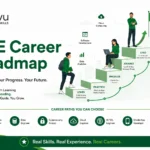
- The 7-step order: Python → statistics and SQL → machine learning → deep learning → deployment and MLOps → generative AI and agents → portfolio.
- Timeline: at 8–10 hours a week, most beginners are job-ready in about 6–7 months. Three months covers the basics, not a job offer.
- Projects matter most. Build 2–3 projects and deploy at least one. Interviewers trust a link they can click over a stack of certificates.
- You can self-learn AI, but most people quit without structure, feedback and deadlines.
- It’s not too late. India still has about a 53% GenAI talent gap, but the premium goes to people who build AI, not just use it.
Quick answer: To become an AI engineer in India, learn Python first, then statistics and SQL, machine learning, deep learning, deployment, and finally generative AI and agents. Along the way, build 2–3 projects you can show and deploy at least one of them. At 8–10 hours a week, most beginners are job-ready in about 6–7 months.
AI engineering is one of the best-paid ways into tech in 2026, and it’s more open than most people assume. You don’t need an IIT degree or a PhD. You need the right skills, learned in a sensible order, and something to show for them.
The topics themselves aren’t the hard part. Knowing what to learn next is. Most beginners hop between YouTube tutorials, pile up half-finished courses and never build anything an employer can actually look at. This roadmap gives you a clear order, honest timelines and the projects worth building at each stage.
How do I become an AI Engineer?
You become an AI engineer by working through seven steps in order: Python, data foundations, machine learning, deep learning, deployment, generative AI and agents, and finally a portfolio. Each step leans on the one before it, so skipping ahead usually means coming back later. The timings assume 8–10 hours of study a week.
-
- Learn Python (3–4 weeks). Everything in AI runs on Python. Get comfortable with variables, loops, functions, lists and dictionaries, then move on to NumPy and Pandas for working with data. You’re ready to move on when you can clean up and analyse a real dataset, say Bangalore house prices.
-
- Build your data foundations (3–4 weeks). Pick up the statistics AI leans on: mean, variance, probability and distributions. Add SQL so you can pull data out of databases, and Matplotlib or Seaborn so you can chart it. Aim to finish with an analysis notebook that has clear charts and real findings.
-
- Learn machine learning (5–6 weeks). Start with regression and classification, then work up to decision trees, random forests and boosting. Just as important, learn to split your data properly, measure accuracy honestly and spot overfitting, all in scikit-learn. A loan-default or customer-churn model with an honest evaluation makes a good finishing project.
-
- Learn deep learning (4–5 weeks). Get to grips with neural networks, then CNNs for images and transformers for language, in PyTorch or TensorFlow. An image classifier or a sentiment model is a solid milestone here.
-
- Learn deployment and MLOps (3–4 weeks). Most beginners skip this step, and it’s the one employers care about most. Wrap a model in an API with FastAPI, package it with Docker, track experiments in MLflow and put it on the cloud. By the end you should have a live model with a public URL.
-
- Learn generative AI and agents (5–6 weeks). Work with LLM APIs, learn to write prompts that actually work, and build RAG apps that answer questions from your own documents using a vector database. Then build agents with a framework like LangGraph or CrewAI. Finish with a RAG chatbot or an agent that completes a real multi-step task.
-
- Build your portfolio and prepare for interviews (3–4 weeks of focus). Polish 2–3 projects on GitHub with clear READMEs and demo links. Practise Python coding rounds and ML interview questions, and get each project down to a two-minute explanation. The goal is a portfolio an interviewer can open, click through and test.
Add it up and you’re looking at roughly 26–33 weeks, or 6–7 months, studying part-time. Fixed weekly classes tend to keep people at the faster end of that.
What a strong fresher portfolio looks like
Three projects are usually enough, as long as each one shows a different skill:
| Project | Skills it proves | Example |
| A machine learning project | Data cleaning, modelling, evaluation | Predicting loan defaults from bank data |
| A deep learning project | Neural networks, working with images or text | Classifying crop diseases from leaf photos |
| A deployed GenAI or agent project | LLMs, RAG, APIs, deployment | A chatbot that answers questions from a company’s policy documents |
One deployed project beats five notebooks. An interviewer can click the link, try your app and ask how you built it, and that conversation is often where the offer gets decided.
How to start a career in AI
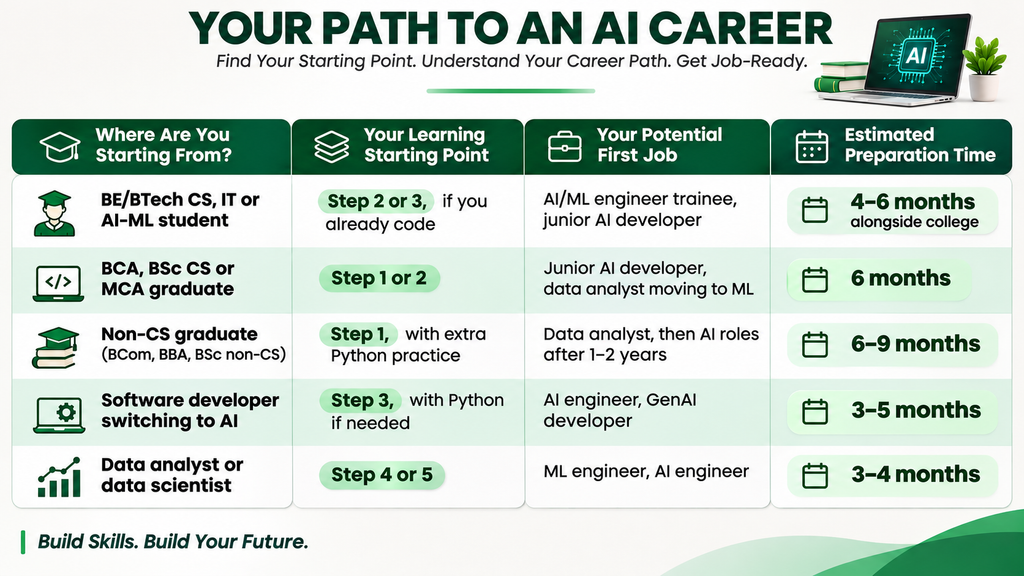
The best way to start a career in AI depends on where you’re coming from. The roadmap doesn’t change, but your starting point decides how long it takes and which first job makes sense.
Tips that apply to every route
-
- Start building early. Don’t wait until you feel you “know enough”. A small project in week 4 teaches you more than another month of videos.
-
- Learn in public. Share your projects and short write-ups on LinkedIn and GitHub, because recruiters in Bangalore search both.
-
- Go after internships. Two or three months at an AI startup often counts for more than another certificate.
-
- Pick one cloud and learn it well enough to deploy your projects. AWS, Azure or Google Cloud all work, and you can pick up the others later.
-
- If you already work in tech, look for an AI task inside your own company. Internal moves are often the fastest way in.
If you’re a non-CS graduate, a data analyst role is often the most realistic first step. You build Python, SQL and business sense on the job, and plenty of analysts move into ML and AI within a year or two.
Can I learn AI by myself?
Yes, you can learn AI by yourself. Free and cheap resources cover almost everything on this roadmap. What self-learners usually lack isn’t content. It’s structure, feedback and someone holding them to a schedule, and that’s what decides whether most people finish.
Self-study suits some people far better than others:
| Self-study works if you… | A structured course helps if you… |
| Already code comfortably in Python | Are new to programming |
| Can study on a fixed schedule without deadlines | Tend to start courses and not finish them |
| Can judge whether your own projects are good enough | Want feedback from someone who has hired AI engineers |
| Are comfortable job hunting on your own | Want help with resumes, mock interviews and referrals |
If you choose self-study, do these five things
-
- Stick to one roadmap. Use the seven steps above and ignore whatever’s trending this week.
-
- Fix your study hours. Same days, same times, every week, like a class.
-
- Build something after every step, not just a finished playlist.
-
- Get feedback. Join communities, share your GitHub and ask a working engineer to review one project.
-
- Deploy something. A live app with a link is the clearest proof you can give an employer.
Can I learn AI in 3 months?
You can learn the basics of AI in 3 months, but most beginners need closer to 6 to become job-ready. Three focused months will get you Python, core machine learning and working with LLM APIs. That’s enough to understand AI and build simple projects.
What usually doesn’t fit into 3 months, for a beginner, is deep learning, deployment, agents, and the portfolio and interview practice that turn skills into an offer.
| Timeline | Realistic outcome for a beginner |
| 3 months | Python, ML basics, simple LLM apps; ready for internships or further study |
| 6 months | Full roadmap with 2–3 projects, one deployed; ready to apply for junior AI roles |
| 12 months | Deeper specialisation, stronger portfolio, possibly an internship completed |
If you already code for a living, 3 months is realistic, because you can jump in at step 3 and spend your time on ML, deployment and GenAI.
Be wary of any course that promises to turn a complete beginner into a job-ready AI engineer in a few weeks. It doesn’t work that way.
Is it too late to study AI?
No, it’s not too late to study AI in 2026. In India, demand for people who can build AI systems is still well ahead of supply. What’s changed is the kind of skill employers pay for. Using AI tools is now simply expected. Building and running AI systems is what earns the premium.
The numbers back this up. TeamLease Digital’s Digital Skills & Salary Primer FY2026–27, published in September 2026, found:
-
- A talent gap of about 53% in GenAI, with demand for GenAI talent expected to cross 10 lakh roles by 2026
-
- Only about 16% of IT professionals hold AI skills, and only about 3 lakh have advanced AI skills
-
- GenAI developers earn about ₹11.2 LPA at 0–2 years, rising to about ₹34.5 LPA at 6–8 years
The same report has a warning in it, though. Entry-level “AI-support” roles, like basic monitoring and first-line support, are shrinking. The money is moving to people who build, deploy and run AI systems. So it’s not too late to learn AI, but it is too late to learn only the surface of it.
Is it too late for me specifically?
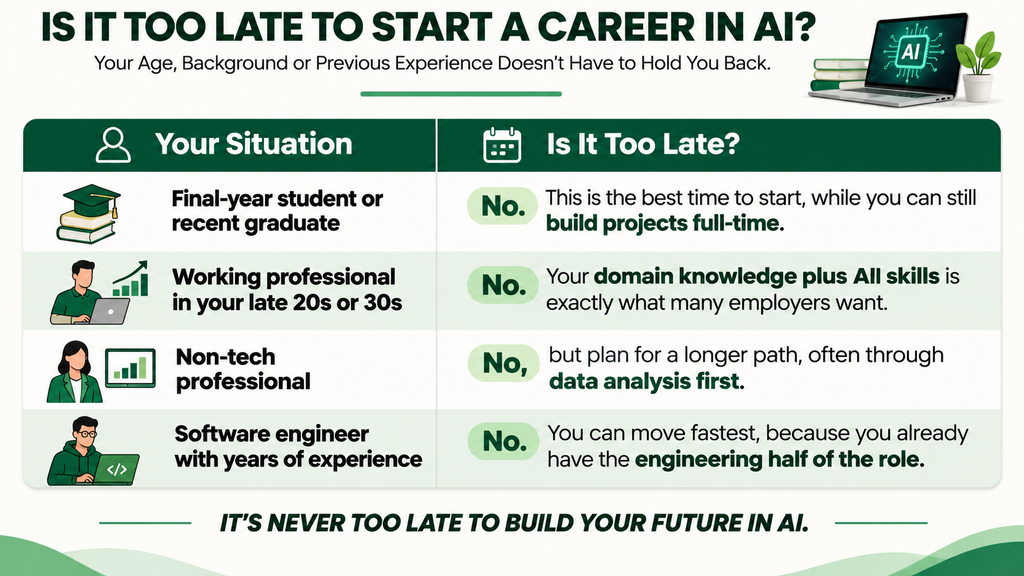
Age is rarely what holds people back. Consistency is. If you study steadily for six months and build real things, you can get into AI at almost any point in your career.
How AI Engineer Pro follows this roadmap
AI Engineer Pro at Arivu Skills follows these same seven steps, so you work through the roadmap with mentors, deadlines and a cohort around you instead of on your own. It’s 210 hours over 6 months of weekend classes at Koramangala, Bangalore.
| Roadmap step | Where it is covered in AI Engineer Pro |
| 1. Python | Phase 1: Python fundamentals, NumPy, Pandas |
| 2. Data foundations | Phase 1: statistics, SQL, EDA and visualisation |
| 3. Machine learning | Phase 2: regression to ensembles, model evaluation, clustering; Machine Learning capstone |
| 4. Deep learning | Phase 3: neural networks, CNNs, NLP, transformers, time series; Deep Learning capstone |
| 5. Deployment and MLOps | Phase 4: MLOps with MLflow and Docker, model deployment, data engineering |
| 6. GenAI and agents | Phase 5: LLM APIs, RAG with LangChain, agents with LangGraph, CrewAI and AutoGen |
| 7. Portfolio and jobs | Phase 6: Industry capstone, employer demo day, mock interviews, support for your first 10 interviews |
ou don’t need to have coded before. The next batch runs on Saturdays and Sundays from 9 am to 1 pm. The Basics phase starts on 19 December 2026, and the main course on 9 January 2027.
Already a developer? You can skip steps 1–3. Our Generative AI and Agentic AI course covers steps 5 and 6 in about 100 hours.
Frequently asked questions
Is studying AI difficult?
It’s challenging, but very manageable if you go in the right order. Most beginners struggle because they jump to advanced topics before they’ve got Python and basic statistics down. Taken step by step, each topic builds on the last. Steady practice of around 8–10 hours a week matters far more than being a natural at maths or coding.
Can I do AI without maths?
You can start without strong maths, but you can’t avoid it forever. Applied AI engineering mostly needs school-level maths: statistics, probability and basic linear algebra. Libraries do the heavy calculations. You just need enough to understand what a model is doing and why it goes wrong. Research roles are different and need far more.
How is Gen Z using AI?
Gen Z uses AI every day for studying, writing, coding, research and creative work, and most treat tools like ChatGPT as a normal part of learning. In India, a NASSCOM report found more than 90% of early-career tech professionals already use AI tools. Since employers now expect that, the real career edge comes from building AI, not just using it.
Follow the roadmap with mentors, not alone.
AI Engineer Pro covers all seven steps, from your first line of Python to three deployed AI projects, in 6 months of weekend classes at Koramangala, Bangalore. The next batch starts on 19 December 2026.
Book a Free Demo Class · Download the Syllabus · Call +91 88846 88847
Sources
Checked on 19 November 2026.
-
- CXOToday: TeamLease Digital Skills & Salary Primer FY2026–27 (GenAI talent gap, AI skills share, GenAI developer pay; September 2026)
-
- SocialTalent: India’s AI talent shortage (NASSCOM figure on early-career AI tool use; seen in search results only, open and confirm)
-
- Arivu Skills: AI Engineer Pro course page (curriculum, batch dates, format)