
TL;DR
- Yes, freshers get AI jobs in India every year, but rarely with a certificate alone.
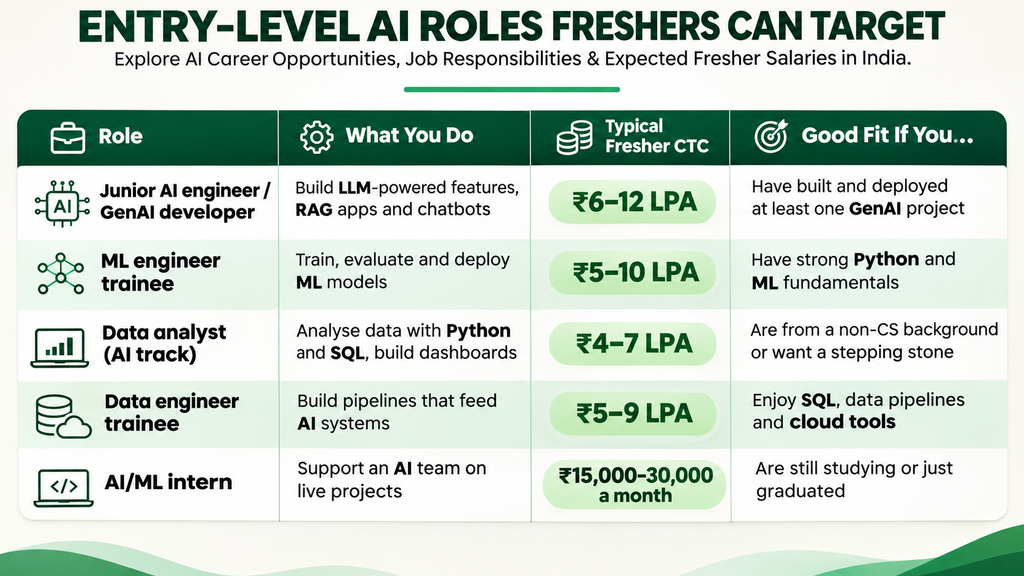
- Realistic first roles are junior AI engineer or GenAI developer (₹6–12 LPA), ML engineer trainee (₹5–10 LPA) and data analyst (₹4–7 LPA).
- GenAI and LLM app developers are the most in-demand AI roles right now, while routine AI-support jobs are shrinking.
- Employers check five things: your projects, Python, ML basics, deployment, and how well you explain your work.
- AI work is demanding, but no more stressful than most software jobs.
Quick answer: Yes, a fresher can get a job in AI in India, just not on a certificate alone. Companies hire freshers as junior AI engineers, GenAI developers, ML engineer trainees and data analysts. The ones who get hired usually have strong Python, 2–3 real projects with at least one deployed, and clear answers about how they built them.
If you’re a student or a recent graduate, you’ve probably heard two completely different stories. One says AI jobs are booming and anyone can walk into one. The other says AI is wiping out entry-level tech jobs. Both are partly true, which is exactly why so many freshers feel stuck.
Here’s the honest picture for 2026. Entry-level jobs built around routine support work are shrinking. Entry-level jobs that involve building with AI are growing, and they pay well above a typical fresher salary. Below, we go through which roles you can realistically aim for, which are in demand, which pay best, and what employers look at before they hire.
Can a fresher get a job in AI?
Yes. Freshers land AI jobs in India every year, at IT services firms, startups, product companies and global capability centres (GCCs). Big employers regularly post AI and GenAI roles for people with 0–2 years of experience. What they want is proof you can do the work, not years on a resume.
The catch is competition. Lots of freshers apply with the same degree and the same certificates. The ones who stand out can show working projects and talk through the engineering behind them.
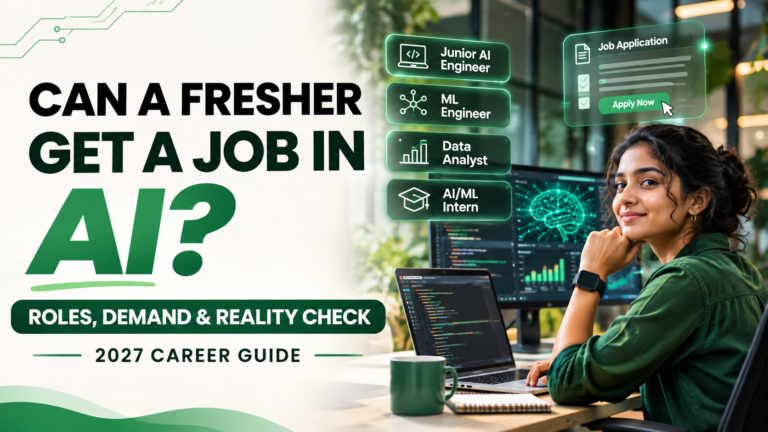
Entry-level AI roles freshers can target
Where freshers get hired
- IT services and consulting firms have the most fresher openings. Pay sits at the lower end of the range, but you get exposure to lots of client projects.
- AI startups and product companies hire fewer freshers and pay more. They also care more about your portfolio than your college name.
- GCCs in Bangalore and Hyderabad are growing fast and often hire through campus drives and referrals.
- Non-tech companies are building AI teams too. Banks, retailers and healthcare firms increasingly hire junior AI talent.
The honest reality check
The entry level of tech is changing. TeamLease Digital’s 2026 skills report found that entry-level AI-support roles, like basic monitoring and first-line support, are shrinking. Hiring and pay are shifting towards people who can build, deploy and run AI systems.
For freshers, that cuts both ways. Applying with only a certificate is harder than it was a few years ago. Applying with deployed projects and real skills pays off more than ever.
Which AI job is in high demand?
GenAI developers and LLM application engineers are the most in-demand AI roles in India right now. TeamLease Digital expects demand for GenAI talent to cross 10 lakh roles, against a supply gap of about 53%. Roles that get AI into production are in strong demand too.
In-demand AI roles in 2026
| In-demand role | Why companies need it | Fresher-friendly? |
|---|---|---|
| GenAI / LLM application developer | Every company wants chatbots, copilots and RAG systems on its own data |
YesWith a deployed GenAI project
|
| AI agent developer | Firms are moving from single chatbots to agents that complete multi-step tasks |
YesIf you’ve built an agent end to end
|
| MLOps / LLMOps engineer | Most AI pilots stall before production; these engineers get them live |
PartlyUsually after 1–2 years
|
| Data engineer for AI | AI is only as good as the data pipelines feeding it |
Yes
|
| Forward Deployed Engineer (FDE) | Works directly with clients to customise and deploy AI products |
LaterBetter after some experience
|
Which AI job is highly paid?
The best-paid AI jobs are senior roles that design, scale and run AI platforms. TeamLease Digital puts an ML platform architect with 15+ years at about ₹94.8 LPA. Among early-career roles, GenAI developers lead, at about ₹11.2 LPA in their first two years and around ₹34.5 LPA by years six to eight.
Specialising pays too. Compared with a general ML engineer at the same level, recruiters report premiums of roughly:
- 60–100% for post-training and fine-tuning LLMs, though very few of these roles exist in India
- 30–50% for LLM application engineering, meaning RAG, agents and evaluation
- 25–45% for MLOps and LLMOps
- 20–35% for computer vision
For a fresher, the practical move is to aim at LLM application engineering. It has the most openings, a strong premium, and skills you can build in months rather than years.
Is AI a stressful job?
AI can be demanding, but it isn’t more stressful than most software jobs. The pressure mostly comes from tools that keep changing, production deadlines and the need to keep learning. How it feels day to day depends a lot on the company, the team and how much you enjoy change.
| Common sources of stress | What helps |
| Tools and models change every few months | Strong fundamentals (Python, ML, system design) that do not go out of date |
| Models behave unpredictably in production | Good testing, evaluation and monitoring habits from day one |
| Pressure to ship AI features quickly | Clear scoping and honest communication about what AI can and cannot do |
| Feeling you must learn everything | Specialising in one area, such as GenAI apps or MLOps, instead of chasing every trend |
There’s plenty on the other side of the scale, too. The work is varied, interesting and well paid. And because AI skills are in demand, you get more choice of employers and more room to negotiate.
Stress also depends on where you work. Early-stage startups move fastest and often expect long hours, while large firms and GCCs tend to have more structure. Ask about on-call duties, release cycles and team size in interviews, so you end up somewhere that suits you.
What employers check in fresher AI candidates
Employers hiring freshers for AI roles check five things: your projects, your Python, your ML fundamentals, whether you understand deployment, and how clearly you explain your work. Your degree and certificates get you shortlisted. These five get you the offer.
| What they check | How they check it | How to prepare |
| Projects | They open your GitHub and demo links, then ask you to walk through one | 2–3 projects with clean READMEs and at least one live demo |
| Python coding | A coding round on data structures and data handling | Regular practice on coding problems plus Pandas exercises |
| ML fundamentals | Questions on overfitting, evaluation metrics, bias and model choice | Be able to explain why you chose each model in your projects |
| Deployment awareness | “How would you put this into production?” | Deploy at least one project with FastAPI, Docker and a cloud platform |
| Communication | Explaining a project in 2 minutes to a non-technical interviewer | Rehearse a short, clear story for each project |
Mistakes that cost freshers AI offers
- Only tutorial projects. Titanic survival and MNIST digits are on thousands of resumes, so pick a problem from a real domain instead.
- Nothing deployed. A notebook proves far less than a working app with a link.
- Listing tools you can’t explain. Interviewers will ask about every framework on your resume.
- Empty GitHub and LinkedIn profiles. Recruiters search both, so a blank profile is a missed chance.
- One resume for every application. Tailor it for GenAI, ML or data roles.
How AI Engineer Pro prepares freshers for hiring
AI Engineer Pro is built around exactly what employers check:
- You build three capstones, including an industry project that ties a data pipeline, a model and an AI agent together.
- You learn the full path from Python to ML, deep learning, MLOps, deployment, GenAI and agents, with no prior coding needed.
- You present your final project at our Employer Demo Day, in front of hiring partners we invite.
- We run mock interviews for AI roles and help with your resume and LinkedIn.
- We support you through your first 10 confirmed interviews.
Classes run on weekends at Koramangala, Bangalore, for 6 months, and the next batch starts with Basics on 19 December 2026.
Frequently asked questions
Which type of AI is ChatGPT?
ChatGPT is a generative AI built on a large language model (LLM) that uses the transformer architecture. In terms of capability, it’s Narrow AI: very good at language tasks, but nowhere near general human-level intelligence. In terms of how it works, it’s limited-memory AI, since it learns from training data and uses the conversation so far to respond.
Can a fresher get an AI job without experience?
Yes. Freshers get hired for AI roles without work experience when they can show equivalent proof of skill. Two or three solid projects, with at least one deployed, often count for more than an internship. An internship still helps, especially at an AI startup, because it shows you can work in a real team.
Will AI replace fresher jobs?
AI is cutting some routine entry-level work, like basic support and simple testing. At the same time, it’s creating fresher roles for people who build with AI, such as GenAI developers and junior AI engineers. Freshers who can build, deploy and evaluate AI systems are far safer than those who only use AI tools.
How long does it take a fresher to get an AI job?
Most beginners need about 6–7 months of focused learning to become job-ready, then usually 1–3 months of applications and interviews. If you already code, it can be quicker. Building projects as you go, rather than all at the end, shortens the job hunt because your portfolio is ready the day you start applying.
Become the fresher AI employers want to hire.
AI Engineer Pro takes you from zero coding to three deployed AI projects, an Employer Demo Day and support for your first 10 interviews, in 6 months of weekend classes at Koramangala, Bangalore. The next batch starts on 19 December 2026.
Book a Free Demo Class · Download the Syllabus · Call +91 88846 88847
Sources
Checked on 19 November 2026.
- CXOToday: TeamLease Digital Skills & Salary Primer FY2026–27 (GenAI demand and talent gap, shrinking AI-support roles, GenAI developer and ML platform architect pay; September 2026)
- Weekday: AI Engineer salary in India 2026 (GenAI and MLOps pay premiums, fresher bands; October 2026)
- AmbitionBox: AI Engineer jobs (examples of 0–2 year AI engineer openings; seen in search results only)
- Arivu Skills: AI Engineer Pro course page (curriculum, placement support, batch dates)