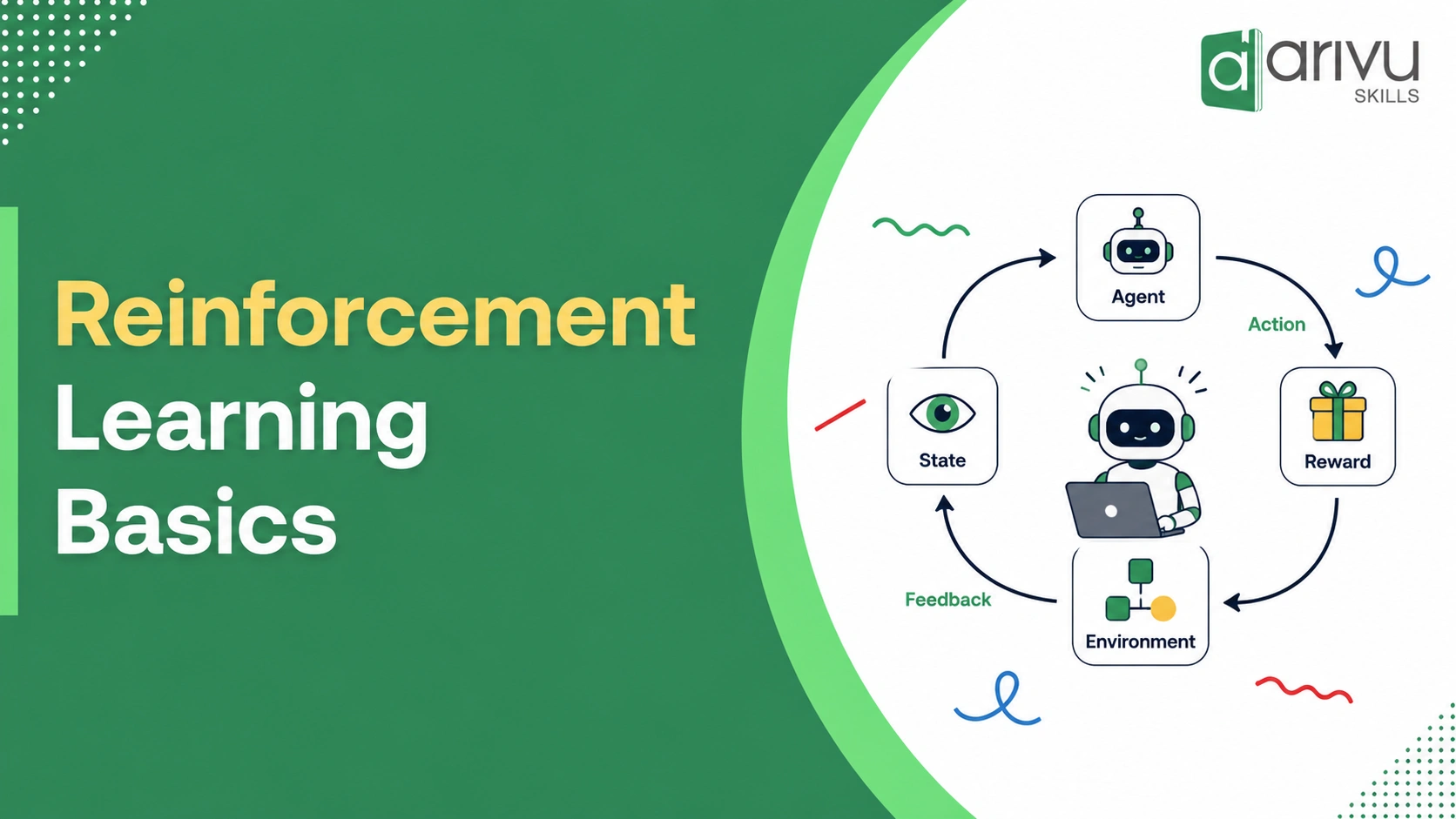

Artificial intelligence is becoming smarter every day. From self-driving cars and game playing robots to customize recommendations AI systems are learning to make better decisions with time. But have you ever wondered how machines learn what the best decision is? That is exactly where reinforcement learning comes in the picture. It is different from traditional machine learning approaches that learn from labeled data. It earns by trying different actions, making mistakes and even receiving rewards by just improving its decision gradually. If you’ve ever trained a pet with treats for good behaviour you might have already seen the basic idea.
Master Python, Machine Learning, AI, and Data Visualisation with our Data Science Course in Chennai.
What is reinforcement learning?
Reinforcement learning is basically a type of machine learning where an intelligent system known as an agent learns by interacting with its environment. Instead of telling it what to do the agent performs actions and receives feedback in the form of rewards or penalties. With time it discovers which actions produce the best long term results. You can think of it like riding a bicycle. No one can teach you every possible situation that you will encounter. Instead you need to practice adjusting your balance and improve with experience. That’s exactly how reinforcement learning works?
How does reinforcement learning work?
The agent is the learner or decision maker. For example robots learning to walk on an AI playing chess. Everything the agent interacts with is the environment. It can include a video game factory floor or just a road for autonomous vehicles. The current environment is known as the state. For example in a chess game the state is the current arrangement of all the Chess pieces. Action is the decision taken by the agent. It includes a chess piece. Feedback received after taking the action is the reward. Positive rewards encourage good decisions while penalties discourage poor ones. The goal of reinforcement learning moves left in artificial intelligence is simply to maximize the total reward with time.
Reinforcement Learning vs Supervised Learning
| Feature | Reinforcement Learning | Supervised Learning |
| Learns From | Rewards and penalties | Labeled data |
| Training Style | Trial and error | Correct answers provided |
| Goal | Maximize rewards | Predict correct output |
| Feedback | Delayed | Immediate |
| Common Use Cases | Robotics, gaming, autonomous vehicles | Image recognition, spam detection |
Why is reinforcement learning important?
Modern AI systems often need to make decisions in dynamic environments where conditions constantly change. That’s exactly why reinforcement learning in AI has become a major technology behind many intelligent systems. It allows machines to learn independently, adapt to changing situations, improve through experience and even solve complex problems.
Popular reinforcement learning algorithms
Different reinforcement learning problems require different algorithms. You can use some algorithms like deep queue networks policy gradient actor critic and proximal policy optimization. You must know that all the algorithms have their own strengths and disadvantages depending on the complexity of the environment and the type of decision being made.
Advantages of reinforcement learning
It is different from supervised learning as reinforcement learning doesn’t require manually labeled data sets. It can solve problems involving multiple decisions with time. The more experience the agent gains the better its decisions become. Reinforcement learning can adjust its strategy when conditions change. It also encourages long-term optimization instead of focusing only on immediate rewards reinforcement learning maximizes future success.
Challenges of reinforcement learning
Even though powerful reinforcement learning is not always easy to implement. Some common challenges include training can take a long time or it requires significant computational power. Despite all the challenges advances in computing and AI research continue to make reinforcement learning more practical.
Skills you need to learn reinforcement learning
If you are interested in building a career in AI learning, reinforcement learning is a valuable step. You need some skills like Python programming, machine learning fundamentals, mathematics , linear algebra, deep learning and data structures. A structured learning program can help you build all these skills through hands-on projects and real-world case studies.
Ready to start your AI journey?
Understanding reinforcement learning is just the beginning. The best way to master reinforcement learning in AI and machine learning reinforcement is by working on real-world projects guided by industry experts. At Arivu Skills you can gain practical experience in Python machine learning and artificial regions through hands-on training design for aspiring professionals.
FAQs
Reinforcement learning is a type of machine learning where an AI system learns by interacting with its environment and improving the decisions based on rewards and penalties.
Supervised learning uses labeled data with known answers while reinforcement learning learns through the trial and error without being given the correct output.
You can use it in robotics, self-driving cars, gaming finance, healthcare and recommendation systems.
Python is the most widely used language because it offers powerful AI and machine learning libraries.
Yes AI adoption goes professionals with reinforcement learning expertise are increasingly sought after for roles in machine learning.