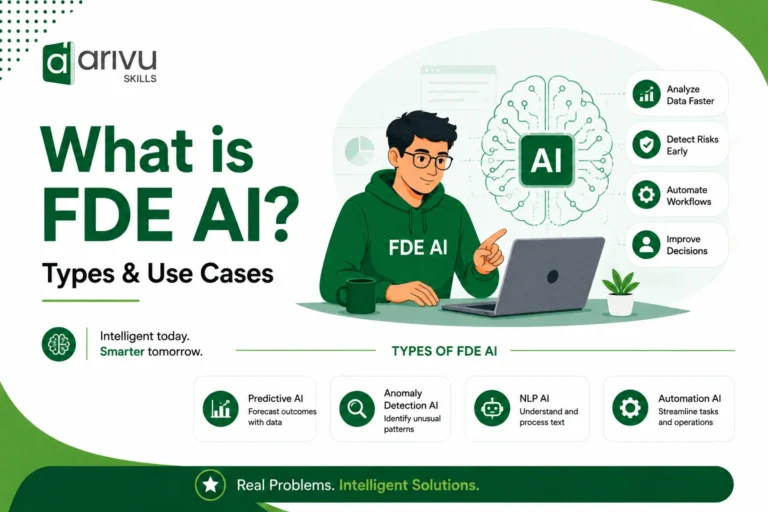
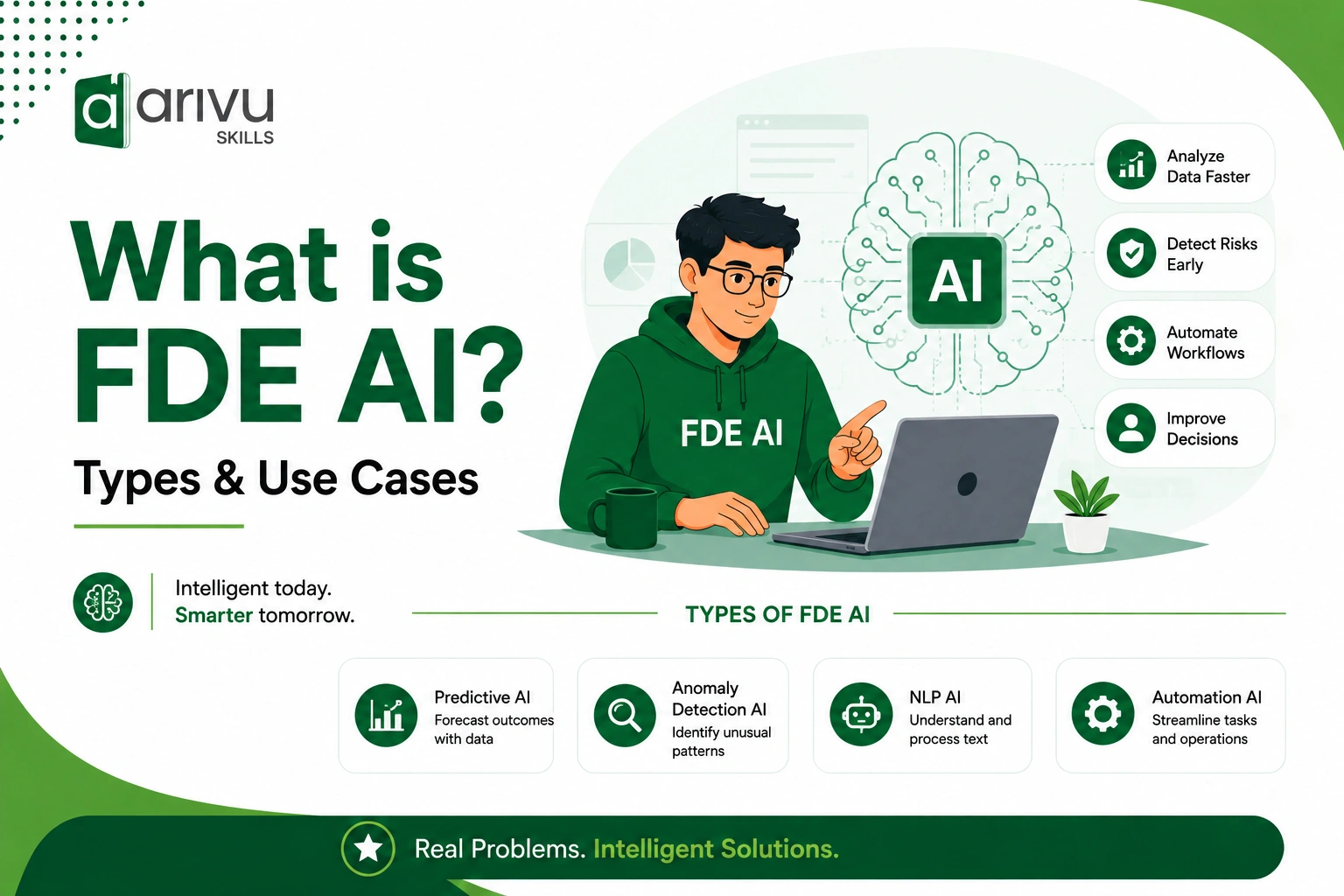

FDE AI refers to the application of the forward deployed engineer model to artificial intelligence systems: an engineer embedded directly with a client to build, customise, and maintain AI-driven solutions — agents, automation workflows, or model integrations — tailored to that client’s specific environment, rather than a generic AI product shipped to every customer in the same form.
The term has gained traction quickly as enterprises move from pre-packaged AI tools to bespoke agentic systems that need direct, hands-on adaptation. This article breaks down what FDE AI means, the main types of work it covers, common use cases, and the skills the role requires.
Explore the Forward Deployed Engineer Course in Bangalore at Arivu Skills
What FDE AI means in practice
A standard AI product engineer builds a model, tool, or agent framework once and ships it broadly, with configuration options but limited per-client customisation. An FDE AI professional does the opposite: they sit close to one client, understand that client’s data, workflows, and constraints in detail, and build or adapt an AI system specifically for that environment.
This typically involves connecting AI agents or models to a client’s existing systems (CRMs, internal databases, ticketing tools), tuning prompts or workflows to match how that specific team actually operates, and iterating quickly as the client’s needs shift, often within the same week the gaps are identified.
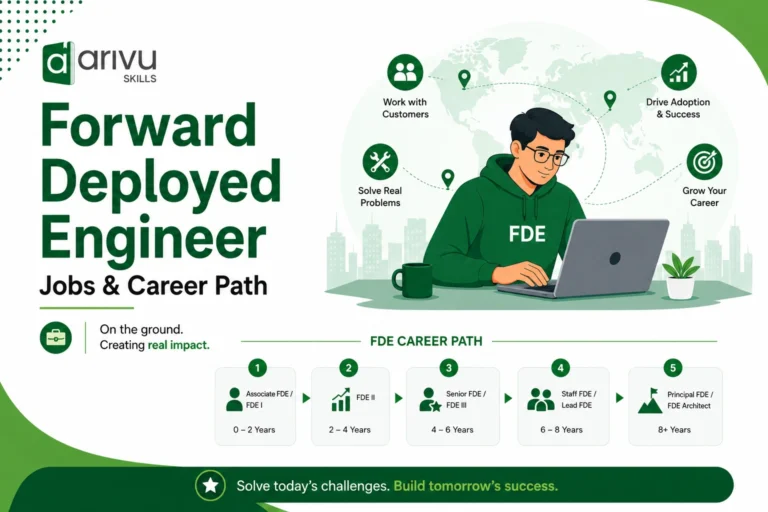
Want to know how much FDE earns? Learn here all about FDE Jobs, Career Path and Roadmap
Types of FDE AI roles
FDE AI work generally falls into a few recognisable categories, though the boundaries between them are not rigid, and a single engineer often moves between them on the same account.
Agentic workflow FDEs: build and refine AI agents that carry out multi-step tasks — processing documents, triaging support tickets, or executing internal workflows — configured to a specific client’s tools and rules.
Data integration FDEs: focus on connecting AI systems to a client’s existing data infrastructure, handling the unglamorous but critical work of getting messy, inconsistent internal data into a form an AI system can use reliably.
Client-facing AI consultants: spend more time translating between the client’s business goals and what the AI system can realistically deliver, often working alongside a more technically focused FDE on the same account.
Vertical-specialist FDEs: concentrate on one industry, such as healthcare, fintech, or logistics, building deep familiarity with that sector’s data patterns, compliance requirements, and common workflows across multiple client engagements.
Common use cases for FDE AI work
FDE AI engagements tend to cluster around a handful of recurring problems. Customer support automation is one of the most common, where an AI agent needs to be trained on a specific company’s tone, policies, and escalation rules rather than generic support scripts. Internal operations automation is another, covering tasks like automating approval chains, generating reports from scattered internal systems, or building AI-assisted dashboards tailored to how a specific team reviews data.
Document and compliance processing is a frequent use case in regulated industries, where AI systems need to be adapted to a client’s specific document formats and regulatory requirements rather than a generic template. Sales and CRM enrichment work also comes up regularly, where an AI system needs to pull from and write back into a client’s existing sales tools in a way that fits their specific process.
Skills required for FDE AI work
The role sits at the intersection of AI/ML fundamentals and the broader forward deployed skill set. Core requirements include a working understanding of large language models and how to build around them (prompt engineering, retrieval-augmented generation, agent frameworks), general software engineering skills for integration work (APIs, data pipelines, authentication), and the same client-facing communication and comfort with ambiguity that defines forward deployed engineering more broadly.
Familiarity with common AI orchestration tools and frameworks is useful, but employers in this space tend to prioritise a candidate’s ability to reason about a client’s actual problem and adapt quickly over deep expertise in any single framework, since the tooling in this area changes fast.
FAQs
FDE AI refers to the forward deployed engineer model applied to artificial intelligence systems — an engineer embedded with a client to build, customise, and maintain AI agents, workflows, or model integrations tailored to that client’s specific environment, rather than a generic AI product.
FDE AI work generally falls into four overlapping categories: agentic workflow FDEs, who build multi-step AI agents; data integration FDEs, who connect AI systems to a client’s data infrastructure; client-facing AI consultants, who translate business goals into technical requirements; and vertical-specialist FDEs, who focus on one industry.
Common use cases include customer support automation tailored to a company’s tone and policies, internal operations automation, document and compliance processing in regulated industries, and sales or CRM enrichment work that integrates with a client’s existing tools.
The role requires a working understanding of large language models and agent frameworks, general software engineering skills for integration work, and the client-facing communication and comfort with ambiguity common to forward deployed engineering roles generally.
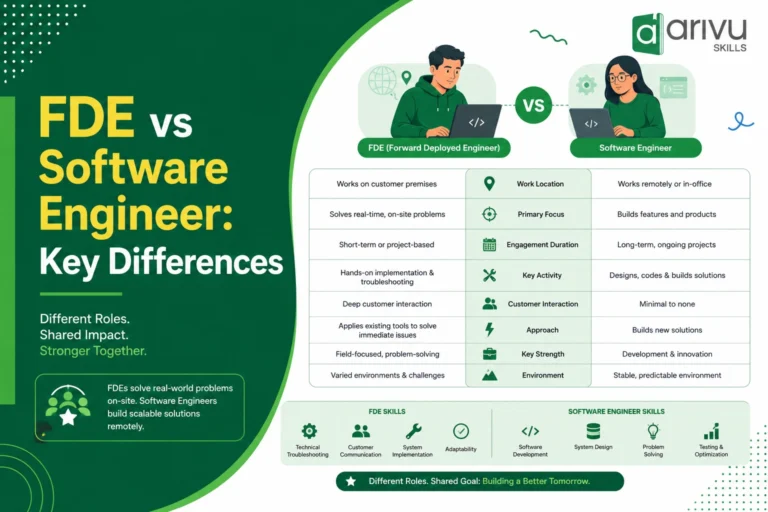
Yes. A regular AI engineer typically builds AI products or features for a broad user base within a company. An FDE AI professional works embedded with individual clients, adapting and integrating AI systems to each client’s specific environment and requirements.