
TL;DR
- What it is: Digital marketing means promoting brands through search engines, social media, email, websites and online ads, and measuring what works.
- Is it a good career in India? Yes, for people who enjoy both creative and analytical work. Almost every industry hires digital marketers, from e-commerce and EdTech to healthcare and real estate.
- Qualifications: No marketing degree is required. Graduates from commerce, arts, science, BBA and MBA backgrounds all enter the field.
- Salary: Digital marketing freshers in India typically start around ₹1.8–3.5 LPA. AmbitionBox puts Digital Marketing Executive pay at ₹1.2–5.4 lakh a year across 0–5 years of experience. Specialists in performance marketing and analytics earn more.
- Skills to learn first: Marketing fundamentals, SEO and social media, then Google Ads, Meta Ads and Google Analytics 4.
- Coding: Not required. Basic WordPress and HTML knowledge helps.
- Getting hired without experience: Build a portfolio of real or clearly labelled sample projects, do an internship, and take on small freelance work.
A neighbourhood bakery wants to show up when someone nearby searches “cakes near me.” A national brand wants its reel in front of the right 2 million people. Different budgets, same problem, and the person who solves it is a digital marketer: someone who understands the customer, picks the right channel and then checks whether the money actually did anything.
It’s one of the more accessible careers in India right now. You don’t need a particular degree, and you don’t need years of experience to get your foot in the door.
What trips most beginners up is the order. Should you learn SEO first? Is being good at Instagram enough? Do you need to code? And how are you supposed to get hired when every job post asks for experience you don’t have yet?
We’ll take those one at a time, from the basics through to your first portfolio.
1. What is Digital Marketing?
Digital marketing is the promotion of products, services and brands through online channels: search engines, social media, websites, email and online ads. Traditional marketing buys space in newspapers, on TV and on hoardings. Digital marketing goes where people already spend hours every day, and, crucially, it lets you see what worked.
You bump into it all the time. The product you searched for on Google, the YouTube ad you skipped, the brand you found while scrolling Instagram, the discount email from a store you bought from once. All of that is someone’s digital marketing.
Businesses use it to get noticed, attract potential customers, collect leads and sell more. The field breaks down into a handful of areas:
- SEO (search engine optimisation): getting a website to rank in Google’s free results
- Social media marketing: building an audience on Instagram, Facebook, LinkedIn and YouTube
- SEM (search engine marketing): paid ads on search engines
- Content marketing: blogs, videos and infographics that attract and inform
- Email marketing: targeted campaigns to customers and leads
- Performance marketing: paid campaigns judged strictly on measurable results
- Marketing analytics: using data to see what’s working and what isn’t
Posting content is the part everyone sees. Most of the actual work happens before and after it, in understanding the customer, choosing where to show up and proving the effort paid off.
2. Is digital marketing a good career in India in 2027?
Yes, particularly if you like both making things and measuring them. Businesses keep shifting budgets online, and someone has to turn that spend into customers. Here’s what makes the field worth a look.
Almost every industry hires for it
Ad agencies are only one option. E-commerce, EdTech, banks, hospitals, hotels, real estate developers, IT companies, media houses and startups all need people who can market online. If you have a preference for a particular industry, you can probably find a digital marketing job in it.
You can specialise later
Most people start as generalists and drift towards whatever they turn out to be good at, whether that’s SEO, paid ads, social media, content or analytics. Nobody expects you to know on day one.
It rewards two kinds of thinking
Creativity gets the click. Data tells you whether the click led anywhere. If you enjoy writing a sharp ad and then figuring out why it flopped (or didn’t), you’ll like this work.
Freelancing is realistic
With a couple of years of solid experience, plenty of people take on independent clients for social media, SEO, Google Ads, content, websites or lead generation, either alongside a job or instead of one.
The ground keeps moving
Platforms change their rules, algorithms get reshuffled and customers change how they shop. Some people find that exhausting. Others find it’s the reason they never get bored.
Worth saying plainly: the field is crowded, and knowing a few tools won’t set you apart. Employers want people who understand what a campaign is supposed to achieve for the business, and who can show they’ve delivered something before.
3. What qualifications do you need to become a digital marketer?
You don’t need a marketing degree. This is one of the few fields where a good portfolio routinely beats a good degree, and people arrive from all sorts of backgrounds.
Commerce graduates tend to bring business sense that pairs naturally with advertising and analytics. BBA graduates already know the marketing theory and just need to apply it online. Arts graduates often have the writing chops that content and social media roles live on. Science and engineering graduates frequently gravitate towards analytics, technical SEO and automation. MBAs can aim straight for strategy, performance marketing and brand roles.
In the end, an interviewer cares far more about whether you can solve a real marketing problem than about which degree you hold.
4. How to start a career in digital marketing: a step-by-step roadmap
The most common beginner mistake is trying to learn twenty tools at once and getting good at none of them. Go in this order instead.
Step 1: Learn the fundamentals
Before you open any tool, get clear on how marketing works online:
- Traditional versus digital marketing
- Target audiences and customer personas
- The buyer’s journey
- Where online traffic comes from
- Brand positioning
- Marketing funnels, conversions and lead generation
This is the stuff that lets you explain why a business should spend on Google Ads rather than Instagram, or the other way round.
Step 2: Learn SEO
SEO is how a website shows up in Google’s free results, and businesses value it because free traffic compounds over time. Start with:
- Keyword research and search intent
- On-page, off-page and technical SEO
- Local SEO
- Competitor analysis and backlinks
- Google Search Console
Try this: Pick a local business. Work out what customers would type into Google to find it, then write an SEO improvement plan for its website. One real plan teaches more than ten tutorials.
Step 3: Build social media skills
Learn to plan a content calendar, design posts and carousels, write captions people actually stop for, understand how each platform decides what to show, read engagement data and manage a business profile. Practise on Instagram, Facebook, LinkedIn and YouTube.
Try this: Choose a business and build a 30-day content calendar, with post ideas, captions, creative concepts and a purpose for each post.
Step 4: Learn Google Ads and Meta Ads
This is where businesses spend real money, which is exactly why employers notice people who know it. Cover:
- Google Search, Display and YouTube ads
- Meta Ads Manager
- Audience targeting and budgeting
- Ad copywriting
- Conversion tracking and remarketing
- Campaign optimisation
Try this: Write a sample campaign plan for a business, with audience, objective, budget, keywords and expected conversions. If you get a chance to work on a real ad account under supervision, take it. Watching actual money get spent (and sometimes wasted) teaches you things a simulation can’t.
Step 5: Learn content and copywriting
Practise blog posts, website copy, social captions, ad copy, emails, video scripts, and headlines that make people want to click. Frameworks like AIDA, PAS and FAB are handy scaffolding when you’re starting out, though you’ll lean on them less over time.
Step 6: Understand websites and WordPress
You don’t need to be a developer. You do need to know how domains and hosting work, how to build and publish pages in WordPress, how to set up a landing page and what makes a site work well on a phone. Nearly every campaign sends people to a web page, so a weak page drags everything else down with it.
Step 7: Learn analytics and automation
Learn Google Analytics 4 and Google Tag Manager well enough to read traffic sources, audience behaviour, conversion rates, lead volume and return on ad spend. Without that, you’re guessing. Then get comfortable with the basics of marketing automation, CRM workflows and automated email campaigns.
Step 8: Use AI tools, carefully
AI has already changed how marketing teams work. Tools like ChatGPT and Canva AI can draft content, speed up SEO research, suggest ad copy, generate creative ideas and summarise campaign results.
Check everything they produce, though. AI gets facts wrong, repeats what everyone else is saying and doesn’t know your brand. Use it to work faster, and keep your own judgement in charge.
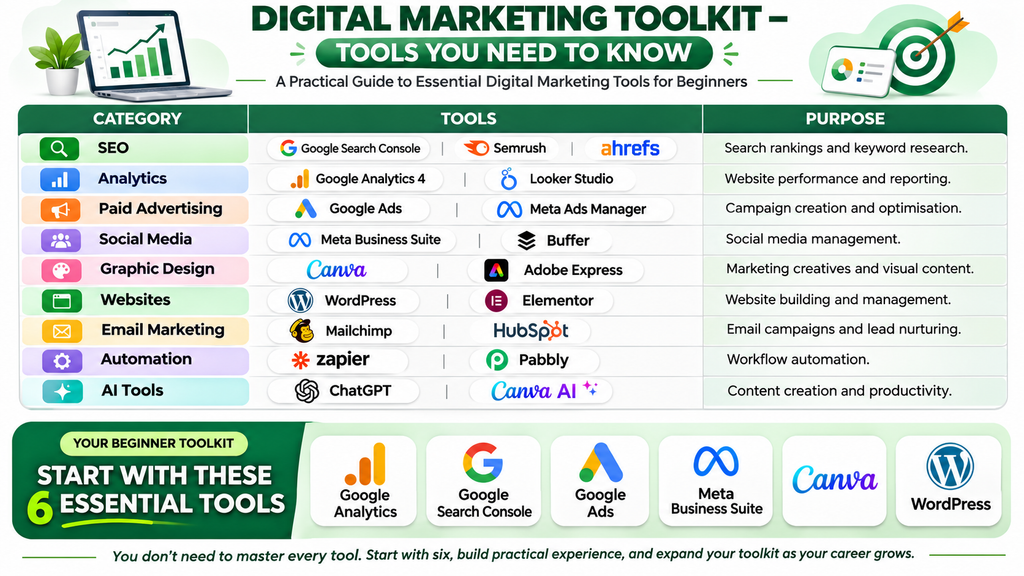
5. What digital marketing tools should freshers learn?
6. What digital marketing jobs are there in India?
Most people’s first job is digital marketing executive, a generalist role that covers social media, publishing content, coordinating campaigns and pulling together reports. It’s a good place to find out what you enjoy.
From there, the paths split. An SEO executive works on rankings and organic traffic through keyword research, technical fixes and content planning. A social media executive runs brand profiles, plans the content calendar and keeps an eye on engagement. A performance marketing executive manages paid campaigns on Google and Meta, owning targeting, budgets and conversion tracking. A content marketing executive writes the blogs, website copy and social content that bring people in.
If you lean towards numbers, a digital marketing analyst digs into traffic, campaign and customer data to work out what to fix and what to scale. Further along, a digital marketing strategist plans campaigns and judges overall performance, though that role usually comes after several years across different channels.
7. What is the salary of a digital marketer in India?
Digital marketing salaries in India start modestly and grow with skill and specialisation. According to AmbitionBox, Digital Marketing Executives earn roughly ₹1.2 lakh to ₹5.4 lakh a year across 0–5 years of experience, based on about 37,000 reported salaries. Naukri, citing AmbitionBox, reports average digital marketer pay of about ₹3 LPA at entry level (1–3 years), ₹4.6 LPA at mid level (4–8 years) and ₹8 LPA at senior level (9+ years).
We’d rather you go in with realistic numbers than be disappointed by your first offer. Here are indicative ranges for planning:
| Experience | Indicative annual salary |
Fresher (0–1 year) |
₹1.8–3.5 LPA |
Junior digital marketer (1–3 years) |
₹2.5–4.5 LPA |
Digital marketing specialist (3–5 years) |
₹3.5–6 LPA |
| Digital marketing manager (5–8 years) | ₹5–9 LPA |
Senior digital marketing manager (8+ years) |
₹8–15+ LPA |
These are broad ranges based on publicly reported salary data, not guaranteed offers. Specialised roles in performance marketing, analytics and growth often pay well above them, and many entry-level offers sit at the lower end.
What pushes your salary up
Proof of real campaign work matters more than anything else, because it’s the one thing an interviewer can’t take on trust. After that, skill in paid ads, analytics and automation tends to pay better than general social media skills. Specialising helps too: a strong performance marketer or SEO lead is much harder to replace than a generalist. And the people who move into senior roles are usually the ones who learned to talk about campaigns in terms of revenue and leads, not likes.
No course can promise you a salary. A portfolio you can walk an interviewer through is what moves the number.
8. How to get your first digital marketing job without experience
It’s the classic fresher catch-22: every job wants experience, and you can’t get experience without a job. The way around it is to make your own proof.
Start a project of your own, whether that’s a blog, an Instagram page or a small website about something you genuinely care about. It’s the cheapest place to practise keyword research, content, SEO and growing an audience, and it gives you something real to show.
Alongside that, write up a couple of sample Google Ads and Meta Ads campaigns: audience, objective, creative ideas, budget and how you’d measure success. Label them clearly as samples. Interviewers respect a well-thought-out sample; they do not respect invented results. An SEO audit of an existing website, with keyword research, competitor analysis and on-page recommendations, makes a strong portfolio piece too.
Then get some real-world exposure. An internship shows you how a marketing team actually operates, which is hard to learn any other way. Small paid or unpaid projects for a local shop, a college club or a startup teach you how to deal with a client, which is a skill in itself.
Finally, put it all on LinkedIn. List your projects, connect with people who work in the field and post about what you’re learning. Recruiters do look.
Three small real projects will get you further in an interview than a stack of course certificates.
9. Why practical digital marketing training matters
Plenty of freshers can define SEO in an interview. Far fewer can sit down and do keyword research for a real website, or set up a Google Ads campaign with a budget and conversion tracking that actually fires. That gap is where most beginners get stuck, and it’s the gap practical training is supposed to close.
At Arivu Skills, our Digital Marketing Mastery Course is built around doing the work, with live campaign setups, assignments and a capstone project.
What you learn in the Digital Marketing Mastery Course
The programme runs across five sections:
- Marketing and digital foundations: customer behaviour and the buyer’s journey, Canva and graphic design, video editing, content writing and copywriting (AIDA, PAS, FAB), social media setup, and YouTube marketing.
- Website and SEO: WordPress website building, blogging strategy, on-page, technical, off-page and local SEO, Google Business Profile management, and Google Analytics with Google Tag Manager.
- Paid marketing and lead generation: social media ads, Google Ads (Search, Display, Video and Shopping), display, programmatic and native ads, and landing pages with funnel building.
- Advanced marketing and AI: conversion tracking and remarketing, marketing automation and CRM (Zapier, Pabbly, HubSpot), WhatsApp and mobile marketing, AI for content, SEO and reporting, growth and conversion rate optimisation, email marketing, influencer and affiliate marketing, and e-commerce stores on WordPress and Shopify.
- Career and professional development: freelancing and project management, resume building with ATS optimisation, mock interviews, portfolio development, and marketing ethics and privacy compliance.
It finishes with a capstone: a multi-channel campaign that you submit as a portfolio case study.
How the course works
You can take it online, offline or through recordings, whichever fits your schedule. No prior experience is needed, since it starts from the basics, and the course mentor and support team are there when you get stuck. On successful completion, you receive an ArivuPro Skills Professional Certificate.
Learners also get placement assistance after completing the course, along with resume, interview and portfolio preparation. To be clear, placement assistance helps you find opportunities; it isn’t a guarantee of a job.
10. How to choose the right digital marketing course in India
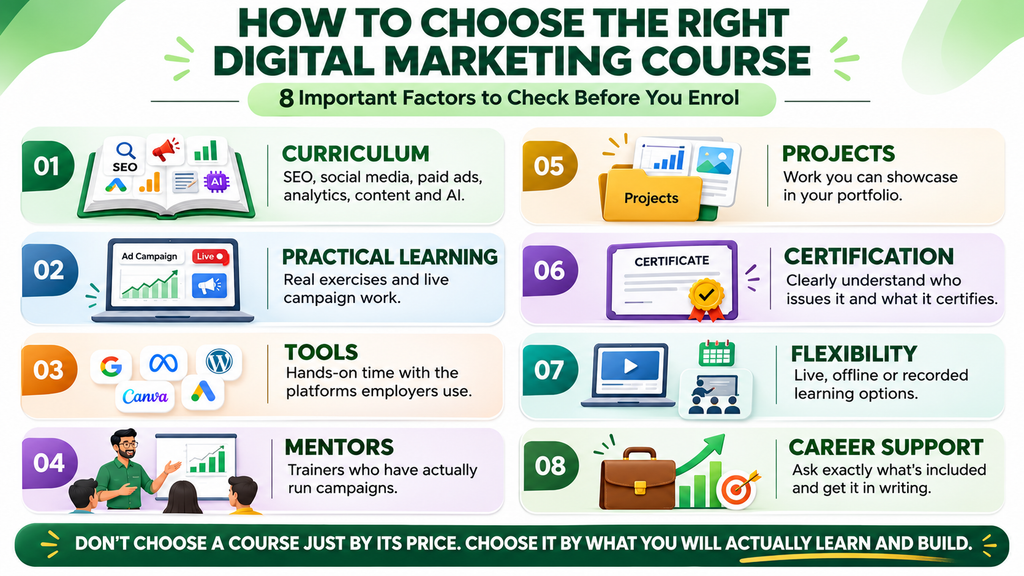
If a course leads with a guaranteed job or a big salary figure, be sceptical. A more useful test is to ask whether, by the end, you’ll be able to:
- Build a digital marketing strategy
- Do keyword research on your own
- Plan a paid ad campaign
- Read website and campaign data
- Show projects that prove all of the above
If the honest answer is yes, the course is probably worth your money.
11. Your 90-day digital marketing learning roadmap
Days 1–30: foundations
Learn digital marketing concepts, SEO basics, social media marketing, content creation, Canva and keyword research.
By day 30: You understand the main channels and have created your first content plan.
Days 31–60: tools and technical skills
Get hands-on with Google Ads, Meta Ads Manager, WordPress, Google Analytics, Search Console, copywriting and basic reporting.
By day 60: You’ve built sample campaigns, optimised a sample website and produced simple performance reports.
Days 61–90: portfolio
Pull it together into a complete SEO project, a social media plan, a sample paid campaign, a blog or website, a short case study, and an updated resume and LinkedIn profile.
By day 90: You have a portfolio you can show, and you’re applying for internships and entry-level roles.
Treat this as a pace to aim for, not a promise. Someone putting in two hours a day will move faster than someone fitting it around a full-time job, and that’s fine.
12. What is the future of digital marketing in India?
AI is quickly becoming part of the everyday toolkit. It already drafts content, researches audiences, tweaks campaigns and writes reports. That doesn’t make marketers redundant, but it does mean the marketers who use it well, and know when not to trust it, will get more done than those who don’t.
Search is also spreading out. People now look things up on Google, Instagram, YouTube and AI assistants, often for the same purchase. Marketers need to understand how discovery works on each of them, not just on Google.
Meanwhile, finance teams are asking harder questions about marketing spend, which is good news for anyone comfortable with analytics and conversion tracking. Short-form video keeps eating attention, so people who can make a reel that holds viewers and explain why it worked are in demand. And automation is spreading quietly through the industry, as more companies use CRM tools to manage leads and email, so setting those systems up is becoming a skill in its own right.
None of this will slow down. The safest bet is to get comfortable learning new tools every year, because you will be.
13. Final thoughts
You don’t need to know everything before you start. Most good digital marketers learned by trying things, getting some of them wrong and working out why.
So begin with the fundamentals, try each of the main channels and build a few small projects. You’ll quickly notice which work you enjoy, and that’s the area to go deep on.
And don’t wait until you feel ready, because that day doesn’t really come. Your first blog post, your first sample campaign and your first website audit will each teach you more than another week of reading about them.
Start learning digital marketing with Arivu Skills
The Arivu Skills Digital Marketing Mastery Course covers SEO, social media, paid ads, analytics, content, AI and automation, with hands-on projects and a capstone campaign. It’s open to recent graduates, students and working professionals, online or offline.
Explore the course: https://arivuskills.com/courses/digital-marketing/
Visit Arivu Skills: https://arivuskills.com/
Frequently asked questions
1. How can I start a career in digital marketing in India?
Learn the fundamentals first, then SEO, social media, Google Ads, content and analytics. Practise with real tools, build a portfolio and apply for internships or entry-level roles.
2. Can I become a digital marketer without a marketing degree?
Yes. People enter digital marketing from commerce, management, arts, science and engineering backgrounds. Practical skills and a portfolio matter more than the degree.
3. Is digital marketing a good career for freshers?
Yes. Freshers can start in SEO, social media, content, paid advertising or general digital marketing roles and specialise later.
4. What is the salary of a digital marketing fresher in India?
Most digital marketing freshers in India start around ₹1.8–3.5 LPA, depending on skills, city and company. AmbitionBox puts Digital Marketing Executive pay at about ₹1.2–5.4 lakh a year across 0–5 years of experience.
5. Which digital marketing skill should I learn first?
Start with marketing fundamentals, keyword research, SEO and social media. Move on to paid ads, analytics and automation after that.
6. Do I need coding knowledge for digital marketing?
No. Most roles don’t need coding. Basic HTML and WordPress knowledge is useful, especially for technical SEO and website work.
7. Which tools should a beginner learn in digital marketing?
Start with Google Analytics, Google Search Console, Google Ads, Meta Business Suite, Canva and WordPress, plus a keyword research tool.
8. Can I get a digital marketing job without experience?
Yes, but you’ll need to create your own proof. Build sample projects, do an internship, help a small business and put it all in a portfolio.
9. How long does it take to learn digital marketing?
A few months of consistent practice gives you a solid foundation. Getting genuinely good across several areas takes real work experience on top of that.
10. What does the Arivu Skills Digital Marketing course cover?
The course covers SEO, social media, Google Ads, Meta Ads, display and programmatic ads, content creation, WordPress, analytics, AI, marketing automation, WhatsApp marketing, e-commerce and career development, ending with a multi-channel capstone project.
11. Does Arivu Skills provide placement assistance?
Yes. Learners get placement assistance after completing the course, along with resume building, ATS optimisation, mock interviews and portfolio development. Placement assistance does not mean guaranteed employment.
12. Is digital marketing useful for entrepreneurs and business owners?
Very. Even a basic understanding helps owners attract customers online, run sensible ads and judge whether an agency is doing a good job.
Sources
- Arivu Skills: Digital Marketing Mastery Course
- AmbitionBox: Digital Marketing Executive Salary in India
- Naukri: Digital Marketer Salary in India