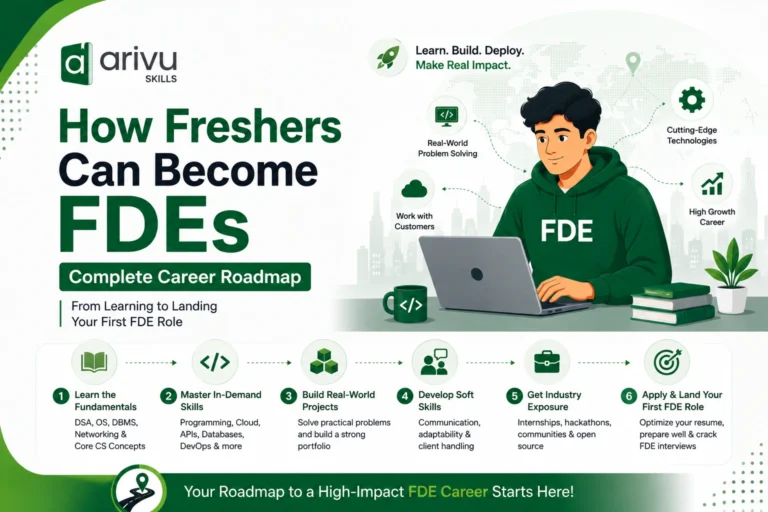
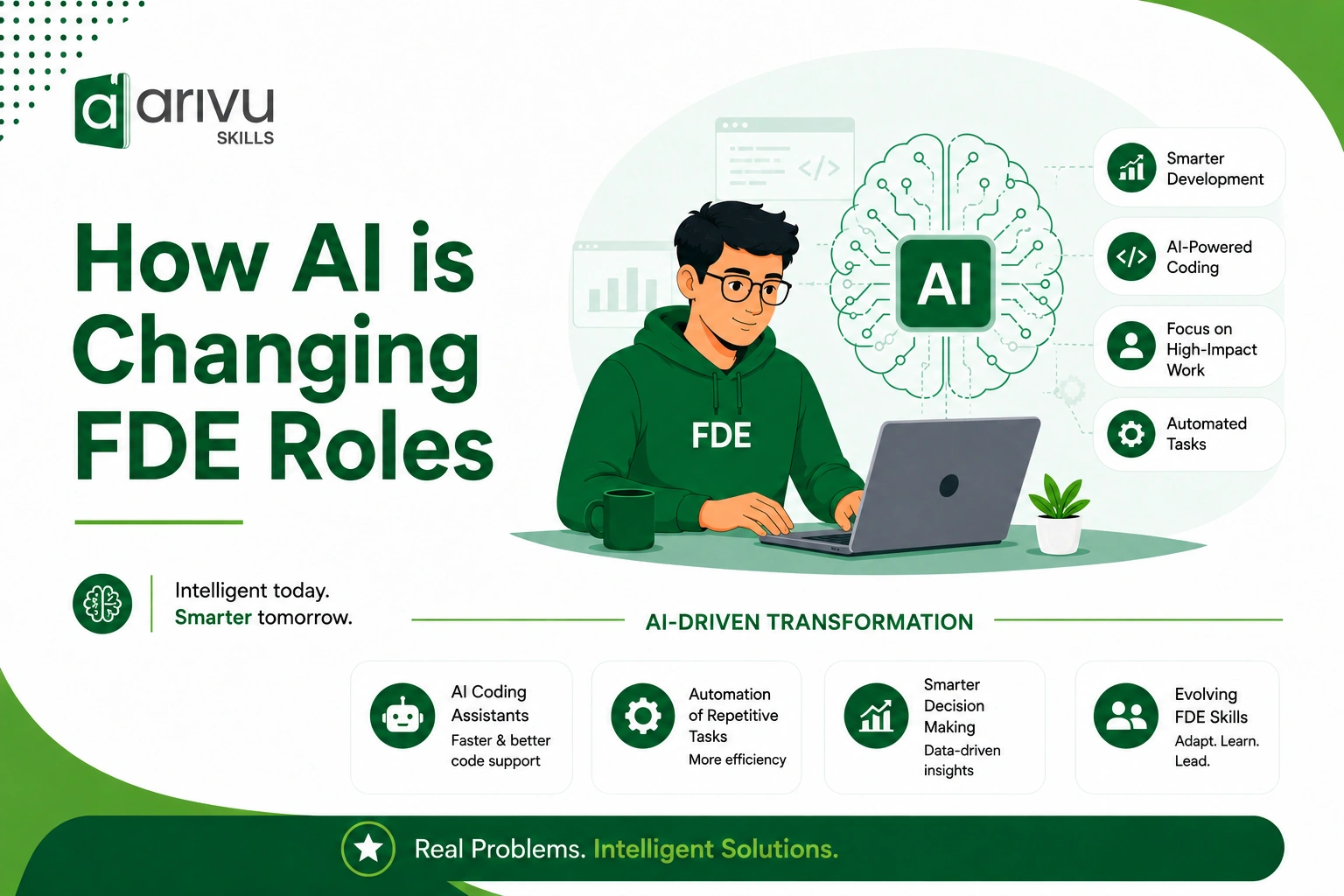

Two years ago, most engineers had never heard the term “forward deployed engineer.” Now it’s one of the fastest-growing job titles on tech hiring boards, and the reason is almost entirely AI. Enterprises don’t struggle to buy AI models anymore. They struggle to get those models working inside their own messy, specific, unglamorous systems. That gap is where the modern forward deployed engineer lives.
This article breaks down what the role actually is, why AI changed so quickly, and what the job looks like today compared to a few years ago.
The FDE Course in Bangalore is built around that gap. You work through real deployment scenarios instead of toy projects, practice the evaluation engineering skills companies are now hiring for, and get direct feedback on the client-facing side of the job that most technical courses ignore entirely.
What is a forward deployed engineer?
A forward deployed engineer (FDE) is a software engineer who works embedded inside a customer’s environment, rather than at a desk building a generic product for anonymous users. Instead of writing code for “the market,” an FDE writes code for one company’s specific data, workflows, and constraints, then stays close enough to that company to fix what breaks and adapt what changes.
The role isn’t new. Palantir built the model over a decade ago, sending engineers directly into government agencies and enterprises to make its platform actually work for each client. What’s changed is the scale. What used to be a niche Palantir specialty is now a standard hiring category at OpenAI, Anthropic, Google Cloud, Salesforce, Databricks, and a long list of applied-AI startups.
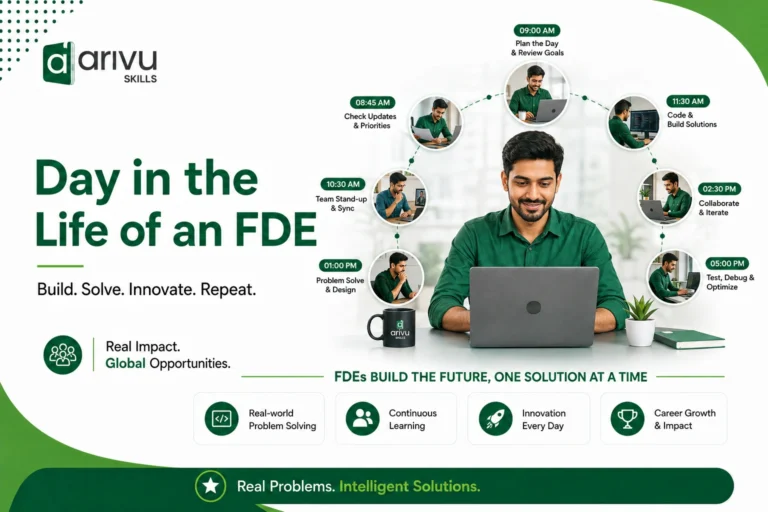
An FDE typically owns the full arc of a deployment: understanding the customer’s problem, adapting the product to fit it, writing whatever glue code is missing, shipping it into production, and reporting what they learn back to the core product team. That last part matters more now than it ever did.
Why AI made this role explode
Traditional enterprise software sells on a simple promise: buy it, configure it, plug it in. That promise mostly holds for mature software categories. It falls apart for AI.
Every enterprise has different data, different compliance rules, and a different definition of “good enough” output. A generic AI product rarely survives contact with a real company’s legacy systems and internal politics without someone reshaping it on-site. That someone is the FDE.
Hiring data reflects how fast this shifted. Job postings for forward deployed engineering roles rose several-fold between 2025 and 2026 across major boards, with compensation now rivaling or exceeding senior software engineering roles at the same companies. AI labs racing to prove enterprise ROI simply can’t wait six months for a traditional integration project. Pilots need to show results in weeks, and FDEs are the ones making that timeline possible.
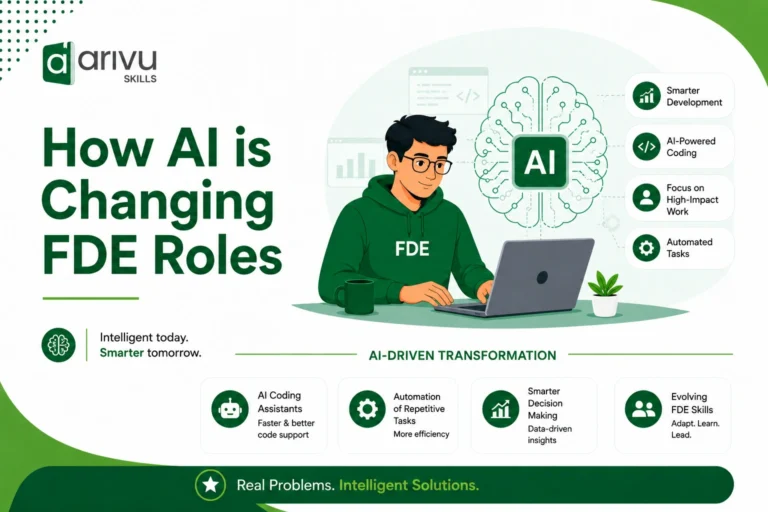
Five ways AI is reshaping the day-to-day job
1. Eval engineering has become a core skill, not a nice-to-have
A model that worked in a demo can still hallucinate or drift once it’s handling a client’s real data. FDEs increasingly spend as much time building test suites that catch these failures before they reach production as they spend writing integration code.
2. Debugging shifted from code paths to decision chains
Traditional integration bugs are usually traceable: an API call fails, a schema mismatches. Debugging an AI agent means tracing why it made a particular decision across a chain of steps, which is a different and messier skill entirely.
3. Deployment timelines compressed hard
Models improve monthly, sometimes faster. A deployment that takes six months risks shipping technology that’s already outdated by the time it launches. FDEs now work in weeks-long sprints where “good enough to prove value” beats “polished.”
4. The feedback loop back to product got tighter
Because FDEs sit inside real deployments, the patterns they notice, where the model breaks, what customers actually ask for, feed directly into product roadmaps. Companies increasingly treat field FDE reports as a primary source of product intelligence, not an afterthought.
5. Client conversations moved from “does this work” to “can we trust this”
Early AI pilots were about proving the technology could do the task at all. Now that most enterprise buyers accept that it can, the conversation has shifted toward governance, hallucination risk, and accountability. FDEs increasingly need to speak that language as fluently as they speak code.
With enterprise AI adoption accelerating across India’s tech hubs, Bangalore’s forward deployed engineer job market is only getting more competitive, and this is the fastest way to get interview-ready.
Skills FDEs need now that weren’t on the job description five years ago
The core FDE traits haven’t changed: strong engineering ability, comfort with ambiguity, and the confidence to sit in a boardroom and then go write production code the same afternoon. What’s new is layered on top of that foundation.
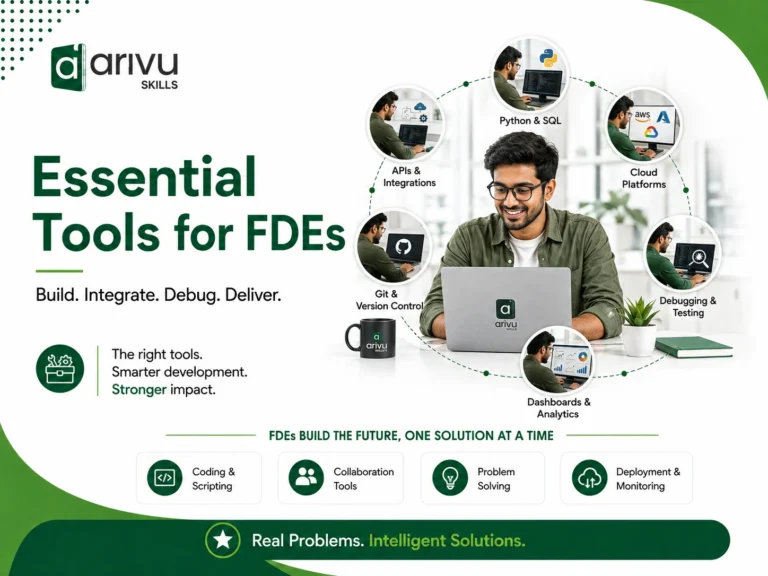
Eval and evaluation-suite design is now close to mandatory, not optional. Familiarity with agent frameworks and how autonomous systems chain decisions together matters more than familiarity with any single API. Basic data engineering, cleaning and wrangling a client’s real-world data, still eats a large share of most deployments, AI or not. And business fluency, the ability to translate a CFO’s concern into a technical constraint, has become as important as the coding itself.
How this differs from adjacent roles
It’s easy to confuse FDE with solutions engineer or machine learning engineer, so it’s worth being precise. A solutions engineer typically supports pre-sales, building demos and proofs of concept for prospects who haven’t bought yet. An ML engineer usually sits on a platform or research team, optimizing models rather than talking to customers. An FDE does neither of those things exclusively. They’re inside a paying customer’s environment, building something that has to survive contact with production, and they own the outcome, not just the demo.
That ownership is really the whole job in one word.
FAQs
A forward deployed engineer is a software engineer embedded with a customer who builds, deploys, and maintains a custom version of an AI product inside that customer’s own environment.
Yes. FDEs write real production code, but the job also demands strong communication skills and comfort working directly with clients, which sets it apart from most purely technical roles.
Solutions engineers mostly support the sales process before a deal closes. FDEs come in after the deal closes and own the actual implementation and its ongoing success.
Not necessarily. Strong general software engineering skills, comfort with ambiguity, and the ability to communicate with non-technical stakeholders matter more than deep ML research experience. Familiarity with how modern AI systems and agents behave in production is becoming important, though.
Because there’s a real shortage of engineers who combine strong coding ability with the client-facing skill to manage a high-stakes deployment. That combination is rare, and enterprise AI deals increasingly depend on it.
Most FDEs come from a software engineering background and add three things on top: hands-on experience deploying agentic AI systems in production, practice with eval engineering, and deliberate work on client communication. A structured FDE course, real deployment projects, or an internal transfer from a customer-facing engineering role are the three common paths in.