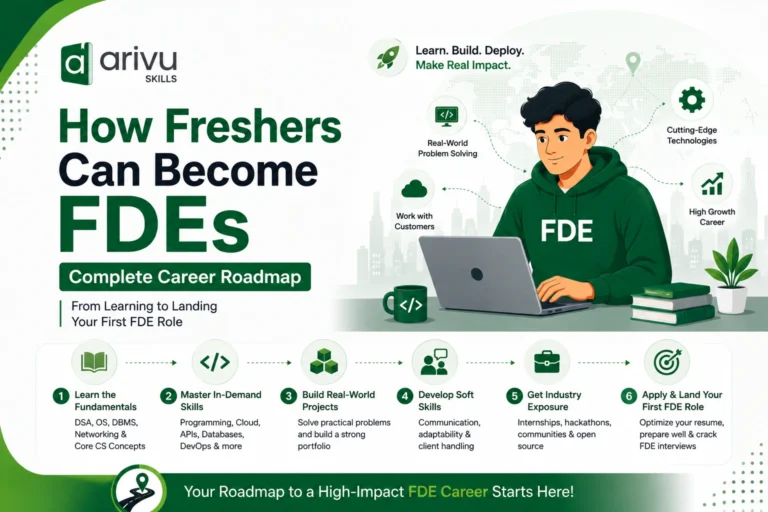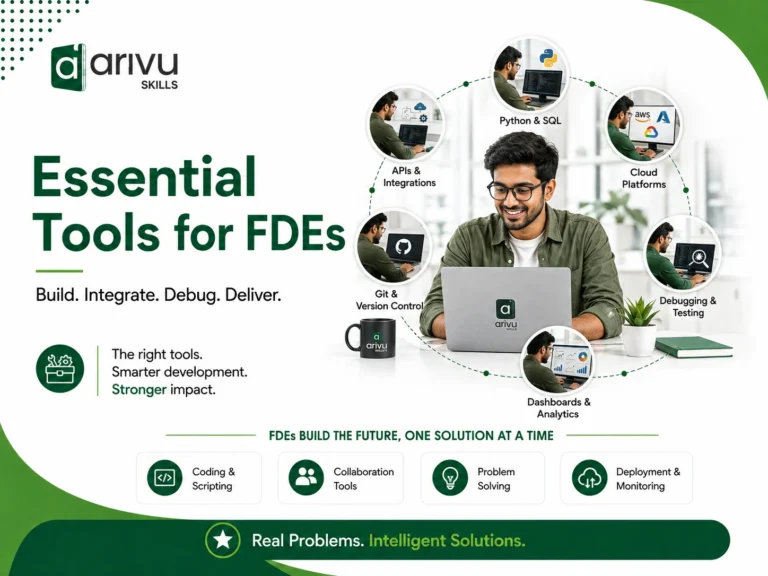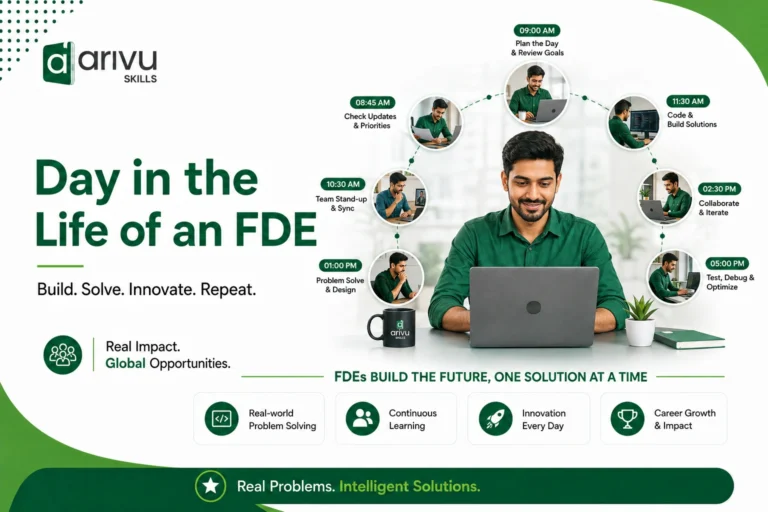
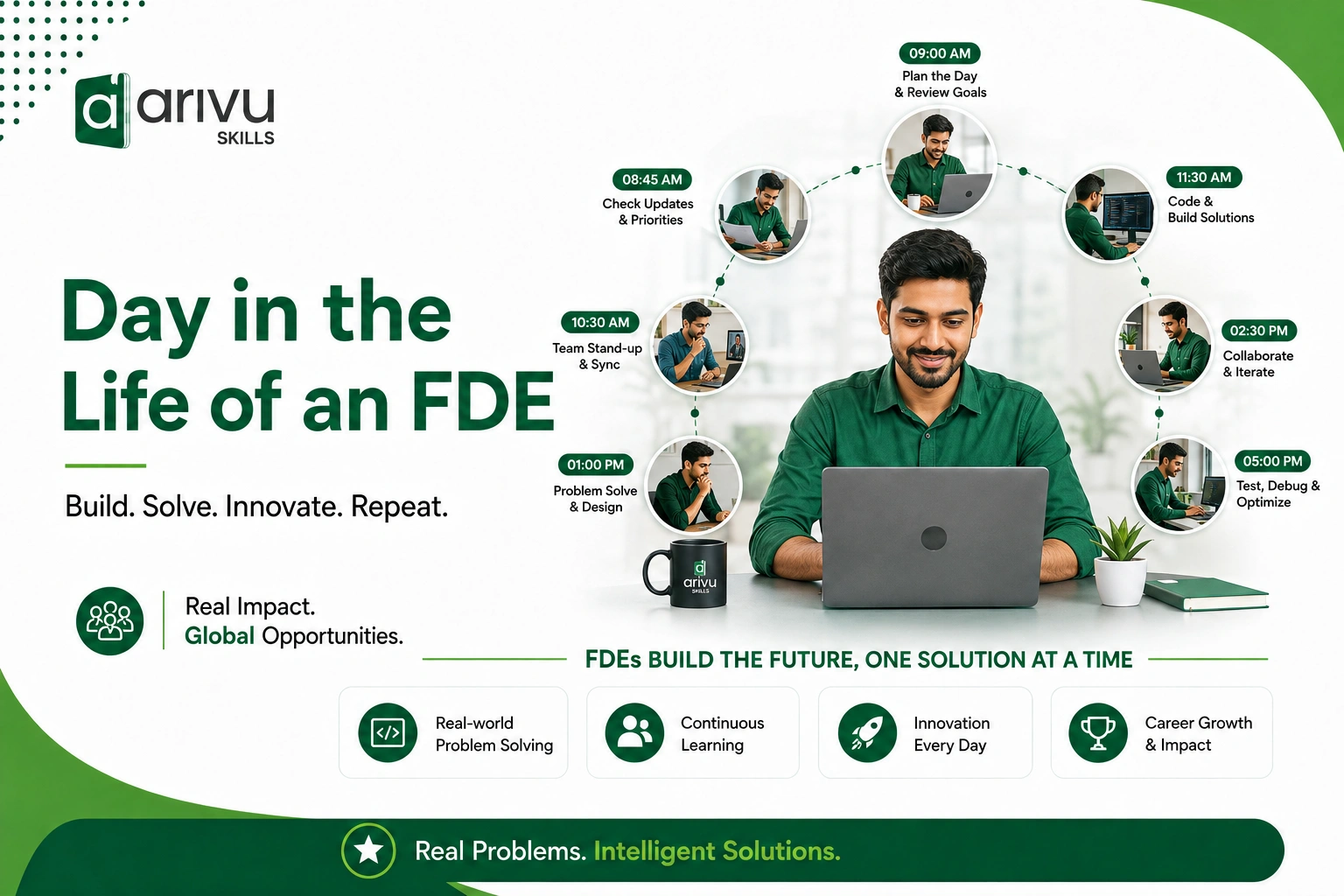

Job descriptions are useless for actually picturing a role. They tell you the responsibilities, never the texture of the day. So if you’ve searched “what is a forward deployed engineer” and come away with a vague answer, here’s the walkthrough instead: an FDE’s day looks less like a typical software job and more like a consultant, an engineer, and a firefighter sharing one calendar.
Curious whether this career path fits you? Explore the Forward Deployed Engineer Course in Bangalore at Arivu Skills for hands-on training built around real client scenarios.
What Is a Forward Deployed Engineer?
Here’s the direct answer: a forward deployed engineer is a software engineer who works on-site or in close, ongoing contact with a client, building and adapting software to solve that client’s specific problems in real time. A typical product engineer builds features for a broad user base from behind their own company’s walls. An FDE doesn’t get that comfort. They embed inside the client’s world — the client’s systems, the client’s data, the client’s day-to-day mess — and engineer something that actually fits.
That’s part of why the role has become so associated with Palantir, and why it’s now showing up at fintech, healthtech, logistics, and enterprise AI companies that need someone who can turn a business problem into working software without three months of back-and-forth first.
8:30 AM — Reading the Overnight Damage
The day rarely starts blank. Most FDEs open the morning checking what broke while they slept: a failed pipeline, a client’s Slack message sent at 11 PM, an alert from a deployed model, feedback from yesterday evening’s demo. Because FDEs often support live client systems, this triage isn’t optional. A broken data feed at a client site doesn’t sit politely in a backlog — it needs eyes now.
9:30 AM — Client Stand-up or Discovery Call
Most of an FDE’s morning goes to people who aren’t engineers. A finance lead might describe a reconciliation process eating three days a month. An operations manager might explain why the current dashboard doesn’t match what’s actually happening on the warehouse floor. The FDE’s job here isn’t just listening — it’s translating vague pain into a problem statement someone can actually build against.
That takes a different muscle than writing code: active listening, systems thinking, and enough curiosity about the client’s business to ask the follow-up question nobody else in the room thought to ask.
11:00 AM — Building Something Fast
Once the problem is clear, building starts, and it starts fast. FDEs ship working prototypes in hours or days, not sprint cycles. That might mean scripting a fix for messy client data, standing up a small internal tool, or stitching together an existing platform’s APIs to solve one narrow workflow. The goal isn’t polish. It’s giving the client something to react to, so the next conversation is grounded in a real thing instead of another slide.
1:00 PM — Syncing With the Home Team
After lunch, FDEs usually loop back with their own side — product managers, data scientists, platform engineers — to report what they saw on-site and push for changes upstream. If five different clients keep hitting the same wall, that’s a sign the core product needs to change, not just the client-specific layer around it. FDEs end up being the feedback loop between what clients actually need and what the platform actually does.
2:30 PM — Deployment and Debugging
Afternoons usually involve getting something live inside the client’s environment, which is rarely simple. It might mean navigating the client’s security review, working around infrastructure you don’t control, or figuring out why a model behaves differently on real client data than it did in testing. FDEs get comfortable operating inside systems that aren’t theirs — a very different feeling from building on your own company’s clean internal stack.
4:00 PM — Documentation and Handoff
Not everything an FDE builds stays with them. Good FDEs document their work clearly enough that the client’s own team, or another engineer entirely, can pick it up later. This step gets skipped constantly under time pressure. It’s also usually what separates a quick fix from a solution the client actually trusts and keeps using.
5:30 PM — Closing Out and Planning Tomorrow
The day tends to wrap with a quick scan of what’s still open: a client question that needs a follow-up, a bug worth another look, a feature the client mentioned wanting “eventually.” Experienced FDEs keep a running list of these threads, because client priorities shift fast — today’s offhand idea can become tomorrow’s fire drill before lunch.
Why This Day Looks Different From Regular Engineering
A few things separate this from a standard product engineering role. Context switching is constant — code, client calls, internal syncs, sometimes all inside one hour. Ambiguity is the default, not the exception; nobody hands an FDE a clean spec, they pull one out of a messy conversation and messier data. Ownership runs deep too, since an FDE often carries a problem from first conversation through to deployment instead of owning one slice of a bigger roadmap. And client trust genuinely is part of the job description — technical skill gets you in the room, but it’s communication and reliability that keep the client calling you back.
Is the FDE Path Right for You?
If this day sounded energizing rather than draining — if solving a messy, undefined problem in front of a client appeals more than shipping a well-scoped ticket alone — forward deployed engineering is worth a serious look. It rewards people who are strong technically but also comfortable improvising, communicating under pressure, and owning outcomes start to finish.
FAQs
A forward deployed engineer (FDE) is a software engineer who works directly with clients, often on-site or embedded with their teams, to build and adapt software for that client’s specific problems rather than building generic features for a broad user base.
An FDE’s day typically includes client calls to understand problems, rapid prototyping of solutions, deployment and debugging inside the client’s systems, internal syncs to relay feedback to the product team, and documentation for handoff.
For engineers who enjoy variety, client interaction, and end-to-end ownership, yes. It suits people comfortable with ambiguity who want their technical work tied directly to visible business outcomes.
Strong programming and systems skills, fast prototyping ability, clear communication with non-technical stakeholders, and comfort working inside unfamiliar or constrained client environments.