Every business eventually hits a point where it needs more money than it currently has. Maybe you want to launch a new product, hire a bigger team, or simply keep the lights on through a rough quarter. Whatever the reason, you have two main paths: borrow the money (debt financing) or bring in investors in exchange for a share of your company (equity financing).
Both options can work brilliantly — or blow up spectacularly — depending on your situation. This guide breaks down exactly what each one means, when to use it, and how to make the right call for your business.
Become a Financial Analyst with Financial Modelling Course in Bangalore
What Is Debt Financing?
Debt financing means borrowing money that you agree to pay back over time, usually with interest. The lender doesn’t get any ownership in your company — they just want their money returned, plus a fee for lending it.
Common examples include bank loans, lines of credit, SBA loans, business credit cards, and bonds. The key thing about debt: you owe it regardless of how your business performs. Good month or bad month, the repayment schedule doesn’t care.
Pros of Debt Financing
- You keep full ownership and control of your business.
- Interest payments are often tax-deductible.
- Once the loan is paid off, the relationship ends — no ongoing obligations.
- Easier to plan around fixed repayment schedules.
Cons of Debt Financing
- You must repay it even if business is struggling.
- Lenders often require collateral or a personal guarantee.
- Too much debt can damage your credit and limit future borrowing.
- Not ideal for early-stage startups with no revenue or credit history.
Enroll in Financial Modelling Training in Coimbatore Today
What Is Equity Financing?
Equity financing means selling a portion of your company to investors in exchange for capital. You’re not borrowing money — you’re giving people a stake in your business. In return, they share in both the upside (profits and growth) and the downside (losses).
This can come from angel investors, venture capitalists, crowdfunding platforms, or even friends and family who buy into your vision. Unlike debt, there’s no repayment schedule hanging over your head. But there is a permanent trade-off: you’re giving up a slice of ownership, and potentially some decision-making power, forever.
Pros of Equity Financing
- No fixed repayments — less pressure on cash flow.
- Investors often bring expertise, networks, and mentorship.
- Ideal for high-growth startups that need large capital injections.
- You’re not personally on the hook if the business fails.
Cons of Equity Financing
- You give up ownership and a share of future profits.
- Investors may want a say in how the business is run.
- Raising equity is time-consuming — pitching, negotiations, due diligence.
- If the business succeeds wildly, you’ll have paid far more than any loan.
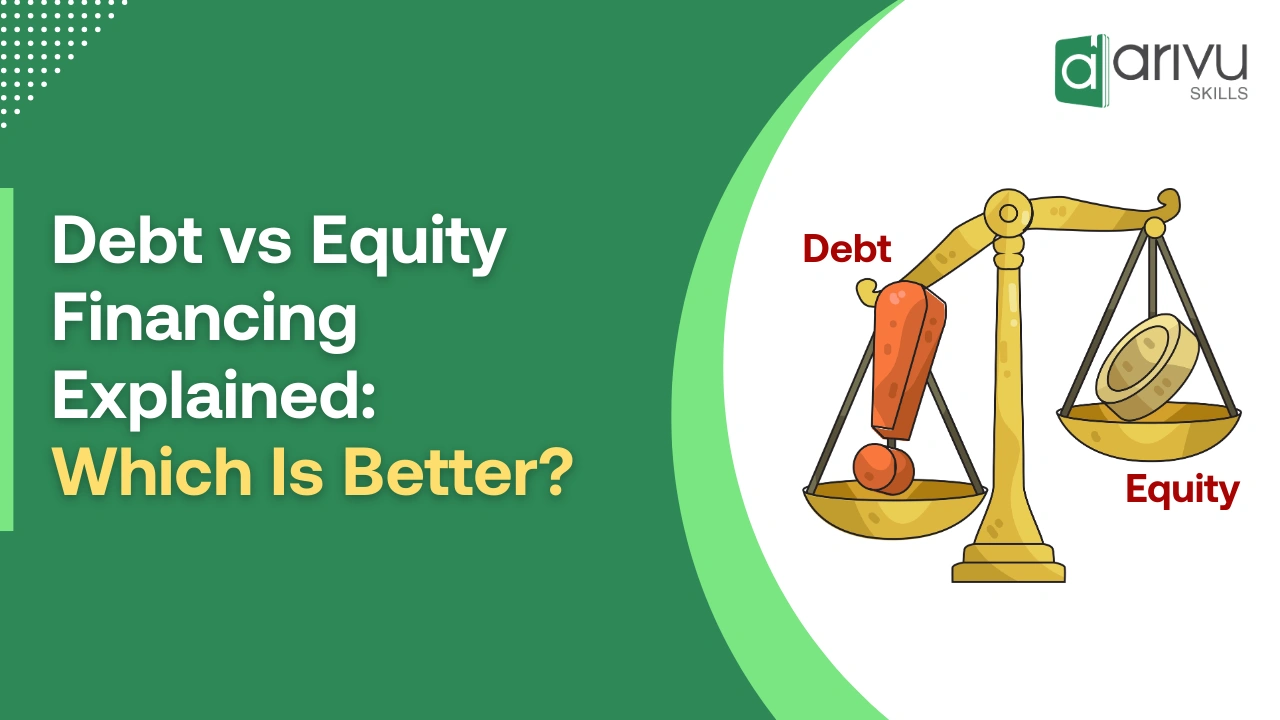
Debt vs Equity: A Side-by-Side Look
Think of it this way: debt financing is like renting money — you use it, pay for the privilege, and move on. Equity financing is like taking on a business partner — they invest in you, but they’re now part of the story, for better or worse.
If your business generates steady, predictable revenue and you have decent credit, debt is often cheaper in the long run. You pay interest, you repay the principal, and that’s that. Your equity — your ownership — stays intact.
If you’re a startup with big ambitions but little revenue, equity financing might be your only real option. Lenders want proof you can repay; investors bet on potential.
Which One Is Actually Better?
Here’s the truth: there’s no universal winner. The right choice depends on your specific situation.
Choose debt financing if you have predictable cash flow, want to keep full control, and can comfortably handle monthly repayments. It’s great for established businesses funding specific, measurable projects — like buying equipment or expanding inventory.
Choose equity financing if you’re pre-revenue or early stage, need a large amount of capital that debt can’t cover, or would benefit from the connections and expertise investors bring. It’s the go-to path for tech startups and companies chasing rapid growth.
Many successful businesses use both — a mix called the ‘capital structure.’ They’ll take on some debt for day-to-day needs while bringing in equity investors for major growth phases. Getting this balance right is one of the core skills of financial management.
Quick Decision Checklist
- Do you have reliable monthly revenue? Debt might work well.
- Are you a pre-revenue startup? Equity is likely your best bet.
- Do you want to keep full control? Lean toward debt.
- Do you need mentorship and network access? Equity investors offer that.
- Is the funding for a short-term, specific need? Debt is cleaner.
- Are you aiming for rapid, aggressive growth? Equity gives you the runway.
FAQs
Yes, and many businesses do. Using a combination — known as a blended capital structure — lets you take advantage of both. You might use a bank loan for operational costs while bringing in an angel investor for a major expansion. The key is making sure your total repayment obligations don’t strain your cash flow.
Not necessarily, but it depends on the deal. Giving up a small percentage to an investor usually doesn’t affect day-to-day control. However, if you sell a majority stake or give investors board seats, they may have significant influence over decisions. Always read the term sheet carefully and understand what rights come with the equity you’re selling.
It carries a specific kind of risk: the obligation to repay regardless of business performance. If revenue dips, you still owe that monthly payment. Taking on too much debt too quickly is a common reason small businesses fail. That said, managed carefully, debt is a powerful and affordable growth tool.
Requirements vary by lender and loan type. Traditional bank loans typically want a personal credit score of 680 or higher. SBA loans may accept scores around 620 to 640. Alternative lenders and online platforms can be more flexible, though they usually charge higher interest rates. Building your business credit history early makes this easier down the line.
Equity investors profit in two main ways: dividends (a share of profits paid out regularly) and capital gains (when the business is sold or goes public at a higher valuation than when they invested). Most venture capitalists and angel investors are betting on that big exit — an acquisition or IPO where their stake becomes worth far more than they put in.