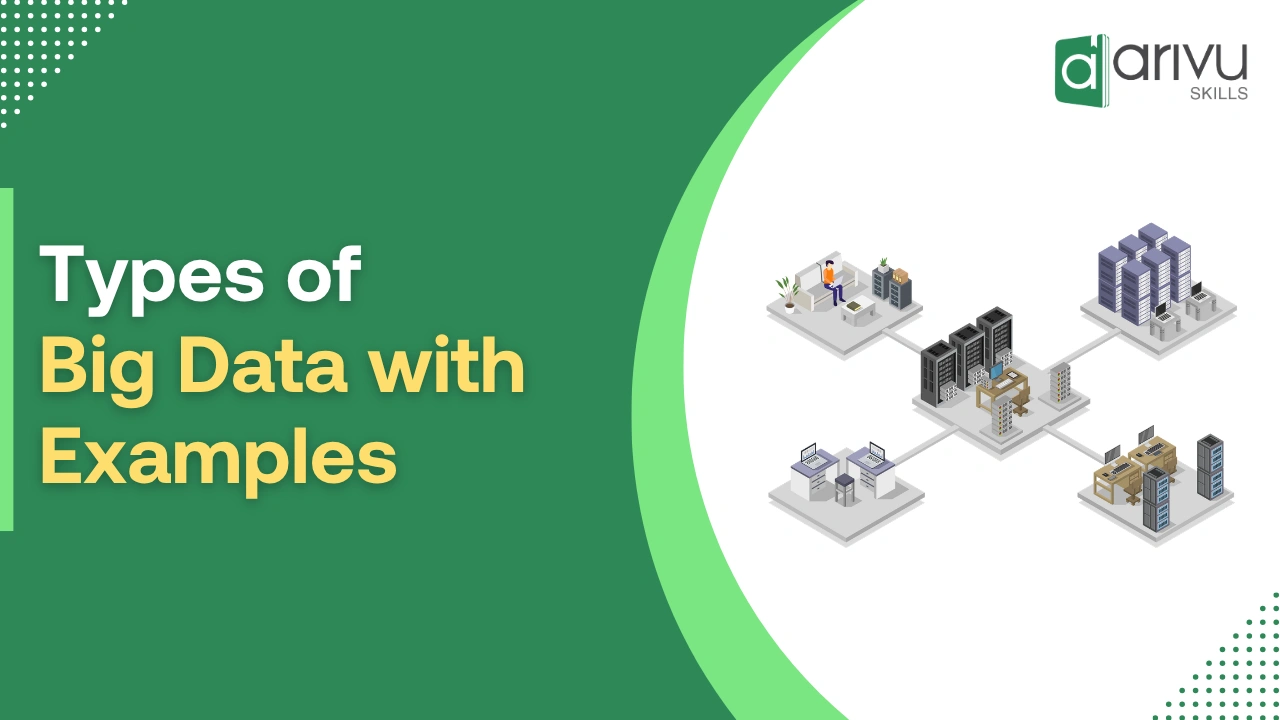

The types of data in big data are broadly classified as structured, semi‑structured, and unstructured data. These data types differ in format, sources, storage methods, and how they are analysed, but together they form the foundation of modern big data systems.
If you’ve ever ordered food at 2 AM, binge-watched a show you didn’t plan to, or received an eerily accurate product recommendation, you’ve already interacted with big data. Not in an abstract, technical sense, but in a deeply personal, almost invisible way.
What most people don’t realise is that behind these experiences lies not just “data,” but different types of data in big data, each behaving differently, each requiring different tools, and each telling a different version of the truth.
Understanding these types isn’t just for data scientists. It’s for anyone trying to understand how decisions are made today, by companies, by algorithms, and sometimes, even by the systems shaping your own choices.
What Is Big Data?
Big data refers to large, complex datasets that traditional data processing systems struggle to handle efficiently. These datasets are characterised by:
- Volume – massive quantities of data
- Variety – multiple data formats
- Velocity – continuous data generation
- Veracity – data quality and reliability
- Value – meaningful insights derived
The first step to working with big data is understanding what kind of data you are dealing with, because analysis methods, tools, and storage systems depend heavily on data type.
What Are the Types of Data in Big Data?
The types of data in big data are typically grouped into three main categories:
- Structured data
- Semi‑structured data
- Unstructured data
Each plays a distinct role in analytics pipelines and business decisionmaking.
Structured Data: Definition and Examples
What is Structured Data?
Structured data is highly organised, stored in fixed formats such as tables with predefined schemas. This data is easy to query, analyse, and validate. Think of it like an Excel sheet which has rows, columns and predictable patterns.
Your bank statement is structured data. Your employee ID, your salary, your transaction history, everything sits neatly in a format that can be queried, filtered, and analysed within seconds. It gives a sense of control, order, logic.
Structured data forms the backbone of business reporting and traditional analytics, which is why SQL and databases remain foundational skills in any data analytics course in Chennai focused on career readiness.
Build strong data foundations with Arivu Skills’ data analytics course in Chennai
Semi‑Structured Data: Definition and Examples
What is Semi‑Structured Data?
Semi‑structured data does not fit neatly into tables. It provides flexibility while still retaining some structure.
Semi-structured data sits somewhere in between order and chaos. It doesn’t fit into rigid tables, but it isn’t completely unorganised either. It carries markers like tags, labels, metadata that give it some form, even if it isn’t immediately obvious.
Emails are a good example. There’s a structure like the sender, the timestamp, the subject, but the actual content can vary wildly. Or take something like app activity logs. Every time you open an app, scroll, pause, or exit, tiny pieces of data are generated. These don’t sit in neat tables, but they still carry patterns like our social algorithm. This is where businesses begin to move from observation to interpretation.
Common Characteristics
- Schema is flexible or evolving
- Uses tags, keys, or metadata
- Requires parsing before analysis
Examples of Semi‑Structured Data
- JSON files
- XML data
- API responses
- Log files
Semi-structured data allows systems to adapt. It can handle variability, something structured data struggles with. It’s also what powers a lot of modern applications.
When you see your Spotify playlist update dynamically or your Instagram feed subtly shift based on what you engage with, you’re looking at semi-structured data in action. It’s not perfect, it still needs processing. But it’s flexible and flexibility, in data, is power.
Unstructured Data: Definition and Examples
What is Unstructured Data?
If structured data is neat and semi-structured is flexible, unstructured data is everything else. Unstructured data has no predefined format or schema. It represents the largest share of big data generated today.
Common Characteristics
- No fixed structure
- Difficult to analyse directly
- Requires advanced processing techniques
Examples of Unstructured Data
- Emails
- Social media posts
- Images and videos
- Audio recordings
A customer review that says, “The product is good but didn’t feel worth the price” carries more nuance than a 3-star rating ever could. A 10-second pause on a video tells a different story than a simple “view” metric.
A tweet, a reel, a comment thread, these are messy, emotional, contextual. They don’t follow rules and that’s exactly why they matter. The challenge, of course, is that unstructured data is incredibly difficult to analyse.
You can’t just run a simple query and get answers. You need advanced tools like machine learning models, natural language processing and image recognition. But once you unlock it, you move from data to understanding.
Comparison Table: Types of Data in Big Data
| Data Type | Structure | Storage | Examples | Analysis Complexity |
| Structured | Fixed schema | Databases | Transactions, CRM data | Low |
| Semi‑Structured | Flexible schema | NoSQL, files | JSON, XML | Medium |
| Unstructured | No schema | Data lakes | Text, images, videos | High |
Understanding this distinction determines which tools, technologies, and skills are required at each stage.
Sources of Big Data in the Real World
To really understand the types of data in big data, you have to look at where this data is coming from. Because data doesn’t just appear. It’s generated, constantly, often without us even noticing. Understanding sources of big data is just as important as understanding data types.
Common Sources of Big Data
| Source Category | Examples |
| Business Systems | ERP, CRM, billing systems |
| Digital Platforms | Websites, apps, e‑commerce |
| Sensors & IoT | Smart devices, wearables |
| Social Media | Posts, comments, reactions |
| Multimedia | Images, video, audio |
| Transactional | UPI, Subscription, online orders |
| Machine Generated | Server logs, system events, error reports |
Many of these sources produce semi‑structured or unstructured data, which is why modern analytics roles demand more than spreadsheet skills. This is where comprehensive programs like a data analytics course in Bangalore help learners work across multiple data formats, not just structured tables.
Learn to work with real-world big data at Arivu Skills data analytics course in Bangalore
Big Data Diagram: From Data Source to Insight
Below is a conceptual big data diagram explained in text form:
Data Sources → Data Ingestion → Storage → Processing → Analytics → Insights
| Stage | What Happens |
| Data Sources | Structured, semi‑structured, unstructured data generated |
| Ingestion | Data collected via APIs, streams, batch jobs |
| Storage | Stored in data warehouses or data lakes |
| Processing | Cleaned, transformed, enriched |
| Analytics | Patterns, trends, predictions extracted |
| Insights | Business decisions and actions |
Each stage requires different tools and skills depending on the type of data in big data being handled.
Let’s take something as everyday as ordering food. When you open a delivery app:
Your account details and past orders → structured data
Your browsing behaviour and app interactions → semi-structured data
Your reviews, ratings, and uploaded photos → unstructured data
Data help the app decide what to show you, when to show it, and how to make you come back.
Why Understanding Big Data Types Matters
Understanding the types of data in big data is not just about classification.
It’s about perspective as it changes how you look at systems, how you interpret behaviour, how you make decisions. Because once you realise that data is not just numbers but stories, patterns, and signals, you stop seeing it as a technical field. Many beginners focus on tools, professionals focus on data context.
Knowing data types helps you:
- Choose the right storage systems
- Apply correct processing methods
- Avoid incorrect analysis
- Design scalable data pipelines
This is why practical training at Arivu Skills emphasises data thinking, not just syntax, especially in industry‑aligned programs like a data analytics course in Coimbatore.
Develop end‑to‑end data skills with Arivu Skills data analytics course in Coimbatore
FAQs
Structured, semi‑structured, and unstructured data.
Unstructured data makes up the largest portion of data generated globally.
It offers flexibility and is widely used in modern applications like APIs and web analytics.
No. It remains critical for reporting, compliance, and core business analytics.
Increasingly yes, especially in roles involving text, social media, and customer feedback.
It captures human behaviour, sentiment, and context, which structured data cannot.
Social media, IoT devices, transactions, and machine-generated logs.
Yes, understanding all three is essential for working effectively in data analytics or data science.
SQL, Python, Hadoop, Spark, and Power BI are commonly used tools.