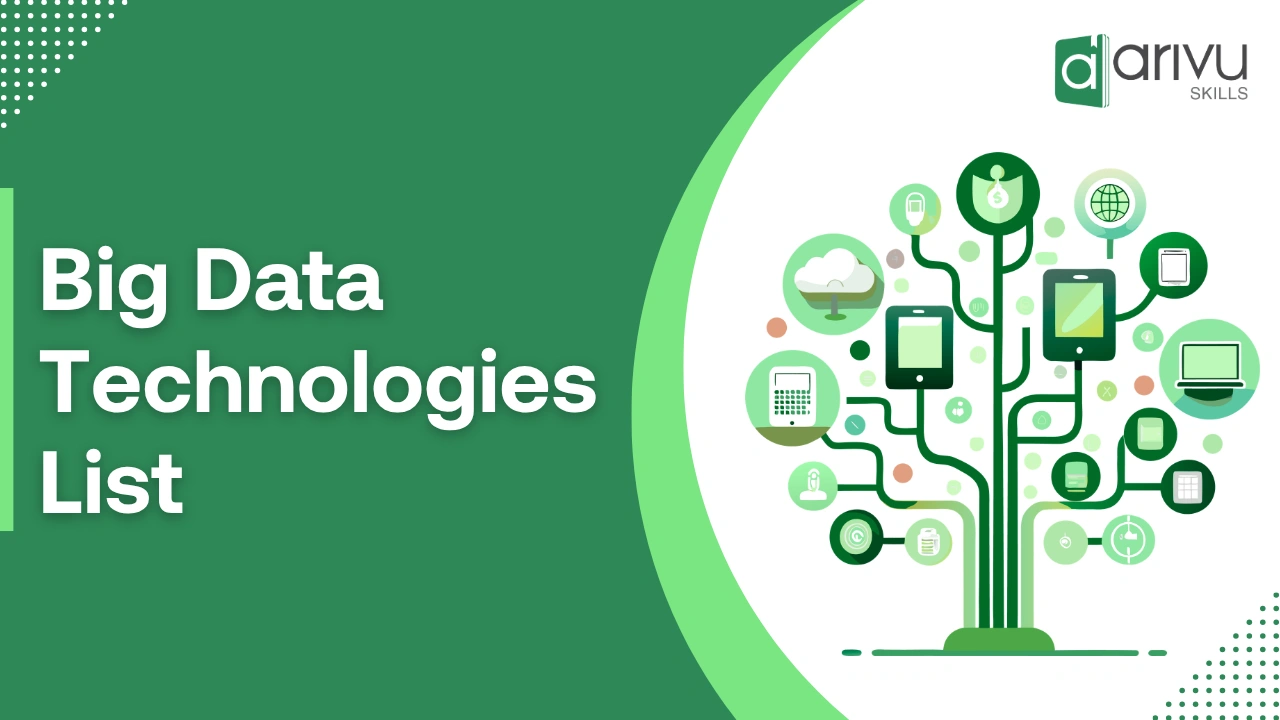

Big data technologies are tools and frameworks designed to store, process, analyse, and manage massive volumes of structured, semi‑structured, and unstructured data. They enable scalable data processing through distributed computing and form the foundation of modern analytics and data science systems.
There’s a strange gap between how we talk about data and how it actually works.
On the surface, everything sounds simple. But when you step even slightly closer, you realise something: none of this happens without a complex ecosystem of technologies working quietly in the background. And that ecosystem is what we call big data technologies.
With data growing exponentially from digital platforms, sensors, and business systems, traditional databases are no longer sufficient. This is why organisations rely on a wide ecosystem of big data technologies that support high‑volume, high‑velocity, and high‑variety data.
This guide explains the big data technologies list, their roles in big data computing, and how different big data tools work together in real‑world architectures.
Learn real big data computing concepts with Arivu Skills’ data analytics course in Chennai
What Are Big Data Technologies?
Big data technologies are a collection of systems and tools that enable:
- Distributed data storage
- Parallel data processing
- Real‑time and batch analytics
- Scalable data pipelines
Unlike traditional systems, big data platforms are designed to scale horizontally, meaning they can handle data growth by adding more machines rather than upgrading a single server.
At their core, these technologies solve one problem: How to extract value from massive datasets efficiently.
Why Are Big Data Technologies Important?
The importance of big data technologies lies in their ability to support data‑driven decision‑making at scale. Big data technologies exist because data today is too large to store on a single machine, too fast to process using conventional methods and too diverse to fit into one format.
This is where big data computing comes in, the idea that data processing needs to be distributed, scalable, and adaptable.
| Business Challenge | How Big Data Technologies Help |
| Data overload | Distributed storage handles volume |
| Slow processing | Parallel computing improves speed |
| Mixed data formats | Flexible data models |
| Real‑time decisions | Streaming analytics |
This is why industries such as banking, healthcare, e‑commerce, and telecommunications heavily rely on big data computing frameworks and big data tools.
Core Categories of Big Data Technologies
To avoid list‑based, basic explanations, it’s important to understand big data technologies by function, not just by name.
Major Categories:
- Big data computing frameworks
- Storage technologies
- Processing and analytics tools
- Streaming and integration tools
Each category plays a distinct role in the data lifecycle. Understanding this layered approach makes everything else easier to grasp.
Big Data Computing Frameworks
Big data computing refers to processing large datasets across multiple machines simultaneously.
Key Big Data Computing Technologies
| Technology | Purpose |
| Hadoop | Distributed storage and batch processing |
| Apache Spark | Fast, in‑memory data processing |
| Apache Flink | Stream and batch processing |
| Apache Storm | Real‑time event processing |
Hadoop
If there’s one name that comes up in every conversation about big data, it’s Hadoop.
Not because it’s the newest but because it fundamentally changed how data is handled.
Hadoop introduced the idea that you don’t need one powerful machine. You can use many smaller machines working together. This concept, distributed computing, is at the heart of big data computing.
Hadoop has two main components:
- HDFS (Hadoop Distributed File System) → stores massive data across multiple machines
- MapReduce → processes data in parallel
It’s not the fastest system today, but it laid the groundwork for everything that followed.
Apache Spark
If Hadoop was the starting point, Apache Spark is what made big data practical at scale. Spark processes data in memory, which makes it significantly faster than traditional systems.
But speed isn’t its only strength. Spark can handle batch processing, real-time data, machine learning and graph processing.
This versatility is why it has become one of the most widely used big data tools today.
It’s also where many professionals start transitioning from basic data analysis to more advanced workflows.
Apache Kafka
Data doesn’t just sit somewhere waiting to be analysed, it’s constantly moving.
Kafka is designed to handle that movement. It acts as a pipeline streaming data from one system to another in real time.
It acts as the nervous system of a data architecture. It collects data from multiple sources and distributes it to different systems and ensures nothing gets lost in the process. Kafka is what enables real-time applications like fraud detection or live analytics dashboards.
NoSQL Databases
Traditional databases rely on structured formats like rows and columns but as data became more complex, that structure became limiting.
This is where NoSQL databases come in. They are designed for flexibility. Instead of forcing data into rigid schemas, they adapt to the data itself. These systems are essential for handling semi-structured and unstructured data, something that’s increasingly common today.
Apache Hive
One of the challenges with big data is accessibility. You might have massive datasets, but if you can’t query them easily, they’re not very useful.
Hive solves this problem as it allows users to write SQL-like queries on top of large datasets stored in Hadoop.
This bridge between traditional querying and big data systems makes it easier for analysts to work with complex data environments.
Apache Flink
While Spark handles both batch and real-time data, Flink is built specifically for real-time processing.
It’s designed for scenarios where data needs to be processed instantly. It is used for monitoring financial transactions, detecting anomalies in systems or processing live user interactions. Flink represents a shift in how data is handled not after it’s stored, but as it’s generated.
Why They Matter
These frameworks allow organisations to process terabytes or petabytes of data efficiently. Spark, for example, dramatically reduces processing time compared to traditional batch frameworks.
Professionals often encounter these frameworks early in hands-on programs like a data analytics course in Chennai, where learners move beyond theory into real big data workflows.
Big Data Storage Technologies
Storage is the backbone of any big data system.
Common Big Data Storage Tools
| Tool | Storage Type |
| HDFS | Distributed file system |
| Amazon S3 | Cloud object storage |
| NoSQL Databases | Flexible data storage |
| Data Lakes | Centralised raw data storage |
Why Traditional Databases Fail
Relational databases struggle with scale and variety. Big data storage tools are designed to handle unstructured and semi‑structured data efficiently.
Big Data Processing and Analytics Tools
Once stored, data needs to be analysed.
Popular Big Data Analytics Tools
| Tool | Primary Use |
| Spark SQL | Structured data analysis |
| Hive | SQL‑like querying |
| Presto / Trino | Fast interactive queries |
| MLlib | Machine learning on big data |
These tools allow analysts and data scientists to query massive datasets using familiar interfaces, accelerating insight generation.
This is why analytics‑focused learning paths such as a data analytics course in Bangalore increasingly include exposure to big data tools, not just spreadsheets and SQL.
Build scalable analytics expertise with Arivu Skills’ data analytics course in Bangalore
Big Data Integration and Streaming Tools
Modern businesses don’t just analyse historical data—they act on data in real time.
Streaming and Integration Technologies
| Tool | Function |
| Apache Kafka | Real‑time data streaming |
| Apache NiFi | Data ingestion & flow management |
| Sqoop | Data transfer between systems |
| Airflow | Workflow orchestration |
E‑commerce platforms use Kafka to stream click events in real time, enabling instant personalisation and fraud detection.
Comparison Table: Big Data Technologies and Use Cases
| Category | Tools | Typical Use Case |
| Computing | Hadoop, Spark | Large‑scale processing |
| Storage | HDFS, S3 | Data lakes |
| Analytics | Hive, Spark SQL | Business analytics |
| Streaming | Kafka, Flink | Real‑time insights |
| Orchestration | Airflow | Pipeline automation |
This ecosystem approach is what makes big data systems flexible and powerful.
How Big Data Technologies Work Together
A simplified big data architecture looks like this:
Data Sources → Ingestion → Storage → Processing → Analytics → Insights
| Stage | Technologies Involved |
| Ingestion | Kafka, NiFi |
| Storage | HDFS, S3 |
| Processing | Spark, Flink |
| Analytics | Hive, Presto |
| Orchestration | Airflow |
Understanding this integration is far more valuable than memorising tool names.
That’s why comprehensive programs at Arivu Skills emphasise end‑to‑end understanding, especially for learners enrolled via a data analytics course in Coimbatore.
Learn how big data tools connect in practice with Arivu Skills data analytics course in Coimbatore
Skills Needed to Work With Big Data Tools
Working with big data technologies requires both technical and analytical skills.
| Skill Area | Why It Matters |
| Distributed systems | Understanding scale |
| SQL & Querying | Data access |
| Programming | Data processing logic |
| Data modelling | Efficient storage |
| Business context | Insight generation |
Professionals with this balanced skill set are in high demand across industries.
FAQs
Big data technologies are tools and systems used to store, process, and analyse large and complex datasets.
It refers to processing large datasets using distributed systems across multiple machines.
Hadoop, Spark, Kafka, Hive, and NoSQL databases are widely used.
Yes. Spark is widely used, often alongside Hadoop‑based storage systems.
No. Understanding concepts and architecture is more important initially.
Yes. Many analytics roles increasingly work with big data platforms.
Because of its speed, flexibility, and ability to handle multiple types of data processing.
No, it’s better to start with fundamentals and gradually specialise based on your career goals.