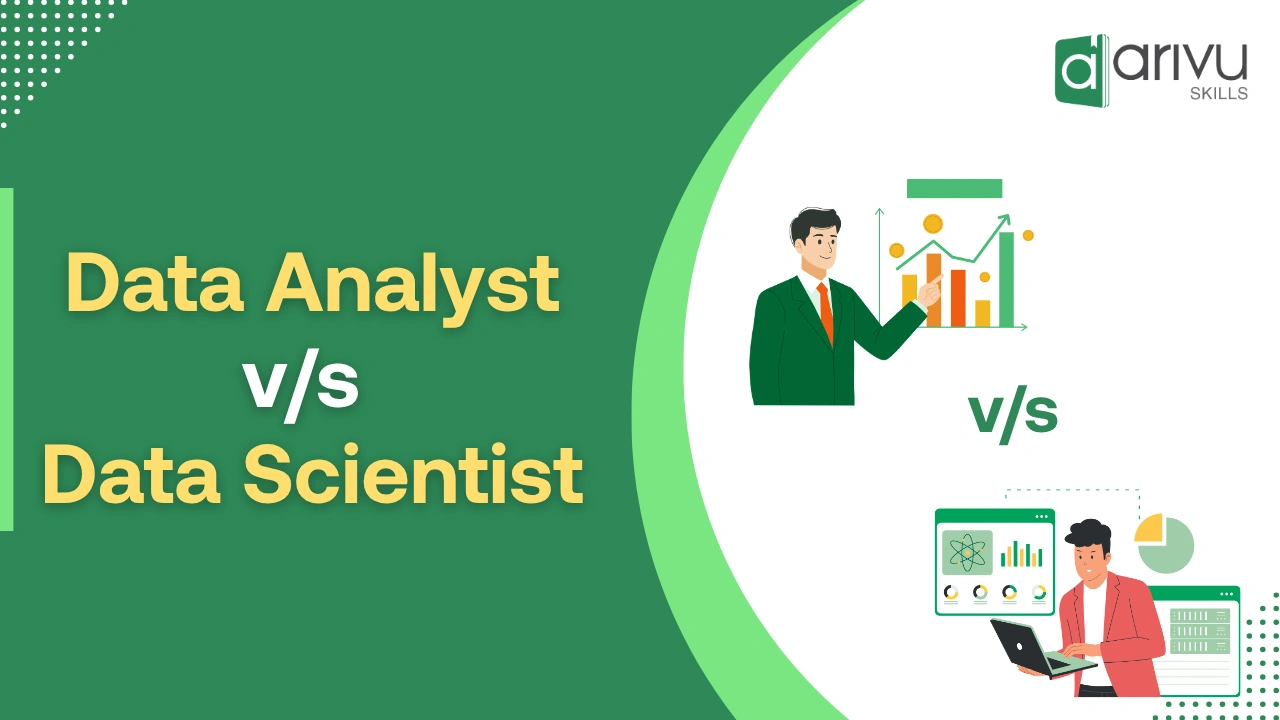

The data analyst vs data scientist distinction comes down to scope and depth. A data analyst focuses on understanding past and present data to support business decisions, while a data scientist builds predictive models and algorithms to influence future outcomes.
Both roles sit at the core of modern data science careers, but they demand different skills, mindsets, and career trajectories.
If you are considering a career in analytics, machine learning, or business intelligence, understanding the difference matters before you invest time in learning the wrong skill set. Want to build job-ready skills for either path? Explore industry-focused programs from Arivu Skills designed for real-world data science careers.
What Is a Data Analyst?
A data analyst interprets structured data to help organizations make better decisions.
They focus on analyzing trends, building reports, creating dashboards, and solving business problems using historical and current data.
Typical responsibilities include:
- Collecting and cleaning datasets
- Writing SQL queries
- Analysing historical trends
- Building dashboards and reports
- Explaining insights to stakeholders
- Identifying trends and anomalies
- Creating reports for stakeholders
- Supporting business decisions with insights
- Common Data Analyst Tools
Most of a data analyst’s work sits in the descriptive and diagnostic analytics layer, helping businesses understand performance and make informed decisions.
Data analysts often use tools like SQL, Excel, Python, Power BI, Tableau, Google Analytics, R (sometimes).
A retail company wants to know why sales dropped. A data analyst might analyze regional sales trends, identify underperforming product categories and compare seasonal patterns. A data analyst builds a dashboard for leadership and recommends pricing or inventory changes. This is descriptive and diagnostic analytics in action.
Learn in-demand skills like Python, ML, and data visualization with our Data Science Course in Bangalore.
What Is a Data Scientist?
A data scientist works at a deeper, more experimental layer. A data scientist combines analytics, statistics, programming, and machine learning to solve more advanced problems. While analysts often explain what happened, data scientists often predict what may happen.
Data scientists often build systems that scale decisions, fraud detection models, recommendation engines, or demand forecasting pipelines.
Data scientists responsibilities typically include:
- Designing predictive models
- Working with structured and unstructured data
- Applying machine learning techniques
- Running experiments (A/B testing)
- Automating decision systems
- Forecasting trends
Common data scientist tools often used are Python, SQL, R, TensorFlow, Scikit-learn Pandas, Spark, Jupyter etc.
The same retail company wants to predict which customers may churn. A data scientist may build a churn prediction model and train machine learning algorithms.
A data scientist identifies risk signals and automates retention recommendations.
That moves from analysis into prediction. This role usually requires stronger foundations in statistics, mathematics, and programming.
Upgrade your skills and salary potential with a professional Data Science Course in Chennai.
Data Analyst vs Data Scientist: Core Differences
1. Scope of Work
Data Analysts focuses on reporting insights, business intelligence and trend analysis
Data Scientist on the other hand focuses on prediction, machine learning, advanced modeling and automation.
2. Questions They Answer
Data Analyst answers questions like what happened and why?
Data Scientist answers questions like what will happen next, what should we optimise and can this decision be automated.
3. Complexity
Data analyst work is often less mathematically intensive whereas data science often requires Probability, Statistics, Modeling, Algorithms and Machine learning concepts.
4. Business vs Technical Orientation
Analysts often sit closer to business teams. Data scientists often work closer to engineering and AI systems.
Step into top roles with our job-oriented Data Science training in Coimbatore.
Data Analyst vs Data Scientist Key Skills Differences
Data Analyst Skills
- SQL and Excel
- Data cleaning and preparation
- Descriptive statistics
- Data visualisation (Power BI, Tableau)
- Business communication
- Dashboarding
- Basic statistics
- Business communication
Data Scientist Skills
- Advanced statistics and probability
- Python/R for modelling
- Machine learning algorithms
- Feature engineering
- Big data tools and cloud platforms
- Model evaluation
- Data engineering fundamentals
Overlapping Skills
- SQL
- Data cleaning
- Problem-solving
- Critical thinking
- Communication
This overlap is why many analysts transition into data science later.
Tools and technologies compared
| Area | Data Analyst | Data Scientist |
| Databases | SQL | SQL + NoSQL |
| Programming | Excel, SQL, Python | Python, R |
| Visualisation | Tableau, Power BI | Matplotlib, Seaborn |
| Modelling | Basic statistics | Machine learning |
| Scope | Business reporting | Predictive systems |
While tools may overlap, intent differs: analysts explain data; scientists operationalise it.
Data Analyst Salary vs Data Scientist Salary
Data analyst salary and data scientist compensation vary by location, experience, and industry.
Data Analyst Salary (India)
- Entry‑level analysts typically earn ₹4–6 LPA
- Mid‑level professionals earn higher with experience
- Senior analysts can reach significantly higher bands depending on skills and company type.
Data Scientist Salary
Multiple industry sources note that data scientists generally command higher compensation due to the complexity of their role and technical depth.
However, salary outcomes vary widely based on:
- Skill stack
- Domain expertise
- Ability to work on production‑grade systems
Career Growth in Data Science Roles
One of the most important realities of data science careers is flexibility.
Common career paths include:
- Data Analyst → Senior Analyst → Data Scientist
- Data Analyst → Analytics Manager → Product/Data Lead
- Data Scientist → ML Engineer → AI Specialist
Many professionals begin as analysts and transition into data science by strengthening programming and machine learning foundations.
For many beginners, data analyst roles are often more accessible. They usually require fewer advanced math concepts, less machine learning knowledge, shorter learning path and faster portfolio development. This makes data analytics a common entry point into data science careers.
Many professionals move through this path:
Data Analyst → Senior Analyst → Data Scientist → ML Specialist
That progression is common. Both careers have strong growth but growth depends on your goals.
Choose Data Analyst if you enjoy solving business problems, working with dashboards, telling stories with data, partnering with business teams and entering the field faster.
Choose Data Scientist If you enjoy statistics, programming, building predictive models
machine learning, solving complex technical problems.
Data Analyst vs Data Scientist: Education Requirements
You do not always need a traditional degree to enter either role.
Increasingly, employers value practical projects, portfolio quality, tool proficiency, real-world problem-solving. This is changing how people enter data science careers.
For Data analyst roles build projects such as sales dashboards, customer churn analysis, marketing performance analysis and SQL case studies.
For Data scientist roles build projects such as fraud detection models, recommendation systems, forecasting models and classification problems.
Projects often matter more than certificates alone.
Arivu Skills helps learners build practical pathways into analytics, machine learning, and advanced data science careers through project-driven training.
Common Misconceptions About Data Analyst vs Data Scientist
Misconception 1: Data scientists are just senior analysts.
Not exactly, the roles overlap, but responsibilities often differ.
Misconception 2: You must become a data scientist eventually.
False, Many analysts build excellent long-term careers.
Misconception 3: Data science always pays more.
Not always, specialized analysts in product, finance, or strategy can earn extremely well.
Summary
- Data analysts focus on reporting, dashboards, and business insights.
- Data scientists focus on prediction, machine learning, and advanced modeling.
- Data analyst roles are often easier for beginners to enter.
- Data scientist roles often offer higher compensation, though specialization matters.
- Both offer strong opportunities in growing data science careers.
- Many professionals start as analysts and transition into data science.
Ready to start a career in analytics or data science? Explore Arivu Skills programs built around practical projects, job-ready tools, and real-world data science careers.
FAQs
A data analyst focuses on analyzing data and generating insights, while a data scientist often builds predictive models and machine learning solutions.
In many cases, data scientists earn more, though specialized analysts can also command strong salaries.
For beginners, data analyst roles are often easier to enter because they usually require less advanced math and machine learning.
Yes. Many professionals transition from analytics into data science by building machine learning and advanced modelling skills.
Many beginners start with data analyst roles because they offer a more accessible entry point.
Start with SQL, Python, statistics, projects, and structured practical training through platforms like Arivu Skills.