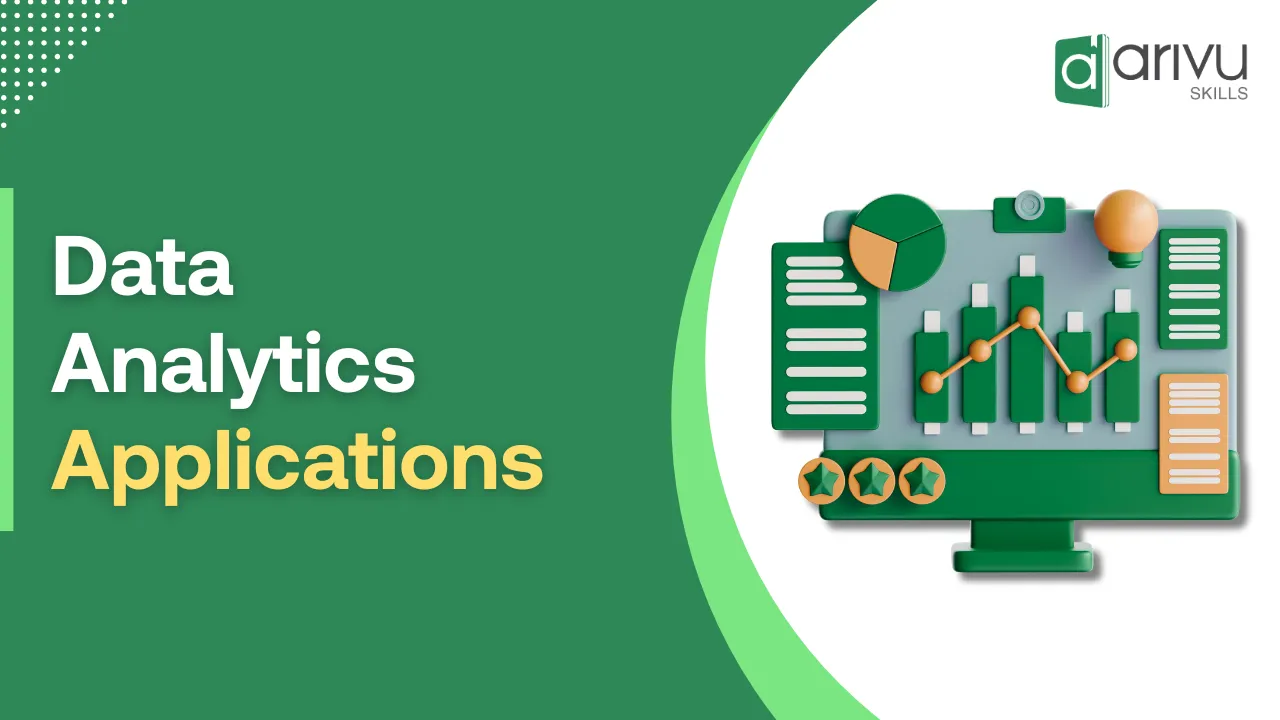

Data analytics applications refer to the real-world use of data analysis to improve decision-making, optimize processes, predict outcomes, and drive business growth. The uses of data analytics span industries such as finance, healthcare, retail, marketing, and operations.
Most people interact with data analytics dozens of times a day without ever noticing it. In today’s economy, data is not just a byproduct, it is a strategic asset. But raw data alone doesn’t create value. What matters is how organizations apply analytics to convert data into measurable business outcomes.
For years, data was treated like storage. Something businesses collected and archived. Today, it has become something entirely different. It has become a decision-making engine. That shift has changed industries, careers, and even the way ordinary people experience technology.
This guide goes beyond basic use cases and explores how data analytics applications actually influence decisions, operations, and strategy in real-world environments.
What Are Data Analytics Applications?
Data analytics is the process of examining information to uncover patterns, trends, and insights that help people make better decisions.
Data analytics applications refer to practical implementations where data is analysed to:
- Solve specific business problems
- Identify patterns and trends
- Support decision-making
- Automate and optimise processes
Unlike theory-heavy definitions, applications focus on outcomes, what actions or improvements result from analysing data.
The interesting part is that analytics is no longer limited to tech companies. The uses of data analytics now stretch across almost every industry imaginable.
A company analysing customer purchase data to identify high-value segments is using data analytics in a targeted, application-driven way.
In essence analytics becomes valuable only when it leads to action.
Why Are Data Analytics Applications Important?
The modern world runs on information but information alone is not useful. The value comes from interpretationOrganizations generate massive volumes of data every day. Without analytics, this data remains underutilised.
Analytics transforms raw numbers into insights, predictions, strategies and decisions. That’s why businesses across industries are investing heavily in analytics capabilities.
Not because it’s trendy, but because it has become necessary. The organisations that understand data effectively move faster, adapt better, and make smarter decisions.
| Business Challenge | Role of Data Analytics |
| Unclear decision-making | Provides evidence-based insights |
| Rising costs | Identifies inefficiencies |
| Customer churn | Enables predictive intervention |
| Market competition | Supports strategic advantage |
The real importance of data analytics applications lies in improving decision quality, not just generating reports.
Professionals who understand this shift toward decision-first analytics are increasingly in demand, often built through structured programs like a data analytics course in Chennai, where learners solve real business problems rather than theoretical exercises.
Learn application-focused analytics with Arivu Skills’ data analytics course in Chennai
How Data Analytics Is Used Across Industries
Understanding the uses of data analytics requires looking at industry-specific applications.
1. Healthcare
Hospitals and healthcare systems now use analytics to identify risks before they become visible symptoms.
Patient records, wearable devices, medical histories, and diagnostic reports generate enormous amounts of information. When analysed together, they reveal patterns that humans alone might miss.
Healthcare systems use data analytics to:
- Predict diseases
- Optimise treatments
- Manage hospital resources
This allows healthcare professionals to move toward preventive care instead of simply responding to illness after it appears.
And beyond treatment, analytics is also improving hospital operations along with managing inventory and optimising staff allocation
Impact: Better patient outcomes and reduced operational costs.
2. Banking & Finance
Financial institutions process millions of transactions every day. Within those transactions lies a constant challenge: identifying risk without slowing down the system. This is where analytics becomes essential.
Data analytics applications include:
- Fraud detection
- Credit scoring
- Risk modelling
- Monitor spending patterns
- Predict financial trends
If a transaction suddenly appears, unusual analytics systems flag it instantly.
Humans cannot manually analyse transactions at this scale, analytics systems can.
And as financial behaviour evolves, these systems continue learning, adapting to new patterns over time.
Impact: Increased security and improved financial decision-making.
3. Retail & E‑Commerce
Online shopping platforms are some of the most advanced users of data analytics.
Retailers rely on analytics for:
- Personalised recommendations
- Demand forecasting
- Inventory management
- Predict purchasing patterns
- Improve product placement
- Reduce cart abandonment
When Amazon recommends products or Myntra curates your homepage, those suggestions are not random. They are built on layers of behavioural analysis designed to increase engagement and improve conversion rates. This is one of the most commercially valuable uses of data analytics.
Impact: Higher sales and improved customer experience.
4. Marketing & Advertising
Streaming platforms like Netflix, Spotify, and YouTube rely heavily on analytics.
Not just to track what people watch, but to understand why they stay engaged.
Analytics is used to:
- Measure campaign effectiveness
- Optimise ad spending
- Understand customer behaviour
- Conversion rates
- Customer journeys
This information helps platforms personalise recommendations and retain user attention. Analytics allows these companies to understand not just content preferences, but emotional engagement patterns.
Impact: Better ROI and targeted engagement.
5. Operations & Supply Chain
Companies use analytics to:
- Forecast demand
- Optimise routes
- Improve logistics efficiency
Impact: Reduced costs and improved delivery performance.
Key Types of Data Analytics Applications
To move beyond basic content, it’s important to classify applications by type of analysis performed.
| Type | Application |
| Descriptive Analytics | Reporting what happened |
| Diagnostic Analytics | Understanding why it happened |
| Predictive Analytics | Forecasting future outcomes |
| Prescriptive Analytics | Recommending optimal actions |
Most businesses begin with descriptive analytics, but real competitive advantage comes from predictive and prescriptive applications.
This is why modern analytics training such as a data analytics course in Bangalore, focuses on decision frameworks and predictive thinking.
Master advanced analytics applications with Arivu Skills’ data analytics course in Bangalore
Business Use Cases of Data Analytics
To make this practical, let’s look at how data analytics applications translate into business decisions.
Use Case 1: Customer Segmentation
Companies analyse customer data to group users based on:
- Behaviour
- Spending patterns
- Preferences
The outcome is targeted marketing and higher conversion rates.
Use Case 2: Revenue Optimization
Analytics identifies:
- Top-performing products
- Price sensitivity
- Revenue drivers
The outcome is Improved profitability.
Use Case 3: Fraud Detection
Financial systems analyse transactions to detect:
- Abnormal activity
- Risk signals
The outcome is reduced financial losses.
Use Case 4: Predictive Maintenance
Manufacturers use analytics to:
- Predict equipment failures
- Schedule maintenance
The outcome is lower downtime and cost savings.
Use Case 5: Workforce Analytics
Companies use data to evaluate:
- Employee performance trends
- Attrition risks
The outcome is improved talent management.
Tools That Power Data Analytics Applications
Applications rely on a mix of tools depending on complexity and scale.
| Category | Tools |
| Data Querying | SQL |
| Analysis | Excel, Python |
| Visualization | Power BI, Tableau |
| Big Data | Spark, Hadoop |
However, tools alone are not enough. The real value lies in choosing the right metrics and understanding context to translate insights into decisions.
Learning programs like those at Arivu Skills emphasize this practical approach, especially in job-oriented tracks like a data analytics course in Coimbatore.
Gain hands-on analytics experience with Arivu Skills data analytics course in Coimbatore
Skills Required for Data Analytics Applications
To effectively apply analytics, professionals need a blend of technical and business skills.
| Skill | Importance |
| Data Handling | Working with real datasets |
| Analytical Thinking | Identifying patterns |
| Business Understanding | Framing relevant questions |
| Visualization | Communicating insights |
| Problem-Solving | Driving action |
The strongest professionals are those who can connect analysis to outcomes, not just generate numbers.
How to Build a Career in Data Analytics
A typical career path in analytics applications includes:
- Entry-level reporting roles
- Data analyst / business analyst
- Domain-specialised analyst
- Analytics manager or consultant
Career growth depends on ability to solve business problems and communication skills along with real-world application experience.
In short, companies hire analysts who can drive impact, not just analysis.
The Human Side of Analytics
One of the biggest misconceptions about analytics is that it removes human judgement. In reality, it enhances it. Analytics does not replace decision-making. It improves the quality of decisions by reducing uncertainty.
At its best, analytics is not about algorithms taking over, it’s about humans understanding complexity more clearly. And that’s why the field continues to grow, not just technically, but strategically.
For learners looking to build skills that align with this evolving landscape, a data analytics course from Arivu Skills can provide a structured path into the world of analytics, visualisation, and business intelligence.
FAQs
Data analytics applications refer to the use of analytics techniques and tools to solve problems, improve decisions, and uncover insights across industries.
Businesses use data analytics for customer insights, fraud detection, marketing optimisation, inventory management, and forecasting.
Healthcare, finance, retail, transportation, education, and entertainment are major users of data analytics.
No. Even small businesses increasingly use analytics to improve efficiency and decision-making.
A mix of SQL, analytical thinking, business understanding, and communication skills.
It helps organisations make faster, smarter, and more accurate decisions using real-time information.
Yes, demand for data analysts continues to grow across industries due to increasing reliance on data-driven decision-making.