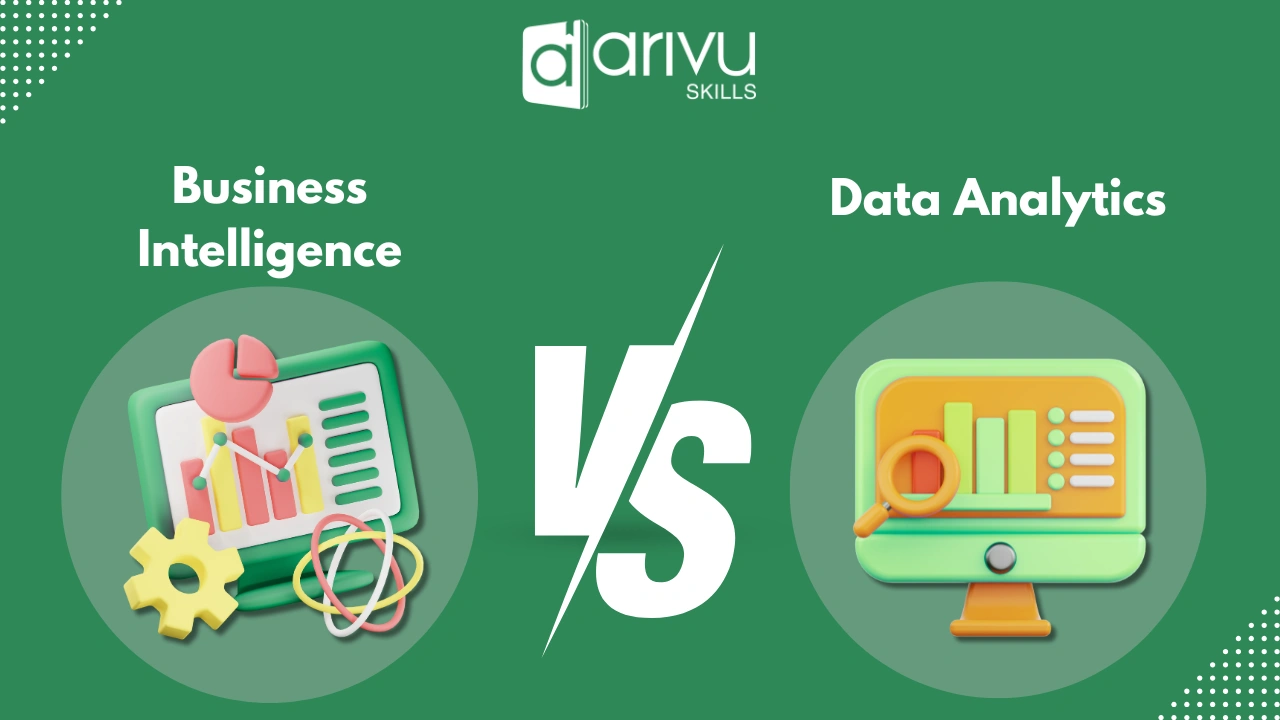

Business Intelligence (BI) is about making sense of what has already happened in your business, clearly and quickly. It focuses on organizing, and visualizing historical data so teams can make informed decisions using dashboards and reports.
Data Analytics on the other hand, goes a step further. It is about digging into data to understand patterns, predict what might happen next, and decide what to do about it.
BI looks back so you can understand, analytics looks ahead so you can act.
Business Intelligence (BI) focuses on what has already happened and why, using structured data and dashboards for decision-makers. Data Analytics, on the other hand, goes deeper, predicting what will happen next and recommending what to do.
The two often overlap, share tools, and are sometimes used interchangeably, but in reality, they solve very different problems inside a business.
This guide breaks down the BI vs data analytics difference in a practical, industry-relevant way, so you can confidently decide which skillset, role, or learning path fits your career goals.
Explore a job-focused learning path with Arivu Skills’ data analytics course in Chennai
What Is Business Intelligence?
Business Intelligence is all about making sense of structured data. It transforms raw business data into meaningful insights through dashboards, reports, and visualizations.
Think of BI as your organisation’s reporting layer, the place where raw numbers finally start making sense. It doesn’t predict the future but explains the past clearly enough for better decision-making.
Business Intelligence (BI) refers to the processes, tools, and technologies used to transform historical and current business data into actionable insights.
Business Intelligence answers questions like:
- What were last quarter’s sales?
- Which region underperformed?
- How is this month tracking against targets?
BI works best when data is structured, clean, and repeatable, making it ideal for day-to-day decision-making and performance tracking.
Core Functions of BI include data collection and integration, reporting and visualization, KPI tracking and dashboard creation.
A retail chain uses BI dashboards to track:
- Daily revenue by store
- Inventory levels
- Category-wise sales performance
This allows managers to monitor business health in real time, without digging into complex data models.
What Is Data Analytics?
Data Analytics takes things further. It doesn’t stop at understanding what happened, it digs into why it happened and what will happen next.
It involves examining raw data to discover patterns, predict trends, and recommend actions. It often includes statistical analysis, forecasting, and machine learning.
Data Analytics uses advanced techniques like statistical modeling, machine learning and data mining to go beyond surface-level insights.
Data analytics answers questions like:
- Why are customer churn rates increasing?
- What will sales look like in the next 6 months?
- Which customers are most likely to convert?
Unlike BI, data analytics can handle both structured and unstructured data, and it’s heavily used in strategy, product, marketing, and innovation teams. Analytics isn’t just about clarity, it’s about direction.
Business Intelligence vs Data Analytics: Core Differences
Here’s a clear, non-basic comparison table highlighting the BI vs data analytics difference:
| Feature | Business Intelligence | Data Analytics |
| Primary Focus | Past & present insights | Future predictions & optimization |
| Core Question | “What happened?” | “What will happen & why?” |
| Goal | Reporting & Monitoring | Insight Generation |
| Data Type | Structured, clean data | Structured & unstructured data |
| Output | Dashboards, reports | Models, forecasts, insights |
| Users | Managers, executives | Analysts, scientists, strategists |
| Tools | Tableau, Power BI | Python, R, SQL |
| Complexity | Moderate | Advanced |
| Business Impact | Operational efficiency | Strategic transformation |
BI vs Data Analytics Difference by Use Case
Understanding business intelligence vs data analytics becomes easier when you look at real-world scenarios.
Business Intelligence Use Cases
- Monthly performance reporting
- Sales and revenue tracking
- Operations monitoring
- KPI dashboards for leadership
Data Analytics Use Cases
- Demand forecasting
- Customer segmentation
- Fraud detection
- Recommendation systems
BI helps businesses understand performance whereas Data analytics helps businesses change future outcomes. BI helps businesses stay informed, Data Analytics helps them stay ahead.
Tools Used in Business Intelligence vs Data Analytics
Tools also reflect the philosophical difference between BI and analytics.
| Category | Business Intelligence Tools | Data Analytics Tools |
| Visualization | Power BI, Tableau, Looker | Tableau, Plotly, Matplotib, Seaborn |
| Data Handling | SQL, Excel | Python, R, SQL |
| Modeling | Minimal | Advanced |
| Automation | ETL pipelines | ML pipelines |
| Big Data | Limited | Hadoop, Spark |
| Machine Learning | Not used | Core component |
Someone trained in BI focuses on data storytelling for decision-makers, while a data analyst focuses on extracting insights through analysis and modeling.
BI tools prioritize ease of use and on the other hand Data Analytics tools prioritize depth and flexibility.
Skills Required for BI vs Data Analytics Roles
Business Intelligence Skill Set
- SQL & relational databases
- Data visualization
- KPI frameworks
- Business communication
- Stakeholder reporting
Data Analytics Skill Set
- Python / R programming
- Statistics & probability
- Predictive modeling
- Data cleaning & transformation
- Business problem framing
- Machine learning basics
This is why many people naturally start with BI and then move into analytics once they are comfortable.
If you’re considering upgrading from dashboards to deeper insights, enrolling in a structured data analytics course in Chennai can help bridge that exact gap with hands-on practice and real business cases.
Career Paths: Business Intelligence or Data Analytics?
Your choice depends less on “which is better” and more on how you want to work with data.
| Preference | Better Fit |
| Love dashboards & reporting | Business Intelligence |
| Enjoy problem-solving & math | Data Analytics |
| Want fast business impact | BI |
| Want long-term strategic roles | Analytics |
Many professionals eventually combine both skills, becoming analytics translators who connect data teams with decision-makers.
If you’re eyeing tech and analytics roles in startup ecosystems, a structured data analytics course in Bangalore can give you exposure to product-led and data-driven environments. There’s no better option, just different ways of working.
Get industry-ready skills with Arivu Skills’ data analytics course in Bangalore
Salary Comparison in India
| Role | Average Salary |
| BI Analyst | ₹5–10 LPA |
| Senior BI Analyst | ₹10–18 LPA |
| Data Analyst | ₹6–12 LPA |
| Data Scientist | ₹12–25 LPA |
Analytics roles tend to scale higher in salary but BI is often the fastest way to enter the field.
Business Intelligence or Data Analytics : Which One Should You Learn First?
For most beginners, the ideal path is: Business Intelligence → Data Analytics
Why? Because
- BI builds data fundamentals
- You learn how businesses consume data
- Analytics then teaches you how to create new insights
Skipping straight into analytics without this foundation often makes things harder than they need to be.
Arivu Skills designs its programs specifically around this progression, focusing not just on tools, but how companies actually use data in real roles.
If you’re based in Tamil Nadu and want hands-on exposure with mentorship, consider enrolling in a data analytics course in coimbatore that balances theory with applied learning.
Start your analytics journey with Arivu Skills’ data analytics course in coimbatore
Industry Trends You Should Know
The line between BI and Data Analytics is slowly blurring.
Here’s what’s happening:
- AI integration in BI tools
- Rise of self-service analytics
- Demand for hybrid roles
- Focus on data storytelling
What companies actually want now isn’t just analysts or BI professionals, they want people who can do both and communicate well.
Here’s something most beginner blogs won’t tell you, the real value lies in combining BI and Data Analytics.
A BI professional who understands predictive analytics becomes far more valuable.
A data analyst who can build dashboards becomes more effective in communicating insights. This hybrid skillset is what companies are actively looking for in 2026.
If you’re planning to build a career in this field, structured learning can accelerate your growth significantly.
Start with a data analytics course by Arivu Skills to build a strong foundation in both BI and analytics.
FAQs
Yes. BI is generally more approachable because it focuses on structured data and reporting, while analytics requires deeper statistical and programming skills.
Absolutely. Many data analysts start in BI roles before moving into analytics, data science, or product analytics roles.
Basic SQL is usually enough. Coding becomes more important when you move into data analytics.
Data analytics roles often offer higher long-term salary potential due to advanced skill requirements, but senior BI roles are also well-paid.
No. BI is evolving, not disappearing. Businesses will always need dashboards, KPIs, and real-time reporting alongside advanced analytics.