
Data Science Course in Bangalore

Become a skilled Data Science professional with hands-on training, real-world projects, and dedicated placement support in Bangalore. Learn in-demand tools like Python, SQL, Machine Learning, Deep Learning, and Data Visualization, and build a career in one of today’s fastest-growing and high-paying fields.
Talk to a Consultant
Fill in the details to get started
Key Features of Data Science Course in Bangalore
- 100% Placement Assessment
- Guaranteed Internship
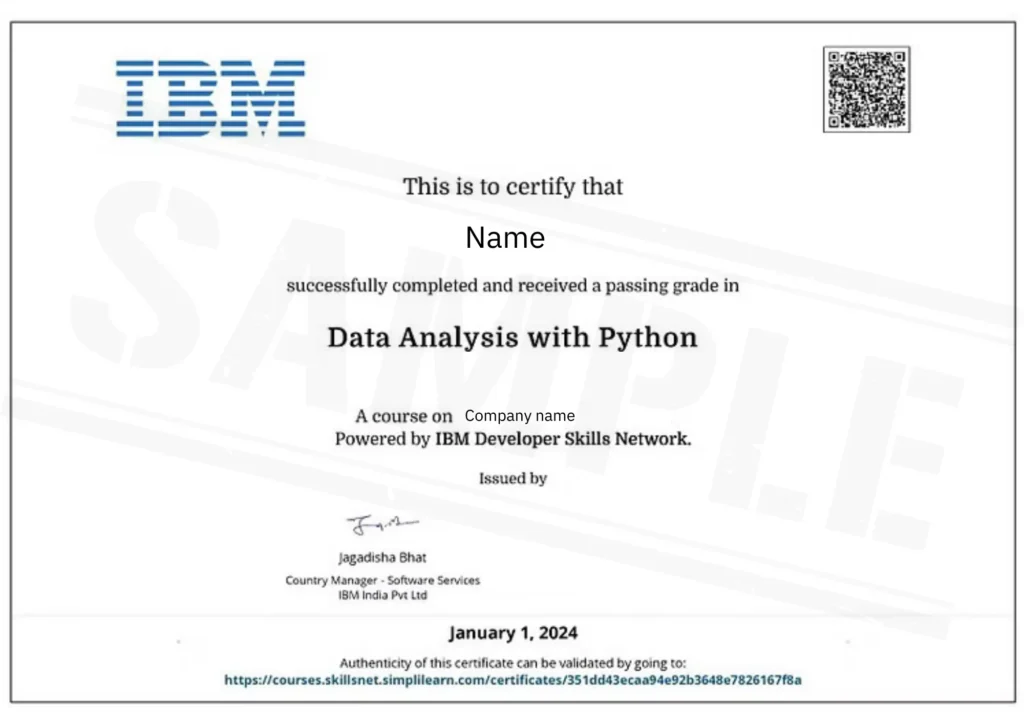
- IBM Certification
- Complete Hands-On Training
- Mock Interviews
- Complete Hands-on Training
- Learn In-Demand Skills
- 24-Hour Doubt Clarification
Why Choose Arivu Skills for Data Science Coaching?
100% Placement Assistance
Get complete support with resume building, interview prep, and job opportunities.
Guaranteed Internship
Gain real industry exposure through a guaranteed internship program.
Mock Interviews
Attend real-time mock interviews to build confidence and crack job interviews.
IBM Certification
Earn a globally recognized IBM certification to boost your career credibility.
Complete Hands-on Training
Learn by doing with practical sessions, live exercises, and real projects.
Capstone Project
Work on a real-world capstone project to showcase your end-to-end skills.
In-Demand Skills Specialization
Learn the most in-demand Data Science skills required by top companies.
Industry-Relevant Curriculum
Curriculum designed based on current industry trends and job requirements.
Real-World Use Case Training
Learn through practical use cases and business scenarios.
Dedicated Mentor Support
Get continuous guidance from experienced mentors throughout the course.
24-Hour Doubt Clarification
Clear your doubts within 24 hours with dedicated support.
Career Guidance & Roadmap
Receive a clear career path and learning roadmap tailored to your goals.
Career Guidance & Roadmap
Start from basics and move to advanced concepts step by step.
Flexible Learning Path
Learn at your own pace with flexible schedules and structured modules.
Who Can Join Data Science Classes in Bangalore?
- Fresh Graduates looking to start a career in Data Science
- Working Professionals planning to switch into Data Science & AI roles
- Students from any degree background (B.Com, BBA, B.Sc, BCA, B.Tech, MBA, etc.)
- IT & Non-IT Professionals interested in building a Data Science career
- Finance & Accounting Professionals who want to upgrade with Data Science & Machine Learning skills
- Entrepreneurs & Business Owners seeking AI-driven and data-driven decision-making skills
- Career Break Professionals looking to restart their career in Data Science
Significant Demand Growth Since 2022
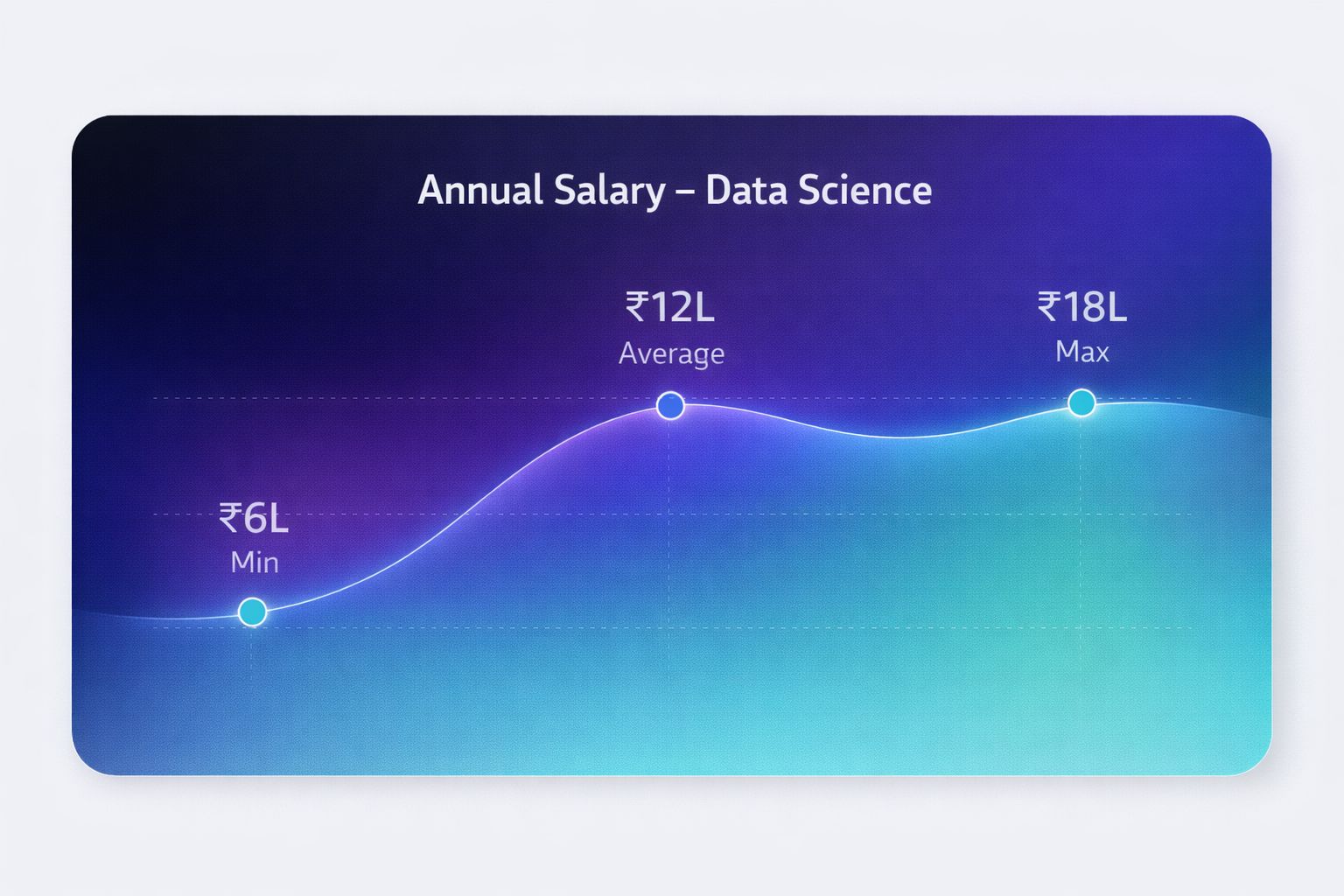
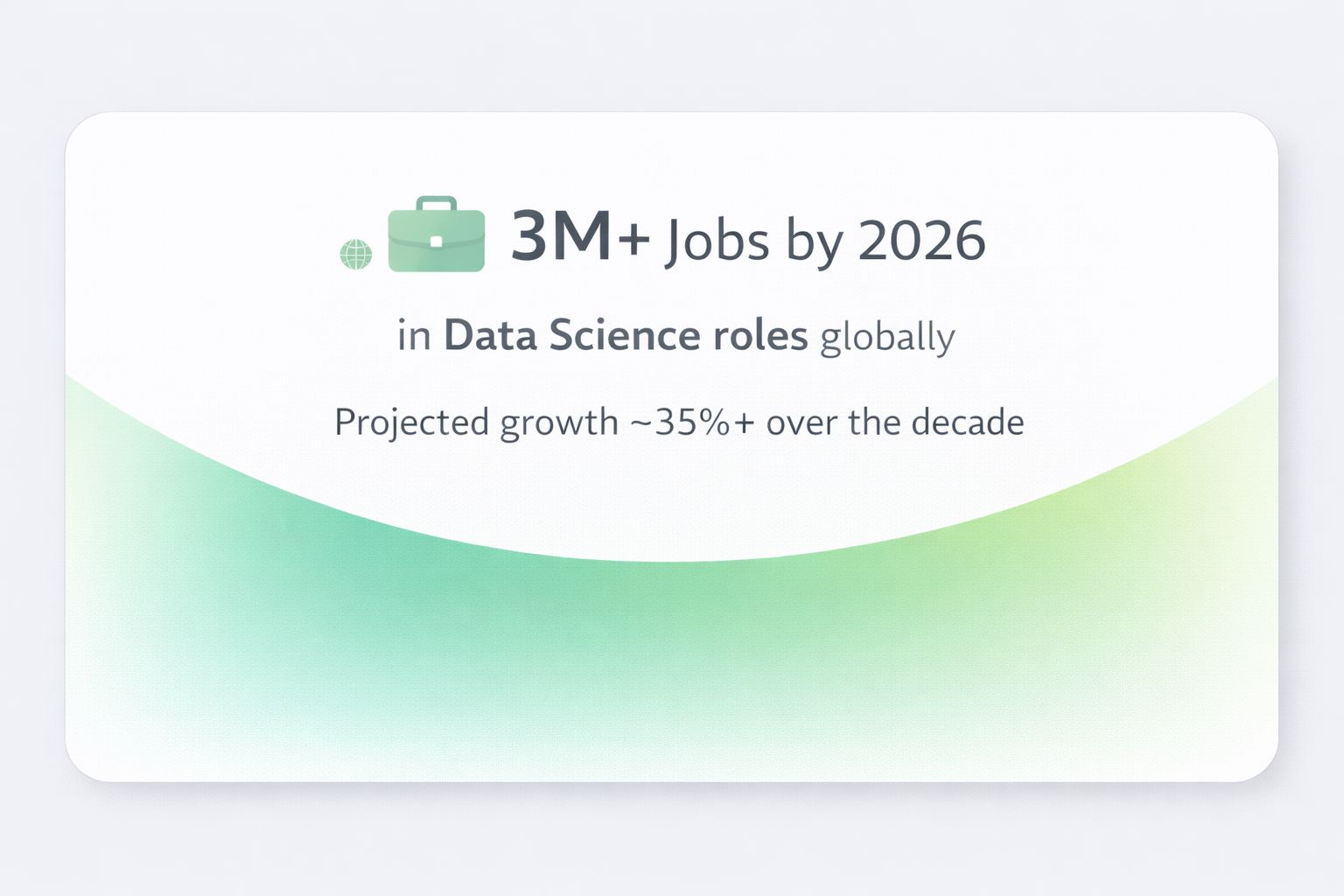
The demand for Data Science professionals is growing rapidly as companies rely on AI, machine learning, and data-driven insights for smarter decision-making and business growth. In India, the data science and analytics job market has grown by nearly 40% since 2020, with strong hiring demand across IT, fintech, healthcare, and e-commerce sectors. Enter this high-demand industry with the online Data Science course from Arivu Skills.
Testimonials
Rajiv Singh
Nitish Sharma
Dimple Prasad
Let's walk you through the journey at Arivu Skills

Course Curriculum
Our course is designed by industry experts for excellent academic and industrial experience. We have a balanced combination of theoretical, technical, and practical knowledge for you to get the best training experience for everyone regardless of their background.
- 6 Months
Python Programming
➔ Module 1: Introduction To Python Programming and Basic
– Introduction to programming, R or Python?, Why Python?, Different job roles with Python, Different Python IDEs, Downloading and setting up Python environment.
– Python input and output operations, Comments, Variables, Rules for naming variables, Basic Data Types in Python, Typecasting in Python.
– Arithmetic operators, Assignment operators, Comparison operators, Logical operators, Identity operators, Membership operators, Bitwise operators.
➔ Module 2 : Data Structure and Control Flow
– Creating strings, String formatting, Indexing, Slicing, String methods, Creating lists, Properties of lists, List indexing, List slicing, List of lists, List Methods, Adding, Updating & removing elements from lists.
– Syntax to create tuples, Tuple properties, Indexing on tuples, Slicing on tuples, Tuple methods, Syntax for creating sets, Updating sets, Set operations and methods, Difference between sets, lists and tuples.
– Syntax for creating Dictionaries, Storing data in dictionaries, Dictionaries keys and values, Accessing the elements of dictionaries, Dictionary methods.
– Setting logic with conditional statements, If statements, If-else statements, If-elif-else statements, Iterating with python loops, while loop, for loop, range, break, continue, pass, enumerate, zip, Assert, Why List comprehension, Syntax for list comprehension, Syntax for dict comprehension.
➔ Module 3: Functions and Advanced Python
– What are Functions, Modularity and code reusability, Creating functions, Calling functions, Passing Arguments, Positional Arguments, Keyword Arguments, Variable length arguments (*args), Variable Keyword length arguments (**kargs), Return keyword in Python.
– Passing function as argument, Passing function in return, Global and local variables, Recursion, Lambda, Lambda with filter, Lambda with map, Lambda with reduce, Creating and using generators, Creating modules, Importing functions from different modules, Importing Variables from different modules.
– Python builtin modules, Creating packages, Importing modules from packages, Different ways of importing modules and packages, Working on Numpy, Pandas and Matplotlib, Math module, Random Module, Sys module, Os module.
– Datetime, Regex – re module, Opening files, Opening different file types, Read, write, close files, Opening files in different modes, Installing BeautifulSoup, Understanding web structures, Chrome devtools, request, Scraping data from web using BeautifulSoup, Scraping static websites, Selenium, Scraping dynamic websites using Selenium.
➔ Module 4: Object Oriented Programming
– Creating classes & Objects, Attributes and methods, Understanding init constructor method, Class and instance attributes, Different types of methods, Instance methods, Class methods, Static methods, Inheritance, Creating child and parent class, Overriding parent methods, The super() function.
– Understanding Types of inheritance, Single inheritance, Multiple inheritance, Multilevel inheritance, Polymorphism, Operator overloading, Accessing Database using sqlite3 and MySql, Creating tables, Insert Values, Commit changes, Query.
– Update and Delete, Understanding APIs, Flask for building APIs, Making requests using APIs, Building a Registration App using API, Ngrok Server for hosting the API.
– Mini Project
Data Visualization and Statistics for Data Science
➔ Module 1 : Data Analysis and Visualization Using Python
– Introduction to numpy, Advantages of Numpy over lists, Creating Numpy arrays – 1-D, 2-D, N-D arrays, Checking the attributes – shape, size, dimensions, dtype, NumPy – Indexing and slicing, Numpy arithmetic, Numpy broadcasting, Linear Algebra using numpy, Numpy universal functions, Reshaping numpy arrays. – Introduction to Pandas – Creating Dataframe, Checking Attributes, Reading different file types, Basic Essential functionality, Indexing and Selecting data, iloc and loc functionality, Working with missing data, Grouping, Reshaping and Selecting Data.
– Using Aggregate for Data Statistics and description, Merge, Concat and join dataframes, Pivot tables, Crosstab, Stack and Unstack, Working with categorical data, Working with time series, Working with text data, Writing/Saving files, Basic Plotting using pandas.
– Data Visualization Using – Matplotlib, Seaborn, Line plot, Setting Labels, Titles, xticks and yticks, Subplots and figure size, Multiple Line Plots, adding legend, Bar charts – What are they, When to use it, Bar chart for comparing categorical data, Horizontal bar chart, Stacked Bar charts and Multiple barcharts.
– Histogram to check the distribution of numerical data, Bins in histogram, Histogram to check the shape of data, Scatterplot, 3D-Scatterplot, Checking relation b/w two variables using scatterplot, Multivariate Analysis using scatterplot, Adding Colorbar, Boxplot – 5 number summary, Checking spread using boxplot, Comparing values using pie chart, Area Plot.
– Changing the style of graphs, adding grid, Seaborn, Plotting statistical graphs using seaborn, Advantages over matplotlib, Basic Line Plots, Count Plots, Adding hue, Barplots – Horizontal and vertical barplots, Distplot – Checking distribution of data, Histplot – for plotting histograms, Boxplots in seaborn, Multiple boxplots, Scatterplot, Pairplot, Regression plots, Jointplot, Violin Plot, Jitter plot.
– Mini Project
➔ Module 2 : Data and Descriptive Statistics
– Data and Different Types of Data, Measure of central tendency, Mean, Median, Mode.
– Measure of spread, Variance, Standard Deviation, Range, IQR, Coefficient of variation.
– Measure of shape, Skewness, Kurtosis, Covariance, Correlation, Pearson’s correlation coefficient, Spearman ranks correlation coefficient.
➔ Module 3: Probability Basics and Distributions
– Probability, Events, Sample Space, Mutually exclusive events, Mutually exhaustive events, Classical Probability.
– Conditional Probability, Bayes theorem, Probability Distribution, Discrete and Continuous Distribution, Uniform Distribution, Expected values, Variance, Means.
➔ Module 4: Understanding Normal Distribution
– Properties of Normal Distribution, Mean, Variance.
– Empirical rule, Standard Normal distribution, Z-score, Central limit theorem.
➔ Module 5: Hypothesis Testing and Statistical Inference
– Hypothesis testing, Null hypothesis, Alternate hypothesis, Type-I & Type-II error, Critical value, Significance level, P-value, Z-test, One tailed test, Two tailed test, T-test, Two sample t-test, One sample t-test, Paired sample t-test.
– Difference between Z-test and t-test, F-test, One way ANOVA, Two way ANOVA, Chi square test of independence, Chi square goodness of fit.
– Mini Project – Applied Statistics With Mini Project
* Mini Project – Applying Statistical Analysis on Customer Churn.
* Using Descriptive Statistics, Conducting Hypothesis Testing, Analyzing correlation and covariance, Interpreting results.
Tableau
➔ Module 1: Introduction to SQL and Database Fundamentals
– Introduction to SQL, Introduction to Data, Introduction to Databases, Introduction to DBMS, DBMS vs RDBMS.
– Introduction to MySQL, Tables in MySQL, Relationships in MySQL, Downloading MySQL Community Setup, Installing MySQL Community, Configuring MySQL Community, Configuring MySQL Workbench.
– Connecting to MySQL Server, Loading Sample MySQL Database in MySQL Workbench, Entity-Relationship (ER) Model, Components of ER Diagram.
➔ Module 2: Basic SQL Commands and Database Design
– Types of SQL commands (DDL, DML, DCL, TCL), Basic steps for designing a data structure, Identifying data elements, Identifying tables and assigning columns, Identifying primary and foreign key.
– Relationships between tables, Normalization of tables, EER model and diagram, How to create and drop a database, How to select a database, How to create a table, How to code primary key constraint, How to code foreign key constraint.
– Alter column of a table, Alter constraint of a table, Rename, truncate and drop a table, Creating a table, Creating a copy of a table, How to insert rows, Insert single row, Insert multiple rows, Insert default and null values.
➔ Module 3: Data Manipulation and Querying Using SQL
– Update existing rows, Delete existing rows, Character types, Integer types, Fixed point and floating point, Date and time types, ENUM and SET types, Large object types, How to convert data, Implicit data conversion, CAST and CONVERT function, FORMAT and CHAR function.
– Basic SELECT statement, SELECT with column specifications, Using ALIASES for columns in result set, Arithmetic operation using SELECT, CONCAT function to join strings, Using functions with string, dates, and numbers, WHERE clause in SQL, Using comparison operators, AND, OR, and NOT operator, Using IN operator, Using BETWEEN operator, Using LIKE and RE-EXP operators, Using IS NULL clause.
– ORDER BY clause in SQL, SORT result by column, SORT by alias, expressions, or column numbers, LIMIT clause in SQL, How to limit the number of rows, How to return the range of rows.
➔ Module 4: Advanced SQL Queries and Joins
– Working with string functions, Summary of string functions, Examples using string functions, How to parse a string, Working with numeric functions, Working with datetime functions.
– Working with CASE, IF, IFNULL, and COALESCE functions, How to code aggregate functions, Queries that use aggregate functions, GROUP BY and HAVING clause, Queries with GROUP BY and HAVING clause.
– Difference between HAVING and WHERE clause, Compound search conditions, How to work with INNER JOIN, Coding INNER JOIN, How to use table aliases, How to use compound join statements.
– How to use a self join, How to join more than 2 tables, Using implicit INNER JOIN syntax, How to work with OUTER JOINS, How to code OUTER JOINS, OUTER JOINS example, How to join with USING keyword, How to join tables with NATURAL keyword, How to use CROSS JOIN, How to work with UNIONS, UNION that combines result set of different tables, UNION that combines result set of the same table, A UNION that simulates FULL JOIN, LEFT JOIN, RIGHT JOIN.
➔ Module 5: Subqueries, Windows Function And Project
– Where to code subqueries, When to use subqueries, Comparison operators in subquery, IN, ANY, ALL in subqueries, Correlated subqueries, EXISTS operator, Subquery in HAVING, SELECT, and FROM clause.
– Aggregate Functions with OVER clause, Ranking Functions – ROW_NUMBER, RANK, DENSE_RANK, NTILE, LEAD, LAG, FIRST_VALUE, LAST_VALUE, NTH_VALUE, PERCENT_RANK, Stored Procedures, Triggers.
– Mini Project – Supply Chain Management SQL Case Study.
Machine Learning For Data Science
➔ Module 1 : Introduction to Machine Learning and Data Preprocessing
– What is machine learning?, How Machine Learning works? Applications of machine learning, Different types of machine learning, How do we know machines are learning right?, Different stages of machine learning projects.
– Handling Numeric Features, Feature Scaling, Standardization and Normalization, Handling Categorical Features, One Hot Encoding, pandas get_dummies.
– Label Encoding, More on different encoding techniques, Simple Train and Test Split, Drawbacks of train and test split, K-fold cross validation, Time based splitting, What is overfitting?, What causes overfitting?, What causes underfitting?, What are bias and variance?, How to overcome overfitting and underfitting problems?.
➔ Module 2: Regression Techniques in ML
– Regression, Introduction to Linear Regression, Understanding How Linear Regression Works, Maths behind Linear Regression.
– Ordinary Least Square, Gradient Descent, R-square, Adjusted R-square, Polynomial Regression, Multiple Regression.
– Performance Measures – MSE, RMSE, MAE, Assumption of Linear Regression, Ridge and Lasso regression, RFE (Recursive Feature Elimination).
➔ Module 3 : Classification Algorithms in ML
– Logistic regression, Introduction to classification problems, Introduction to logistic regression, Why the name regression?.
– The sigmoid function, Log odds, Cost function, Feature importance and model interpretability, Collinearity of features, Feature engineering for non-linearly separable data.
– ORDER BY clause in SQL, SORT result by column, SORT by alias, expressions, or column numbers, LIMIT clause in SQL, How to limit the number of rows, How to return the range of rows.Performance Metrics for Classification Algorithms, Accuracy Score, Confusion Matrix, TPR, FPR, FNR, TNR, Precision – Recall, F1-Score, ROC Curve and AUC, Log Loss, K Nearest Neighbors.
– Introduction to KNN, Effectiveness of KNN, Distance Metrics, Accuracy of KNN, Effect of outlier on KNN, Finding the k Value, KNN on regression, Where not to use KNN, Natural Language Processing.
– Introduction to NLP, Converting Text to vector, Data Cleaning, Preprocessing Text Data – Stop word removal, Stemming, Tokenization.
– Lemmatization, Collecting Data from the web, Developing a Classifier, Building Pipelines for NLP projects, Uni-grams, bi-grams and n-grams, tf-idf, Word2Vec, Naive Bayes, Refresher on conditional Probability, Bayes Theorem, Examples on Bayes theorem, Exercise problems on Naive Bayes, Naive Bayes Algorithm, Assumptions of Naive Bayes Algorithm, Laplace Smoothing, Naive Bayes for Multiclass classification, Handling numeric features using Naive Bayes, Measuring performance of Naive Bayes, Support Vector Machines.
– Introduction to SVM, What are hyperplanes?, Geometric intuition, Maths behind SVM, Loss Function, Kernel trick, Polynomial kernel, rbf and linear kernels, SVM Regression, Tuning the parameter, GridSearch and RandomizedSearch, SVM Regression, Decision Tree.
– Introduction to Decision Tree, Homogeneity and Entropy, Gini Index, Information Gain, Advantages of Decision Tree, Preventing Overfitting, Advantages and Disadvantages, Plotting Decision Trees, Plotting feature importance, Regression using Decision Trees, Ensemble Learning.
– Introduction to Ensemble Learning, Bagging (Bootstrap Aggregation), Constructing random forests, Runtime, Case study on Bagging, Tuning hyperparameters of random forest (GridSearch, RandomizedSearch), Measuring model performance, Boosting, Gradient Boosting, Adaboost and XGBoost, Case study on boosting trees, Hyperparameter tuning, Evaluating performance, Stacking Models.
➔ Module 4: Time Series and Unsupervised Learning
– Time Series, Time Series Basics, Time Series Data Loading and Visualization, Feature Engineering on time series data, Resampling techniques on Time Series Data, Time Series Transformation, Power Transformation, Moving Averages, Exponential Smoothing, White Noise, Random Walk, Decomposing Time Series, Differencing, Splitting time series data, Naive (Persistence) Model, Auto Regression Model (AR), Moving Average Model (MA), ARIMA, SARIMA, Stationary time series, Linear Regression and Model Creation, Un-Supervised Machine Learning Algorithms, Clustering.
– Introduction to unsupervised learning, Applications of Unsupervised Learning, Kmeans Geometric intuition, Maths Behind Kmeans, Kmeans in presence of outliers, Kmeans random initialization problem, Kmeans++, Determining the right k, Evaluation metrics for Kmeans.
– Case study on Kmeans, Hierarchical Clustering, Agglomerative and Divisive, Dendograms.
– Case study on hierarchical clustering, Segmentation, Case Study on Segmentation, DBSCAN – Density based clustering, MinPts and Eps, Core Border and Noise Points, Advantages and Limitations of DBSCAN.
– Case Study on DBSCAN clustering, What are the dimensions?, Why is high dimensionality a problem?
– Introduction to MNIST dataset with (784 Dimensions), Intro to Dimensionality reduction techniques, PCA (Principal Component Analysis) for dimensionality reduction, t-SNE (t-distributed stochastic neighbor embedding).
➔ Module 5: Recommender Systems and Deep Learning
– Introduction to Recommender Systems, Recommender Engine Architecture, Content Based Recommendation, Cosine Similarity, K-Nearest Neighbors and content Recommendation, Neighborhood based collaborative filtering, User-based collaborative filtering, Item Based Collaborative filtering, Tuning Collaborative filtering Algorithms.
– Matrix Factorization methods – PCA, SVD, NMF, Train/Test cross-validation, Evaluation metrics for recommender systems.
– History of Deep Learning, Perceptrons, Multi-Level Perceptrons, Representations, Training Neural Networks, Activation Functions, Artificial Neural Networks.
– Introduction, Deep Learning, Understanding Human Brain, In Depth Perceptrons, Example for perceptron, Multi Classifier Problems, Neural Networks, Input Layer, Output Layer, Sigmoid Function.
– Introduction to TensorFlow and Keras, Training Neural Network, Understanding Notations, Activation Functions, Hyperparameter tuning in Keras, Feed Forward Networks, Online offline mode, Bidirectional RNN.
– Understanding Dimensions, Back Propagation, Loss function, SGD, Regularization, Training for batches.
– Mini Projects – Churn Prediction, Air Pollution Prediction, Books Recommender System, Dog Breed Classification, Loan Default Prediction.
– Final Project – Building a Recommender System on Movie Lens Dataset/Toxic Comment Classification using NLP/ House Price Prediction.


Career Track
Once you have enrolled for the program then you will have access to a wide range of resources which will help you in becoming a Job-Ready Candidate. We have a dedicated placement team of professionals who excel in their individual domains committed to assist you in our journey.
- 1 Months
Profile and Resume building
- Profile and Resume building
- Portfolio Building
- Build highly optimized
- Resumes and Cover Letters
- Build your LinkedIn Profile
Business Communication
- Master class from the industry expert
- Get proficient in business presentations
- Learn how to frame professional emails
- Excel in telephonic communication and Business Vocab
- Networking and building Interpersonal Skills
Competency Challenge Test
- Based on the course curriculum
- Evaluates the understanding of theoretical and practical concepts
- Adds credibility and accountability to the candidate
- Difficulty level – moderate
Technical Mock Interviews
- Interview prep and mock interviews
- Interview Best Practices
- Mock interviews
- Module-wise Interview Questions

Get Placed
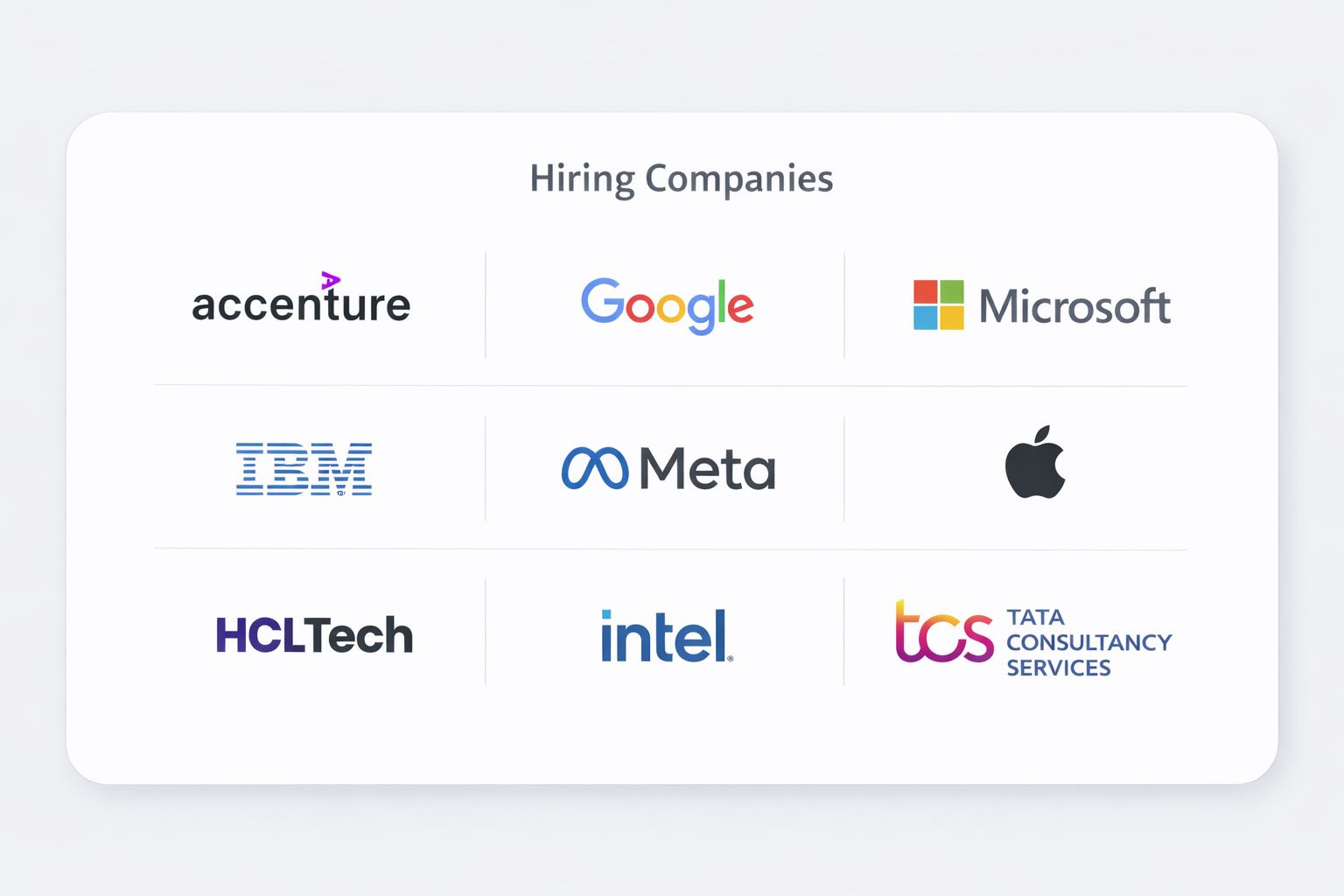
Companies Hiring for Data Science











95%
Placements
5 LPA
Average CTC
22 LPA
300+
82%

4.8/5
250+ Reviews
Data Science Course Training
- Ongoing Batch
Jan 17 - Mar 17 2026
IST: 09:00 AM – 01:00 PM
- Weekend Batch | 120 Sessions
- Certified Traine
- Next Batch
May 02 - July 02 2026
IST: 09:00 AM – 01:00 PM
- Weekend Batch | 120 Sessions
- Certified Traine
Do you want to customize your batch request?
Corporate Training
The work force is your asset. Up-Skill them with our Corporate Training Programs!
- Unleash In-Demand Skills Across the Enterprise
- Align Skill Development with Business Objectives
- Drive Increased Employee Productivity
- Leverage Immersive Learning
Data Science Certification Course in Bangalore Overview
How Data Science Certification Impacts Your Career
A Data Science Certification from Arivu Skills opens strong career opportunities in today’s AI-driven and data-powered business environment:
Career Advancement:
- Salary Growth:Entry-level Data Science professionals in India earn an average salary of ₹5–8 LPA, with potential salary hikes of 20–60% based on skills and experience.
- Job Demand: The Indian Data Science and AI job market has seen nearly 40% growth since 2020, with strong demand across IT, Finance, Healthcare, E-commerce, Consulting, and Manufacturing sectors.
What’s Included in the Course?
The Data Science Certification Program by Arivu Skills provides comprehensive, job-oriented training:
- Python Programming
Core programming, data structures, OOP, and real-time applications. - Data Visualization & Statistics
NumPy, Pandas, Matplotlib, Seaborn, descriptive statistics, hypothesis testing. - SQL for Data Handling
Database design, joins, subqueries, window functions, and case studies. - Machine Learning & AI
Regression, Classification, Clustering, NLP, Time Series, Ensemble Learning, and Model Evaluation. - Deep Learning & Recommender Systems
Neural Networks, TensorFlow, Keras, Collaborative Filtering, and real-world projects. - Mini Projects & Final Project:
Churn Prediction, Loan Default Prediction, Recommender System, and more. - Certification & Career Support:
IBM Certification, Guaranteed Internship, Placement Support, Mock Tests, Resume Building, and Interview Preparation.
Key Benefits
100 Hours Weekend Batch (Sat & Sun, 9 AM – 1 PM)
150+ Hours Hands-on Learning
Industry Expert Faculties
Internship Assurance
End-to-End Placement Support
Personalized Mentorship
9 Months Access to Course Materials & Sessions
Data Science Eligibility and Prerequisites
Educational Qualifications:
Any Undergraduate or Postgraduate Degree
Open to fresh graduates and working professionals
No mandatory coding background required
Enrolling in the Data Science course in Bangalore opens doors for professionals from diverse educational backgrounds seeking AI-driven career growth.
Basic Requirements:
Basic computer knowledge (programming will be taught from scratch)
Analytical mindset
Laptop/PC with stable internet
Commitment of 8–10 hours per week
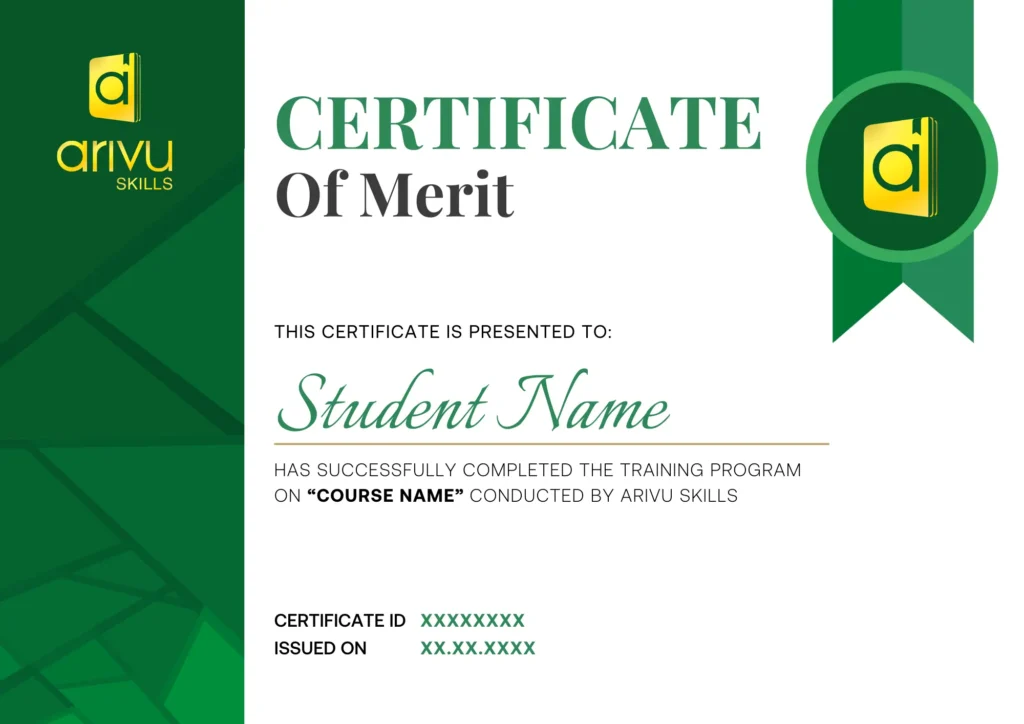
Data Science Course Certificate
Skills Covered
- Python Programming
- SQL
- Data Visualization
- Machine Learning
- Deep Learning & AI Tools
Tools Covered











Data Science Certification Course in Bangalore FAQ
1. What is Data Science, and why is it a good career choice?
Data Science is the practice of extracting meaningful insights from large datasets using tools like Python, SQL, Machine Learning, and AI. It’s one of the fastest-growing career fields globally, with India’s data science job market growing nearly 40% since 2020, offering high salaries and strong demand across IT, finance, healthcare, and e-commerce.
2. Do I need a coding background to enroll in a Data Science course?
No. Most Data Science courses, including Arivu Skills’, are designed to take learners from scratch. Basic computer knowledge and an analytical mindset are sufficient. Python programming is taught from the ground up as part of the curriculum.
3. What tools and technologies will I learn in a Data Science course?
A comprehensive Data Science course covers Python, SQL, NumPy, Pandas, Matplotlib, Seaborn, Scikit-learn, TensorFlow, Keras, and tools for machine learning, deep learning, NLP, and data visualization.
4. What job roles can I apply for after completing a Data Science course?
Graduates can pursue roles such as Data Scientist, Data Analyst, Machine Learning Engineer (Entry Level), Business Intelligence Analyst, and AI/ML Associate in industries like IT, fintech, consulting, and healthcare.
5. What is the average salary for a Data Science professional in India?
Entry-level Data Science professionals in India typically earn between ₹5–8 LPA, with experienced professionals commanding significantly higher packages. Career switchers often see salary hikes of 20–60% after completing a certified Data Science program.
6. Where is Arivu Skills located in Bangalore?
Arivu Skills is located at 1st Floor, Sai Prema, Christ Lane No. 39, Krishnanagar, Hosur Road, Koramangala, Bengaluru – 560029. The institute offers both classroom training and live online classes, making it accessible for students across Bangalore.
7. What makes Arivu Skills' Data Science course stand out among institutes in Bangalore?
Arivu Skills offers a unique combination of 150+ hours of hands-on training, an IBM Certification, a Guaranteed Internship, and a structured 6-month curriculum designed by industry experts. The program also includes capstone projects, mock interviews, resume building, and dedicated placement support — all under one roof in Bangalore.
8. Does Arivu Skills provide placement assistance for Data Science students in Bangalore?
Yes. Arivu Skills has a dedicated placement team that assists students with resume building, LinkedIn profile optimization, mock interviews, and connects them with 300+ hiring partners including companies like Infosys, Wipro, IBM, Google, Accenture, and Cognizant. The institute reports a 95% placement rate.
9. What batch timings does Arivu Skills offer for the Data Science course in Bangalore?
Arivu Skills offers weekend batches (Saturday & Sunday, 9:00 AM – 1:00 PM) with 120 sessions spread over 6 months, making it ideal for both students and working professionals in Bangalore. The next batch is scheduled for May 2 – July 2, 2026.
10. What certifications will I receive after completing the Data Science course at Arivu Skills in Bangalore?
Upon successful completion, students receive an Arivu Skills Course Completion Certificate. Students who score above 80% are awarded a Certificate of Merit. Additionally, all enrolled students receive an IBM Certification, a globally recognized credential that significantly boosts employability in Bangalore’s competitive tech job market.
Distinctions and Achievements
Explore the milestones of our journey!

Best Skill Learning Institute of the Year
The Education Excellence Award by Brands Impact
Edutech Company of the Year
The Education Awards by The Corporate Titan

Institute with the Best Placement
The Education Awards by Mantra
People also viewed courses like
Data Science Course in Other Cities
Bangalore (Offline + Live- Online Class)
Chennai (Live - Online Class)
Coimbatore (Live - Online Class)
This course has served
Learn
In-Demand Tools
3 Months
Structured Program
100%
Hands-On Training
IBM
Certification Included
Projects
Real-Time Capstone
Drop a Query
