
Introduction
Imagine three doors. Behind each is a strong, well-paid, future-proof tech career: the
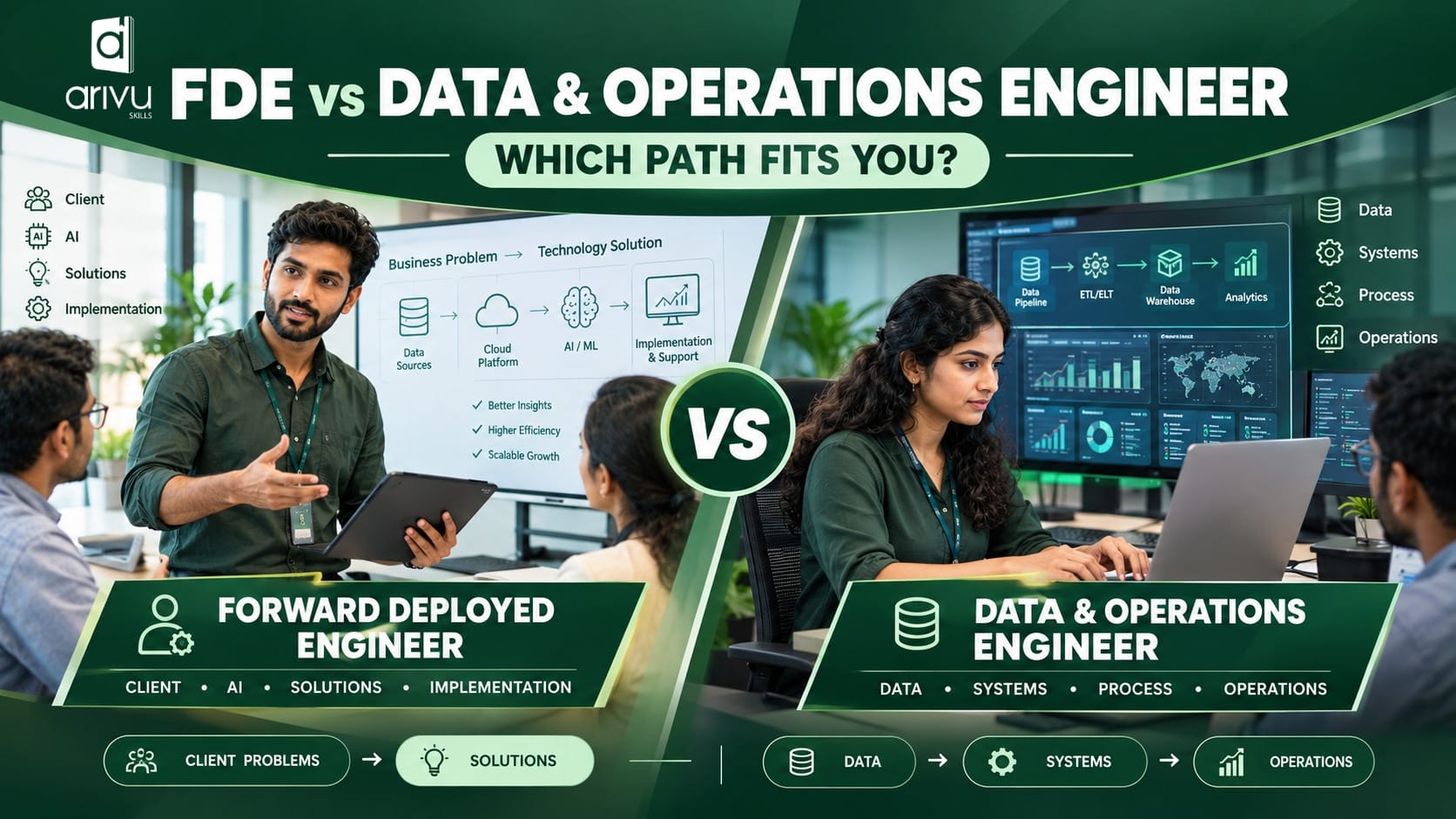
Data Engineer, the Operations Engineer, and the Forward Deployed Engineer (FDE). The good news? All three are in high demand. The real question is not which one is “best” it is which one fits the way you like to work. Some people love working quietly with data. Some love keeping big systems running smoothly. And some love being on the front line with customers, solving real problems. This guide explains all three in plain language — including what is FDE and how it compares so you can choose with confidence.
Meet the Three Roles (In Simple Words)
| Works with Data Data Engineer | Works with Systems Operations Engineer | Works with Customers Forward Deployed Engineer |
| Builds the “plumbing” that moves and cleans data so it is ready to use. | Keeps the systems running reliably deploying, monitoring, automating. | Sits with one customer and builds a solution that delivers real value. |
A simple way to remember it: the Data Engineer works closest to the data, the Operations
Engineer works closest to the systems, and the Forward Deployed Engineer works closest
to the customer.
The Data Engineer — the foundation builder
Think of data as water. Before anyone can drink it, someone must lay the pipes, filter out the
dirt, and make sure it flows to the right taps. That is the data engineer. They build and
maintain the “pipelines” that collect, clean, store and deliver data — so that analysts and AI
systems get accurate information to work with. Their success is measured by data quality
and reliability.
The Operations Engineer — the reliability guardian
Once software is built, someone has to launch it smoothly and keep it running 24/7 without
crashing. That is the operations engineer (often called a DevOps engineer). They set up the
cloud infrastructure, automate deployments, monitor performance and fix things fast when
systems wobble. Their success is measured by uptime and reliability.
The Forward Deployed Engineer — the customer-facing builder
The FDE takes powerful technology all the way to a real customer and makes it genuinely
useful for them. They sit with the customer, understand the problem, build a custom solution,
and own the result. Their success is measured by one thing: did the customer’s business
actually improve? This is the most people-facing of the three roles.
The Key Differences at a Glance
| Content | Data Engineer | Operations Engineer | Forward Deployed Engineer |
| Works closest to | Data | Systems & infrastructure | Customers & outcomes |
| Main job | Build pipelines that move & clean data | Deploy & keep systems running reliably | Build & deliver a solution for one customer |
| Where they sit | Behind the scenes | Behind the scenes (infrastructure) | On the front line with the customer |
| Measured by | Data quality & pipeline uptime | System reliability & uptime | Real customer business outcome |
| Customer contact | Low | Low | Very high |
| Daily rhythm | Structured & predictable | Reliability-driven (some on call) | Varied, unpredictable, some travel |
| Core skills | SQL, ETL, cloud data tools | Cloud, Kubernetes, CI/CD, automation | Coding + AI + communication + business sense |
| India salary (2026)* | ~₹4–8 → ₹15–30 LPA | ~₹4–6 → ₹18–35 LPA | ~₹18–28 → ₹55–90+ LPA |
They Are Teammates, Not Rivals
Here is something important: on a real project, all three roles work together. The data
engineer prepares the clean data. The operations engineer keeps everything running. The
forward deployed engineer takes the finished solution to the customer and makes it deliver
value. Choosing a path is not about picking the “winner” it is about picking the part of the
journey you most enjoy.
Salary: An Honest Comparison
All three careers pay well and are in strong demand in India. Data and operations
engineering have huge, well-established job markets with plenty of openings — a great,
stable way to start. The forward deployed engineer salary tends to sit highest of the
three, because the rare mix of engineering and customer skill is hard to find — but the FDE
market is smaller and more selective.
In simple terms: data and operations engineering are often easier to enter, while the FDE
role usually pays a premium but expects some experience first. In fact, many people begin
in data or operations engineering and later move into an FDE role once they have built both
technical depth and confidence with customers.
Where Does the “AI Engineer” Fit?
You will also hear the term AI engineer — someone who builds and improves AI models.
Increasingly, the customer-facing version of this is the AI forward deployed engineer (an
AI FDE): a forward deployed engineer who specialises in delivering AI solutions to
customers. If AI excites you and you also enjoy people, that blend is where a lot of the fastest
growth is happening today.
Real Examples: One Project, Three Roles
Picture a hospital chain that wants an AI tool to predict how many beds it will need each
week. All three engineers play a part:
1) The Data Engineer builds the pipelines that pull clean, reliable data from every
hospital’s records.
2) The Operations Engineer sets up the cloud systems and keeps the tool running around
the clock without failing.
3) The Forward Deployed Engineer sits with the hospital staff, tailors the tool to how they
actually work, and makes sure it truly helps doctors plan.
Same project — three different kinds of hero. Remove any one of them, and it does not work.
A Small, Real-Life Style Ca
Nisha — Data Engineer
Nisha loves structure. Her week is calm and focused: she designs data pipelines for an
e-commerce company, making sure sales data is clean and always available. She rarely
meets a customer, and that suits her perfectly — she finds deep satisfaction in a system
that runs flawlessly.
Vikram — Operations Engineer
Vikram loves keeping things alive. He manages the cloud setup for a fintech app,
automating deployments and jumping in fast when something breaks. The occasional
late-night alert doesn’t bother him — he enjoys being the reliable person who keeps
everything running.
Sana — Forward Deployed Engineer
Sana loves people and variety. One month she is with a logistics client, the next a bank learning each business and building custom AI tools with them. She travels often and no two weeks are alike. The unpredictability that would stress Nisha is exactly what Sana finds thrilling.
The lesson: Three friends, three very different “perfect jobs.” The right path isn’t the
highest-paid one on paper — it’s the one whose daily rhythm matches your personality.
Key Takeaways
1) Data Engineer works closest to data, Operations Engineer to systems, and the FDE
to customers.
2) Data & operations roles are behind-the-scenes and structured; the FDE role is front
line, varied and people-facing.
3) All three are in demand — and they work as a team on real projects, not as rivals.
The forward deployed engineer salary usually sits highest, but data/operations
roles are larger and easier to enter.
4) Many people start in data or operations and later move into an FDE role.
Choose by fit: pick the daily rhythm that matches your personality, not just the pay.
Still Deciding Which Path Fits You?
Arivu Skills helps students and professionals build job-ready skills across data, cloud and
applied AI — and choose the tech career that suits them best.
Explore programs at www.arivuskills.com
Topics covered in this article