
TL;DR
- A Data Analyst course trains you for one job using Excel, SQL and Power BI. It takes 3–6 months and needs little or no coding.
- A Data Analytics course covers the whole field and adds Python, statistics and forecasting. It takes 6–12 months.
- Want a job fast, or come from commerce/arts? Pick Data Analyst.
- Aiming for data science or AI roles later? Pick Data Analytics.
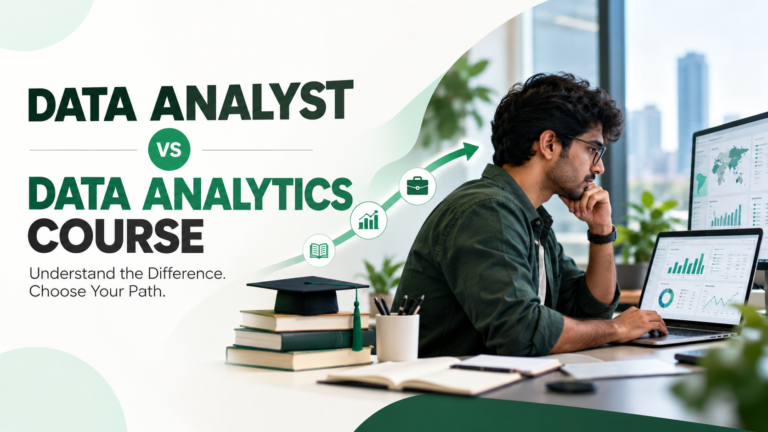
Data Analyst and Data Analytics courses sound like the same thing, and plenty of institutes sell them that way. They aren’t. A Data Analyst course gets you job-ready for one role: cleaning data, building reports, and explaining what the numbers mean to your manager. A Data Analytics course goes wider and deeper, into Python, statistics and forecasting. Need a job in the next few months? Go with Data Analyst. Planning a longer climb toward data science or strategy roles? Data Analytics is the better bet. Below, we compare the two on syllabus, tools, duration and salary so you can decide for yourself.
Introduction
Quick answer: The difference between a Data Analyst and a Data Analytics course comes down to scope. A Data Analyst course trains you for one job using Excel, SQL and Power BI. A Data Analytics course covers the whole field, adding Python, deeper statistics and forecasting.
If you’ve searched for a data course recently, you’ve probably seen both names on the same page, sometimes for the same program. It’s confusing, and honestly, a lot of course listings don’t help.
Here’s the simplest way to think about it. “Data Analyst” is a job title. “Data Analytics” is a field of study. Mix them up and you could spend six extra months learning things you didn’t need, or finish a short course and find you can’t apply for the roles you wanted.
So let’s clear it up: what each course teaches, how they compare, and which one makes sense for where you are right now.
What is a Data Analyst course?
A Data Analyst course is built around one job. You learn what a working analyst does day to day, and not much beyond that, which is the point.
Picture a sales head asking, “Why did Chennai sales drop last month?” The analyst pulls the numbers from the database, cleans up the mess (there’s always a mess), spots that two big distributors placed late orders, and puts it on a dashboard the sales head can read in thirty seconds.
A typical Data Analyst syllabus covers:
- Excel, including pivot tables, VLOOKUP/XLOOKUP and charts
- SQL to pull and filter data from company databases
- Power BI or Tableau for dashboards
- Basic statistics like averages, growth rates and percentages
- Presenting findings so a non-technical manager actually gets it
Most of these courses take 3 to 6 months. The good ones make you build portfolio projects on real business data, because that’s what recruiters ask to see.
What is a Data Analytics course?
A Data Analytics course teaches the whole field. You still learn the analyst toolkit, but you go further, from explaining the past to predicting what comes next.
Analytics is usually split into four levels, and a full course touches all of them:
- Descriptive: what happened? (reports, dashboards)
- Diagnostic: why did it happen? (digging into causes)
- Predictive: what’s likely to happen next? (forecasts, simple models)
- Prescriptive: what should we do about it? (recommendations backed by data)
On top of Excel, SQL and Power BI or Tableau, expect to learn:
- Python (sometimes R) for working with large datasets
- Probability, hypothesis testing and regression
- An introduction to machine learning for prediction
- Applied projects in marketing, finance, HR or supply chain
These courses usually run 6 to 12 months. It’s a bigger commitment, but it leaves more doors open later.
Data Analyst vs Data Analytics: Key differences
If you remember one line from this post, make it this: a Data Analyst course prepares you for a job, and a Data Analytics course prepares you for a career in the field. Here’s how they stack up.
| Factor | Data Analyst course |
Data Analytics course |
| Focus | One job role |
The whole field of analytics |
Main question answered |
What happened and why? |
What happened, why, what next and what to do |
Core tools |
Excel, SQL, Power BI or Tableau |
All of these plus Python or R |
| Statistics level | Basic | Intermediate to advanced |
Machine learning |
Rarely included |
Introduction usually included |
Typical duration |
3 to 6 months |
6 to 12 months |
Coding needed |
Little to none |
Moderate |
Best for |
Quick job entry |
Long-term growth and specialization |
Starting roles |
Data Analyst, MIS Executive, Reporting Analyst |
Data Analyst, Business Analyst, Analytics Consultant |
Which course should you choose?
It depends on where you’re starting and how far you want to go.
Pick a Data Analyst course if you:
- Are a B.Com, BBA, BA or B.Sc graduate who wants a job within a few months
- Already work in sales, finance, HR or operations and keep getting handed spreadsheets
- Haven’t coded before and would rather not start with Python
- Want a shorter, cheaper course with a clear job at the end
Pick a Data Analytics course if you:
- Come from engineering, BCA, statistics or maths
- See yourself as a Business Analyst, Data Scientist or in an AI role in a few years
- Are happy to learn Python and work through some real statistics
- Can give it 6 to 12 months
Still not sure?
You don’t have to decide your whole career today. A lot of people take the Data Analyst route first, land a job, and pick up Python and machine learning later while they’re earning. Both roads end up in the same industry. One just gets you in the door sooner.
Career and salary outlook in India
Almost every industry hires for data skills now, from banks and e-commerce to hospitals and ed-tech. Bengaluru, Hyderabad, Pune, Chennai and Mumbai have the most openings. Here’s roughly what data analyst salaries in India look like.
| Role | Experience | Approx. salary (per year) |
Junior Data Analyst / MIS Executive |
0 to 2 years |
₹3.5 to 6 LPA |
Data Analyst |
2 to 5 years |
₹6 to 12 LPA |
Business Analyst |
2 to 5 years |
₹7 to 14 LPA |
Senior Analyst / Analytics Consultant |
5+ years |
₹12 to 25 LPA |

How to pick the right course: a quick checklist
Whichever path you go with, check these before you pay a fee:
- The syllabus includes SQL, Power BI and (for analytics) Python, not just Excel
- You’ll build at least 3 to 5 projects you can show in interviews
- Trainers have actually worked as analysts
- There’s real placement help: resume reviews, mock interviews, hiring partners
- Batch timings work for you (weekend or online if you’re working or in college)
- The certificate is one employers recognise
And ask for a demo class. Twenty minutes with a trainer tells you more than any brochure.
Frequently asked questions
Are Data Analyst and Data Analytics the same thing?
No. Data Analyst is a job role. Data Analytics is the wider field, which includes that role along with others like Business Analyst and Analytics Consultant.
Can a commerce or non-IT student become a Data Analyst?
Yes, and many do. Excel, SQL and Power BI don’t need a coding background. B.Com and BBA graduates often have an edge because they already understand how a business makes money.
Do I need to know coding for a Data Analytics course?
Not when you start. Most courses teach Python from scratch. What helps more is being comfortable with numbers and patient with problems.
Which course gets me a job faster?
A Data Analyst course. It’s shorter and focused on the skills entry-level roles ask for.
Can I move from Data Analyst to Data Scientist later?
Yes. You’ll need Python, stronger statistics and machine learning, which you can pick up on the job or through an upskilling course. Plenty of data scientists started out as analysts.
Is data analytics a good career in 2026?
Yes. AI tools can now generate reports in seconds, but someone still has to check whether the numbers make sense and decide what to do about them. That’s the analyst’s job, and it isn’t going away.
Conclusion
If you want a job soon and you’re more comfortable with Excel than code, start with a Data Analyst course. If you’re aiming for analytics, data science or AI roles and can commit most of a year, take the Data Analytics route.
Either way, the first step is the same: be honest about your background and how much time you have, then pick the course that fits.
Ready to start your data career? Arivu Skills runs analytics programs with hands-on projects, industry mentors and placement support. Book a free counselling session and we’ll help you figure out which one suits you.