
A forward deployed engineer rarely receives a neat problem, a complete dataset and a detailed technical brief. More often, the client knows something is slowing the business down but cannot explain exactly what the software should do. The FDE has to understand the problem, find the missing details and build a solution that works inside the client’s real environment.
That mix of engineering, product thinking and client communication makes the job interesting. It also makes it demanding. A feature that works perfectly in a test environment may fail when it meets outdated systems, restricted data or a workflow that nobody documented.
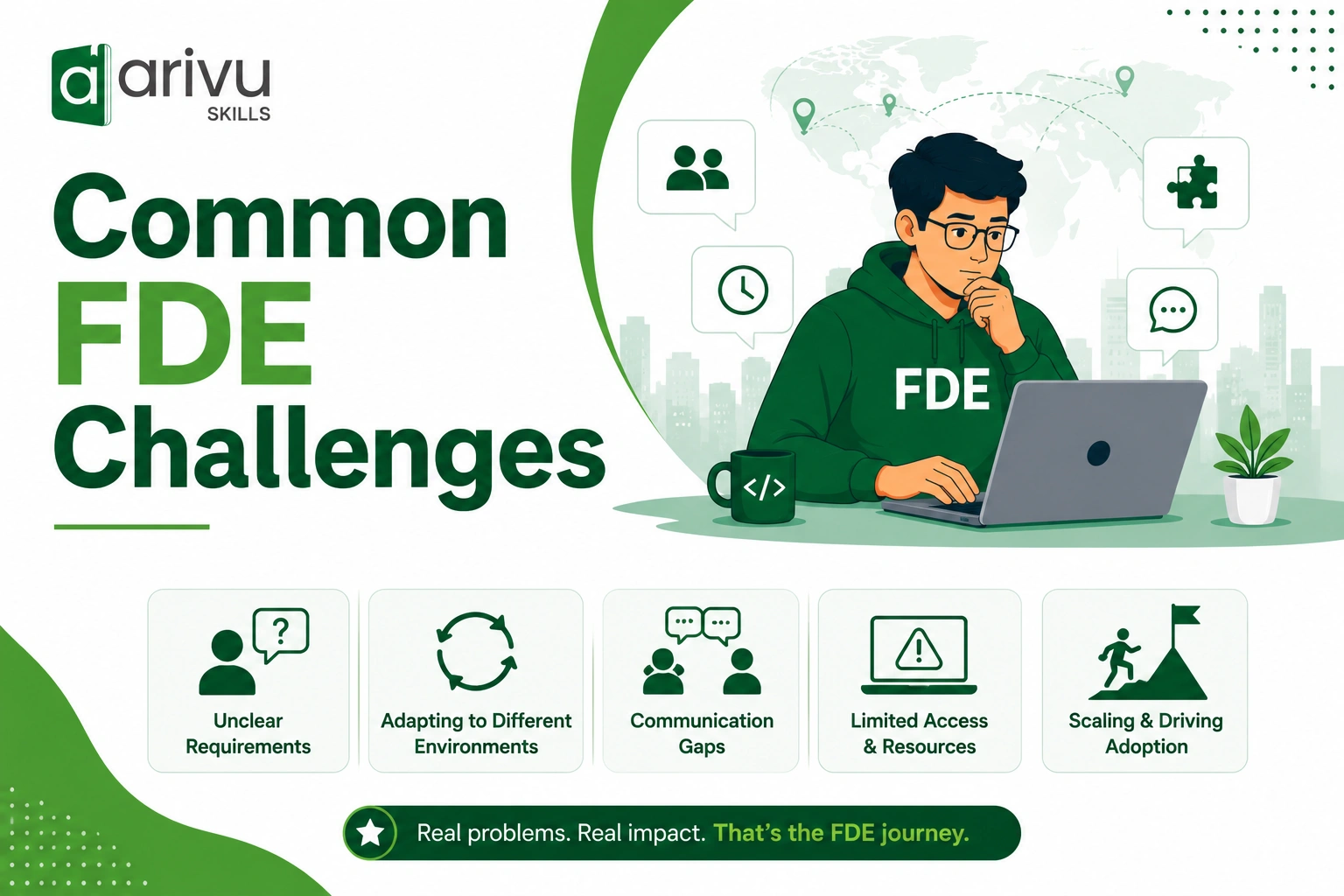
This guide explains the most common FDE challenges, why they happen and how forward deployed engineers deal with them in practice.
Want to build these skills through practical projects? Explore the Forward Deployed Engineer Course in Bangalore at Arivu Skills and learn how to move from business discovery to deployment in real client-style scenarios.
What Is a Forward Deployed Engineer?
A forward deployed engineer is a software engineer who works closely with customers to build, adapt and deploy technology for their specific business needs. Instead of working only on a standard product roadmap, an FDE spends time inside the customer’s operational and technical environment.
The FDE full form is Forward Deployed Engineer. If you are searching for the forward deployed engineer meaning, think of the role as the link between a software product and the business that needs to use it. An FDE may speak with stakeholders in the morning, inspect an API or data pipeline in the afternoon, and deploy a working improvement by the end of the sprint.
The title is not used in exactly the same way by every company. However, most FDE roles combine software development, systems integration, solution design and direct customer interaction. Current job descriptions also show a strong focus on taking loosely defined business problems through prototyping, enterprise integration and production deployment.
Why Is the FDE Role So Challenging?
Most software engineers work with some separation between product development and the customer. A forward deployed engineer works much closer to the point where technical decisions affect real operations.
This means the FDE must manage two kinds of uncertainty at once. The business problem may still be unclear, while the client’s technology may contain security restrictions, poor-quality data or legacy systems. Delivery deadlines usually continue moving even while these issues are being discovered.
An FDE therefore needs more than coding ability. The role rewards engineers who can ask useful questions, make sensible trade-offs and explain decisions without hiding behind technical language.
1. Turning Unclear Requirements Into a Buildable Problem
Clients often describe symptoms instead of causes. They may say, “We need an AI assistant” when the real problem is that staff spend hours searching across several internal systems. If the engineer accepts the first request without investigating it, the team may build an impressive tool that nobody needs.
The first challenge is finding the actual business problem. A good FDE asks how the work is done today, where delays occur, who uses the output and what a successful result would change. These conversations should produce a clear problem statement and a measurable outcome.
For example, “build a support chatbot” is vague. “Reduce the time agents spend finding approved policy answers while keeping a human review step” is something an engineering team can scope and test.
How FDEs handle it
- Interview the people who perform the task, not only senior stakeholders.
- Map the current workflow before proposing a new one.
- Write down assumptions and confirm them early.
- Define success through a business or user metric.
- Build a small prototype to test the riskiest assumption first.
2. Working With Legacy Systems and Difficult Integrations
Client environments are rarely clean. A modern application may need to connect with an old ERP, a custom database, spreadsheets maintained by different teams and APIs with incomplete documentation. Authentication methods can also vary across systems.
This is where a simple demo becomes a real engineering project. The FDE has to understand data formats, access controls, rate limits and failure behaviour. A quick workaround may help during a demonstration but create reliability problems in production.
Enterprise FDE job descriptions commonly mention integration with legacy platforms, existing identity systems, security controls and client infrastructure. This is a central part of the role, not an occasional inconvenience.
How FDEs handle it
Start by documenting every system the solution will touch. Identify the owner, interface, authentication method, data format and known limitations for each one. Where possible, place adapters or service layers between the new solution and older systems. This keeps legacy-specific logic out of the main application and makes future changes easier.
The engineer should also design for partial failure. If one external service stops responding, the system should retry safely, preserve useful logs and tell the user what happened.
3. Managing Poor or Incomplete Data
Many client projects look like software problems but turn out to be data problems. Records may be missing, duplicated, inconsistent or stored in formats that were never meant for analysis. In AI projects, weak data can produce unreliable answers even when the model and application code are sound.
The uncomfortable part is that an FDE may discover this after development has started. Fixing every historical data issue is rarely possible within one engagement, so the engineer must decide what needs to be corrected now and what can be handled later.
How FDEs handle it
An FDE profiles the data early and checks completeness, consistency, freshness and ownership. Validation rules should be added at the point where data enters the system. For AI applications, the team should also create a representative evaluation set and test outputs against expected answers before release.
When the data cannot support a promised feature, the engineer needs to say so clearly. Resetting expectations early is better than hiding the problem until launch.
4. Balancing Speed With Production Quality
FDE teams are often expected to show progress quickly. A prototype can help stakeholders understand the idea and expose flawed assumptions. The risk begins when a prototype quietly becomes the production system.
Prototype code may lack automated tests, observability, access controls or a recovery plan. Those shortcuts are understandable during discovery, but they become dangerous once real users and business data depend on the system.
How FDEs handle it
The FDE should make the maturity of each build visible. Label work as an experiment, pilot or production release, and define what must change before it moves to the next stage. Security, monitoring, testing and rollback planning should be part of the production path.
A useful approach is to move fast on reversible decisions and slow down on decisions that affect security, sensitive data or core architecture. This preserves delivery speed without treating reliability as an afterthought.
5. Communicating With Technical and Non-Technical Stakeholders
An FDE may work with developers, operations teams, department heads, legal reviewers and end users during the same project. Each group cares about a different part of the solution. A detailed architecture diagram may help the engineering team but confuse a business stakeholder who only needs to understand the impact on turnaround time.
Miscommunication creates real technical costs. A vague agreement in a meeting can become a disputed requirement two weeks later.
Build the skills companies are looking for and prepare for a career as a Forward Deployed Engineer
How FDEs handle it
Strong FDEs adjust the level of detail without changing the facts. They explain decisions in terms of impact, trade-offs and next steps. They also document important decisions, owners and deadlines after meetings.
Working software is often the clearest communication tool. A short demonstration can reveal misunderstandings faster than a long presentation, especially when the user can try the workflow and react to it.
6. Handling Changing Scope and Priorities
Requirements change when clients see the first working version. Some change is healthy because it reflects new learning. Constant uncontrolled change, however, can break timelines and leave the team with a collection of half-finished features.
The challenge is to stay responsive without saying yes to every new request.
How FDEs handle it
Keep a visible backlog and connect each request to the agreed outcome. When a new feature appears, explain what it will replace, delay or cost. This turns scope discussions into decisions rather than arguments.
Short delivery cycles also help. The team can review priorities at a regular point instead of interrupting active work every time a new idea appears.
7. Navigating Security, Privacy and Compliance
Forward deployed engineers often work with enterprise data, internal tools and regulated workflows. They may have limited access to production systems, or the client may prohibit data from leaving a private network. AI deployments add questions about model access, prompt logging, output reliability and human oversight.
Security requirements can slow a project if they are discovered late. They can also force major architecture changes.
How FDEs handle it
Bring security and compliance teams into discovery. Identify sensitive data, access boundaries, retention rules and approval requirements before choosing an architecture. Use least-privilege access and keep auditable records of important system actions.
For AI workflows, define where human review is required and how incorrect outputs will be detected. A model working well in a demo is not enough evidence for a high-impact production use case.
8. Owning Results Without Controlling Everything
An FDE may be responsible for the outcome while depending on client teams for credentials, infrastructure, data access and approvals. A delayed dependency can block the project even when the engineering work is ready.
This mismatch between ownership and control can be frustrating. It also tests the engineer’s ability to manage a project without formal authority over everyone involved.
How FDEs handle it
Make dependencies visible early. Assign an owner and target date to each one, and explain the effect of a delay. If access to a production system will take two weeks, the FDE can use realistic test data or build an adapter against a mock interface while the approval moves forward.
Good ownership does not mean silently absorbing every problem. It means raising risks early and offering workable options.
9. Learning a New Business Domain Quickly
Code alone does not tell an FDE which problem matters. An engineer working in logistics needs to understand why delivery windows, route constraints and service-level agreements affect a solution. In finance or healthcare, the vocabulary and risk level will be different.
Without domain knowledge, technically correct software can still produce the wrong business result.
How FDEs handle it
The fastest route is to learn from the people closest to the process. Ask users to walk through real cases, including unusual ones. Build a simple glossary and record business rules as testable statements. The FDE does not need to become the company’s leading domain expert, but must understand enough to challenge assumptions and spot dangerous gaps.
10. Avoiding Burnout in a High-Ownership Role
Client deadlines, production issues, travel and frequent context switching can make FDE work intense. Engineers who try to solve every problem personally may become a bottleneck and eventually burn out.
How FDEs handle it
Set clear support boundaries, document repeatable work and share knowledge with the client team. Reusable components can reduce repeated effort across deployments, but only when they genuinely fit the new context.
Teams should also separate urgent production incidents from requests that merely feel urgent. Sustainable delivery is part of good engineering because exhausted teams make poorer decisions.
Skills That Help Forward Deployed Engineers Overcome These Challenges
The most useful FDE skills work together:
- Software engineering fundamentals: Writing maintainable code, testing it and debugging failures across systems.
- Systems integration: Working with APIs, databases, authentication, cloud infrastructure and data pipelines.
- Product judgment: Choosing the smallest useful solution and connecting technical work to a user outcome.
- Client communication: Asking precise questions, explaining trade-offs and managing expectations.
- Delivery ownership: Moving a project forward even when the path is incomplete.
- Security awareness: Designing around access, privacy and compliance requirements from the start.
- Domain learning: Understanding unfamiliar workflows quickly enough to build the right solution.
Current Bengaluru listings reflect this broad mix. They ask FDEs to coordinate AI workflow deployments, integrate enterprise platforms and work across technical and business teams.
How Can Aspiring FDEs Prepare for the Role?
Start with solid software engineering. Learn to build and deploy a small full-stack application, connect it to external APIs, handle authentication and monitor failures. Then practise working with imperfect requirements rather than following only step-by-step tutorials.
A strong portfolio project should explain the business problem, the choices you made, the constraints you found and how you measured the result. That story is more relevant to FDE work than a repository containing code without context.
You can also practise the client-facing side of the role. Present your project to someone without a technical background. Ask them to use it without guidance. Their confusion will show you where the workflow or explanation needs work.
FAQs
The biggest challenge is usually ambiguity. The FDE must understand an unclear business need while also discovering technical constraints inside the client’s environment. A wrong assumption at the start can waste more time than a coding error later.
FDE stands for Forward Deployed Engineer. It is a client-facing engineering role focused on adapting and deploying software in real customer environments.
An FDE is primarily an engineer, but the role includes parts of technical consulting and product discovery. Unlike a consultant who mainly recommends a solution, a forward deployed engineer usually helps build and deploy it.
Not every FDE role is centred on AI, but AI and agent-based enterprise projects now appear frequently in FDE job descriptions. Strong engineering, integration and deployment skills remain essential because an AI feature still has to work securely inside a production system.
Some entry-level opportunities may exist, but many employers expect previous software engineering or deployment experience. Freshers can prepare by building end-to-end projects, learning APIs and cloud deployment, and showing that they can translate a practical problem into working software.
The titles overlap across companies. In general, an FDE spends more time writing production code and owning the implementation after the initial solution is proposed. A solutions engineer may focus more heavily on pre-sales demonstrations, architecture and technical evaluation.