
Introduction
Picture two students who finish the same coding course with the exact same skills. Five years later, one is a Software Engineer and the other a Forward Deployed Engineer. Both still write code every day yet their careers have moved in almost opposite directions.
So what really separates the two? It is not the programming language, the tools, or the seniority. Both roles need strong engineering fundamentals. The real difference is the direction the work points in, and who owns the result when the software goes live. If you are choosing between these paths or simply asking “what is FDE” and how it differs from normal software work this guide is for you in an simple language.
Same Skills, Opposite Directions
The clearest way to picture it is inward versus outward.
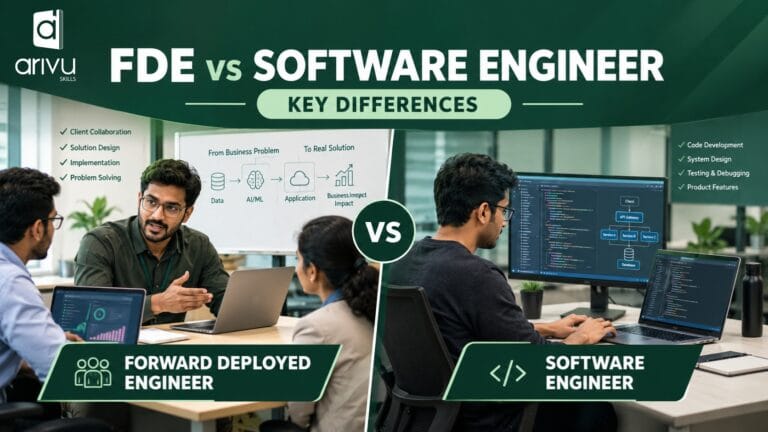
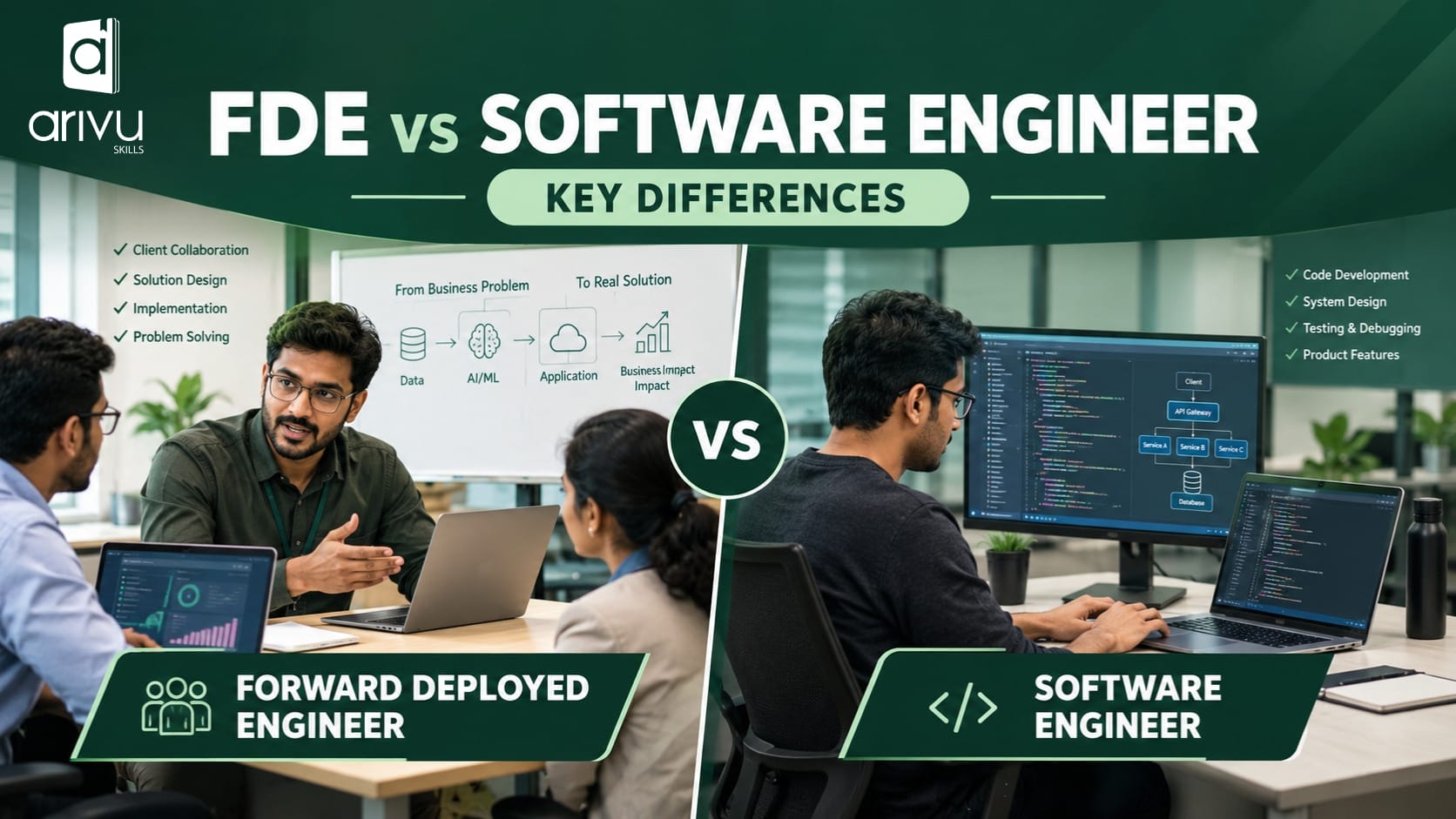
| SOFTWARE ENGINEER | FORWARD DEPLOYED ENGINEER |
| Builds inward, into the product. One codebase, made to serve all users. | Builds outward, into the customer’s world. Custom systems for one customer. |
A software engineer sits on a product team and ships features that everyone will use. A forward deployed engineer takes that product and shapes a working, production-grade solution for a single customer inside their systems, with their messy data
The Key Differences at a Glance
| Content | Software Engineer | Forward Deployed Engineer |
| Who they build for | All users of the product | One specific customer |
| Where they work | The company’s own systems | Inside the customer’s environment |
| Customer contact | Rare can do the job without ever meeting a customer | Constant customer-facing by definition |
| What they inherit | The company’s codebase | The customer’s data, legacy systems and internal politics |
| Judged on | Output — shipped on time, runs reliably | Outcome — did this customer actually get value |
| Daily rhythm | Predictable — sprints, tickets, roadmap | Unpredictable — priorities change by the hour |
| Travel | Mostly office or remote | Often 20–40% travel or on-site |
| The core trade | Depth & stability | Variety & a scarcity premium |
Output vs Outcome: The Big Mental Shift
This is the difference that matters most. A software engineer’s job is largely done when the feature ships, works and stays up. A forward deployed engineer’s job is only done when the customer’s business actually improves. Shipping the code is just the halfway point. If it runs perfectly but the customer sees no real benefit, an FDE has not succeeded. This is why the role demands business sense as much as coding skill.
Two Different Career Paths
Both paths can lead to excellent, senior careers they just climb different ladders.
The Software Engineer path
A well-established route with decades of settled structure: Engineer → Senior → Staff/ Principal, or into engineering management. Levels are clear, progression is predictable, and there are many open roles at any time.
The Forward Deployed Engineer path
Newer but increasingly defined: FDE → Senior FDE → Lead FDE (owning a region and mentoring others), and onward into deployment leadership, product management (FDEs have unmatched real-world insight), or even founding a startup. In fact, several well-known founders began as field engineers, because building under pressure with deep customer focus is exactly the founder mindset.
What About the “AI Engineer”?
You will often see the term AI engineer too. Here is the simple map: an AI engineer builds and improves AI models and systems in general, for many users. An AI forward deployed engineer (an AI FDE) takes those AI systems and makes them work for one specific customer’s data and workflow. In short, an AI FDE is a forward deployed engineer who specialises in AI — the fastest-growing flavour of the role today.
Salary: Who Earns More?
Because the FDE blend — strong engineering plus customer skill — is genuinely rare, it usually commands a premium. Globally, forward deployed engineers tend to out-earn software engineers at similar experience levels; 2026 US reports put the median FDE base pay near $195,000, with individual postings ranging widely (roughly $135,000 to $280,000 plus at top companies, often with equity).
In India (2026), the forward deployed engineer salary commonly runs from about ₹18–28 LPA at entry level to ₹55–90 LPA and above for senior roles — typically a step above a comparable software engineering role. The trade-off: software engineering offers more openings and steadier, more predictable pay, while FDE pay is a scarcity premium that swings higher at elite AI companies. For a fuller breakdown, see our companion Arivu Skills salary guide.
Which One Is Right for You?
It is not about which role is “better” — it is about which trade fits your personality.
1) Choose Software Engineering if you love going deep into a codebase, prefer stability and clear structure, and enjoy focusing on the technology itself.
2) Choose Forward Deployed Engineering if you love variety, enjoy solving new real world problems with different customers, and like being where the technology meets people.
The single question that decides it: do you want to go deep inside a codebase, or broad across a customer’s problems?
Real Examples of the Difference
1. Building the product vs deploying it
A software engineering team builds an AI chatbot product that thousands of companies can buy. That is inward work one product for many. A forward deployed engineer then takes that same chatbot into one bank, connects it to the bank’s private data and rules, and makes it genuinely useful there. That is outward work one customer, made to fit.
2. When a software engineer is sent to “unstick” a deployment
A common real-world lesson: a complex customer rollout stalls, so a company pulls a talented software engineer from the product team to help. It sounds sensible they know the product and they are technical. But within a week the gap shows. They can build the product beautifully, yet struggle to navigate the customer’s messy systems, office politics and old software all at once while keeping the relationship healthy. That exact combination is the forward deployed engineer’s home turf.
A Small, Real-Life Style Case Study
Same start, different roads Divya and Aakash graduated together from a Bengaluru college with identical coding skills. Divya joined a product company as a software engineer; Aakash joined an AI startup as a forward deployed engineer. Five years on:
Divya, the Software Engineer
Her days are focused and predictable. She works within clear sprints, has become a deep expert in her company’s payments system, and is now a respected senior engineer. She rarely meets a customer her craft is the code itself, and she loves that depth.
Aakash, the Forward Deployed Engineer
His weeks are varied and unpredictable. He has embedded with a hospital chain, a logistics firm and a bank — learning each business, building custom AI solutions, and travelling often. No two months look alike. He thrives on the variety and the visible, real-world impact.
The lesson: Neither chose “better.” They chose differently — depth and stability
versus breadth and variety. Knowing which one excites you is the real career decision.
Key Takeaways
1) Both write production code; the difference is direction (inward for the product vs outward for one customer) and who owns the outcome.
2) A software engineer is judged on output; a forward deployed engineer is judged on outcome — real customer value.
3) SWE work is predictable and office-based; FDE work is varied, customer-facing and often involves travel.
4) Both have strong career paths; the FDE path is newer but clear, and maps well to product and founder roles.
5) The forward deployed engineer salary usually carries a premium, while software engineering offers steadier pay and more openings.
6) The deciding question: go deep into code, or broad across customer problems?
Not Sure Which Path Fits You?
Arivu Skills helps students and professionals build job-ready engineering and applied-AI skills and choose the career direction that suits them best.
Topics covered in this article