
Certificate in US GAAP
Talk to a Consultant
Fill in the details to get started
Learning Format
Online Bootcamp
Validity
6 Months
Access Anytime
Grant Thornton
About Program
The program by Arivu Skills, guided by experienced faculty and industry experts, is designed to build a strong foundation in US Generally Accepted Accounting Principles (US GAAP). It equips learners with the skills needed to apply US accounting standards, prepare and present financial statements, handle revenue recognition and fair value measurement, and understand the key differences between US GAAP and IFRS, helping them support accounting and reporting functions for US-based entities and Global Capability Centers (GCCs) operating in India.
Key Highlights
- Industry-aligned curriculum
- Real-world fraud case studies
- US GAAP framework & ASC codification
- Financial statement presentation
- Revenue recognition (ASC 606)
- US GAAP vs IFRS differences
- Dual certification
- Fair value measurement (ASC 820)
- GCC-relevant skill focus
- Job-ready skill focus

Are you Confused? Let us assist you.
Discover the Ultimate
Brochure Now
About Grant Thornton
ArivuSkills, in collaboration with Grant Thornton, brings a strong focus on application-oriented learning and industry-driven innovation across key domains such as strategy, analytics, risk, and digital transformation. Backed by Grant Thornton’s global expertise and real-world consulting experience, the program emphasizes practical problem-solving, business impact, and future-ready skills to help learners thrive in a rapidly evolving professional landscape.
Who Can Apply for the Course?
- Students from any degree background
- Commerce, finance, or accounting students
- Fresh graduates aspiring for accounting and financial reporting roles
- Working professionals looking to upskill
- CA, CMA, CS, ACCA, and CPA aspirants
- Beginners with no prior experience
Curriculum
- Live Course
- Self Paced
- Industry Expert
- Academic Faculty
Module 1: Introduction
- 1.0 Innovation, Regulation, and Emerging Technologies
1.1 Foundations of FinTech and Financial Services
1.2 Historical Evolution
1.3 Traditional → Tech-Enabled Finance
1.4 What is FinTech?
1.5 What is FinTech? (Contd.)
1.6 Drivers of FinTech Innovation
1.7 Technology as a Driver of FinTech Innovation
1.8 Consumer Behavior Shifts – Driving FinTech
1.9 Regulatory Environment as Catalyst and Constraint
1.10 Technology Innovations in Depth
1.11 Insights into Changing Consumer Behavior
1.12 Regulatory Trends – Shaping FinTech
1.13 Interaction of Drivers – Case Examples
1.14 Challenges & Opportunities
1.15 Traditional Institutions vs FinTech Players
1.16 Business Models in FinTech
1.17 Types of FinTech Business Models
1.18 Types of FinTech Business Models (Contd.)
1.19 Types of FinTech Business Models (Contd.)
1.20 Digital Transformation in Banking and Payments
1.21 Digital Transformation in Banking and Payments (Contd.)
1.22 Digital Transformation in Banking and Payments (Contd.)
1.23 Digital Transformation in Banking and Payments (Contd.)
1.24 Digital Transformation in Banking and Payments (Contd.)
1.25 Regulatory Framework: Institutions, Laws, and Compliance Structure
1.26 Major Financial Institutions
1.27 Key Laws Governing Financial Services
1.28 Compliance Structure in Financial Services
1.29 Financial Inclusion and its Components: Role of FinTech
1.30 Introduction to Power BI
1.31 Foundations of FinTech
1.32 Case Study – Identifying Fraud Behaviour in Transactions
1.33 Case Study – Identifying Fraud Behaviour in Transactions (Contd.)
1.34 Case Study – Identifying Fraud Behaviour in Transactions (Contd.)
1.35 Case Study – Identifying Fraud Behaviour in Transactions (Contd.)
Module 2: ASC 105 - GAAP Hierarchy
2.0 Digital Payments and Infrastructure
2.1 What are Real-Time Payment Systems
2.2 Technological Foundations & RTP Methods
2.3 Example Transaction Flow
2.4 Security and Compliance
2.5 Product Architecture of UPI, Wallets, and Payment Gateways
2.6 Identity
2.7 Data Exchange
2.8 Real-Time Settlement Systems
2.9 Immediate Payment Service
2.10 Faster Payments System (FPS)
2.11 RTGS, IMPS, and FPS Comparison
2.12 Cross-Border Payments Framework, Architecture, and Platforms
2.13 Modern Solutions
2.14 Modern Solutions (Contd.)
2.15 Regulatory and FX Considerations
2.16 Regulatory and FX Considerations (Contd.)
2.17 Innovations in Payments
2.18 Innovations in Payments (Contd.)
2.19 Innovations in Payments (Contd.)
2.20 UPI
2.21 Paytm Case Study
2.22 Paytm Case Study (Contd.)
2.23 Paytm Case Study (Contd.)
2.24 Paytm Case Study (Contd.)
2.25 Cryptocurrency
2.26 Cryptocurrency (Contd.)
Module 3: ASC 205 - Presentation of Financial Statements
3.0 FinTech in Capital and Financial Markets
3.1 Algorithmic Trading and Robo-Advisory
3.2 Historical Evolution
3.3 Manual vs Algorithmic Trading
3.4 Why Algorithmic Trading
3.5 Myths vs Reality about Algorithmic Trading
3.6 Blockchain-Based Settlement Systems
3.7 How FinTechs Can Use Blockchain
3.8 Use Cases of Blockchain
3.9 Blockchain in Banking
3.10 Digital-First Banks
3.11 Licensing, Partnerships, and Monetization Models
3.12 FinTech Licensing Process
3.13 Regulatory Bodies and Jurisdiction
3.14 Partnership Models in FinTech
3.15 Private-Label & Vendor Models
3.16_Monetization Models Transaction & Subscription
3.17_Payment For Order Flow & Interest
3.18_Data, API, And Ad-Based Monetization
3.19_Regulatory Landscape
3.20_India’s Open Banking Revolution UPI And Account Aggregator Framework
3.21_Key Regulatory Guidelines For Capital & Financial Markets In India
3.22_India’s Regulatory Sandbox Ecosystem – Multi-Regulator
3.23_India’s Regulatory Sandbox Ecosystem – Multi-Regulator (Contd..)
3.24_Challenges And Future Outlook
3.25_Post Trade Clearing And Settlements
3.26_Modern Settlement Process
3.27_Central Counterparty (CCP) Models
3.28_Hot And Cold Storage In Digital Assets
3.29_Role Of Digital Payments In Settlement
3.30_Regulatory Landscape & Trends
3.31_Future Directions & Technology Innovations
3.32_FinTech In Capital And Finance Markets
3.33_Case Study – Settlement Flows In Capital Markets
3.34_Case Study – Settlement Flows In Capital Markets (Contd..)
Module 3: Reference Files
Module 3: Practice Quiz
Module 3: Feedback
Module 4: ASC 210 - Balance Sheet
Sub Module 4.1: Regulatory & Institutional Framework
4.1.1: Regulatory And Institutional Framework
4.1.2: RBI’s Role Under The Payment And Settlements Systems Act, 2007
4.1.3: Authorization, Supervision Of Payments And Other Regulatory Mechanisms Under The PSS Act, 2007
4.1.4: Key Entities & Regulatory Mechanism
4.1.5: Customer Protection (Turnaround Times, Grievance Redressal & Escalation Paths) & Liability Norms
Sub Module 4.2: Security Standards & Compliance
4.2.1: Security Standards & Compliance
4.2.2: Global Security Frameworks
4.2.3: The Compliance Landscape In Payments
4.2.4: PCI-DSS Card Data Security Standard
4.2.5: ISO 27001 ISMS Controls
4.2.6: Incident & Breach Response (NIST SP 800-61 Rev. 3)
4.2.7: NPCI & RBI Frameworks
4.2.8: NPCI Security Guidelines
4.2.9: Audit & Certification Requirements
4.2.10: Root Cause Analysis & Corrective Action
4.2.11: Industry Best Practices In Operationalizing Compliance
4.2.12: Integrating Compliance With Risk Management
4.2.13: Continuous Monitoring & Control Automation
Sub Module 4.3: Sector-Specific Regulations
4.3.0: Sector-Specific Regulations
4.3.1: BNPL (Buy Now Pay Later) Platforms
4.3.2: InsurTech Regulations
4.3.3: WealthTech Regulatory Framework
4.3.4: Implementation And Integration
4.3.5: Third-Party Vendor Management
4.3.6: Adoption Challenges
Sub Module 4.4: Privacy & Data Protection
4.4.1: Privacy & Data Protection
4.4.2: Digital Personal Data Protection (DPDP) Act
4.4.3: GDPR Principles
4.4.4: Data Privacy Framework
4.4.5: Data Subject Requests, Incident Management & Reporting
4.4.6: Data Localisation
Sub Module 4.5: AML, KYC & Financial Crime
4.5.1: Fundamentals
4.5.2: Industry Best Practices
4.5.3: NPCI Frameworks
Sub Module 4.6: Governance, Audit & Outsourcing
4.6.1: Governance, Audit & Outsourcing
4.6.2: Fundamentals
4.6.3: Industry Best Practices
4.6.4: NPCI Frameworks
Module 5: ASC 220 - Income Statement
5.1: Introduction To InsurTech
5.2: Key Financial Technologies Powering InsurTech
5.3: Key Financial Technologies Powering InsurTech (Contd..)
5.4: Case Study Lemonade (Contd..)
5.5: Key Financial Technologies Powering InsurTech (Contd..)
5.6: Case Study Lemonade
5.7: Case Study Lemonade (Contd..)
5.8: Innovations In InsurTech
5.9: Innovations In InsurTech (Contd..)
5.10: Innovations In InsurTech (Contd..)
5.11: Innovations In InsurTech (Contd..)
5.12: Innovations In InsurTech (Contd..)
5.13: Innovations In InsurTech (Contd..)
5.14: Embedded Insurance The FinTech Growth Driver
5.15: Embedded Insurance The FinTech Growth Driver (Contd..)
5.16: Digital Underwriting, Policy Issuance, And Claims Management
5.17: Digital Underwriting, Policy Issuance, And Claims Management (Contd..)
5.18: Digital Underwriting, Policy Issuance, And Claims Management (Contd..)
5.19: AI ML IoT In Fraud Detection & Pricing
5.20: Indian InsurTech Landscape
5.21: Bima Sugam IRDAI’s Digital Infrastructure Vision
5.22: Bima Sugam IRDAI’s Digital Infrastructure Vision (Contd..)
5.23: Regulatory Landscape And Sandbox Framework
5.24: Regulatory Landscape And Sandbox Framework
Module 5: Reference Files
Module 5: Feedback
5.0: Digital Lending & Credit Innovation
Module 6: ASC 230 - Statement of Cash Flows
Module 7: ASC 250 - Accounting Changes and Error Correction
Module 8: ASC 260 - EPS - Earnings Per Share
Module 9: ASC 270 - Interim Financial Statements
Module 10: ASC 280 - Segment Reporting
Module 11: ASC 305 - Cash and Cash Equivalents
Module 12: ASC 310 - Loans and Receivables
Module 13: ASC 330 - Inventory
Module 14: ASC 360 - PPE (Property Plant and Equipment)
Module 15: ASC 350 - Intangibles
Module 16: ASC 405 - Joint and Several Liability
Module 17: ASC 410 - AROs (Asset Retirement Obligation)
Module 18: ASC 420 - Exit and Disposal Obligations
Module 19: ASC 450 - Accounting for Contingencies
Module 20: ASC 505 - Equity
Module 21: ASC 606 - Revenue from Contract with Customers
Module 22: ASC 705 - Cost of Sales
Module 23: ASC 710-712 - Compensation
Module 24: ASC 715 - Pension and Other Benefits
Module 25: ASC 718 - Stock Compensation
Module 26: ASC 740 - Income Taxes
Module 27: ASC 205 - Discontinued Operations
Module 28: ASC 830 - Foreign Currency Matters
Module 29: ASC 820 - Fair Value Measurements
Module 30: ASC 855 - Subsequent Events
Module 31: ASC 850 - Related Party Disclosures
Module 32: ASC 842 - Leases
Module 33: ASC 480 - Liability vs Equity
Module 34: ASC 815 - Derivatives and Hedge Accounting
Module 35: ASC 323 - Equity Method of Investment & Joint Ventures
Module 36: ASC 805 - Business Combinations
Module 37: ASC 810 - Consolidation
Module 38: Key Differences
Program Highlights
- 53+ Hours of Comprehensive US GAAP Learning
- Industry-Relevant Case Studies & Practical Applications
- Live Online Classes with Industry Experts
- 24*7 Support
What roles can a US GAAP professional play?
US GAAP Accountant
Prepare and maintain financial statements in accordance with US GAAP, ensuring accuracy, consistency, and compliance for US-based entities and their Indian operations.
Technical Accounting Specialist
Interpret and apply complex US GAAP standards such as revenue recognition, leases, and fair value measurement to real-world transactions.
Financial Reporting Analyst
Compile and analyze financial reports under US GAAP, support period-end close, and ensure disclosures meet US accounting and regulatory requirements.
Statutory & Compliance Analyst
Ensure financial reporting meets US GAAP requirements, manage compliance obligations, and support internal and external audit processes.
GCC Accounting Associate
Support accounting and reporting functions for Global Capability Centers in India, aligning local operations with US GAAP compliance standards.
US GAAP / IFRS Consultant
Advise organizations on US GAAP application and the key differences between US GAAP and IFRS, supporting accurate reporting across jurisdictions.
Skills to Master
US GAAP framework
Financial statement presentation
Revenue recognition (ASC 606)
Fair value measurement (ASC 820)
Lease accounting (ASC 842)
Business combinations (ASC 805)
Consolidations
US GAAP vs IFRS
Financial reporting
Technical accounting
Companies Hiring for US GAAP Professionals











Admission Details
The admission process is quick and simple. Fill out the admission form on this page, our Career Guidance team will call to confirm your enrollment, and you’ll get instant access to your course.

Fill the Form
Share your details in the admission form on this page to get started.

Confirmation Call
Our Career Guidance team will call to confirm your enrollment and answer any questions.

Get Course Access
Once confirmed, you'll get instant access and can start learning right away.
Frequently Asked Questions
1. What is US GAAP, and why is it a good career choice?
US GAAP (Generally Accepted Accounting Principles) is the standard framework of accounting rules used for financial reporting by companies in the United States. As Global Capability Centers (GCCs) grow rapidly in India and US companies increasingly outsource their accounting and reporting functions here, proficiency in US GAAP has become a high-demand, well-paying skill for finance professionals.
2. Do I need an accounting background to enroll in this course?
A background in accounting or finance is helpful, but the program is structured to build understanding from the fundamentals of the US GAAP framework upward. This makes it accessible to both students and working professionals looking to develop US GAAP expertise step by step.
3. What topics and standards will I learn in this course?
You’ll gain a comprehensive understanding of the US GAAP framework and ASC codification, including financial statement presentation, revenue recognition (ASC 606), fair value measurement (ASC 820), leases (ASC 842), business combinations (ASC 805), and consolidations. The course also covers the key differences between US GAAP and IFRS.
4. What job roles can I apply for after completing this course?
Graduates can pursue roles such as US GAAP Accountant, Financial Reporting Analyst, GCC Accounting Associate, Technical Accounting Specialist, Statutory & Compliance Analyst, and US GAAP/IFRS Consultant. These roles are in strong demand across GCCs, MNCs, and accounting and advisory firms.
5. What is the average salary for a US GAAP professional in India?
US GAAP expertise is a sought-after skill, particularly within GCCs and multinational finance teams, and it commands strong earning potential that grows with experience. Salaries vary by role, organization, and location.
6. Who should attend this course?
It’s designed for commerce, finance, and accounting students; fresh graduates aspiring for accounting and financial reporting roles; working professionals looking to upskill; and CA, CMA, CS, ACCA, and CPA aspirants. Professionals working in or targeting GCCs will find it especially valuable.
7. What is the certification offered?
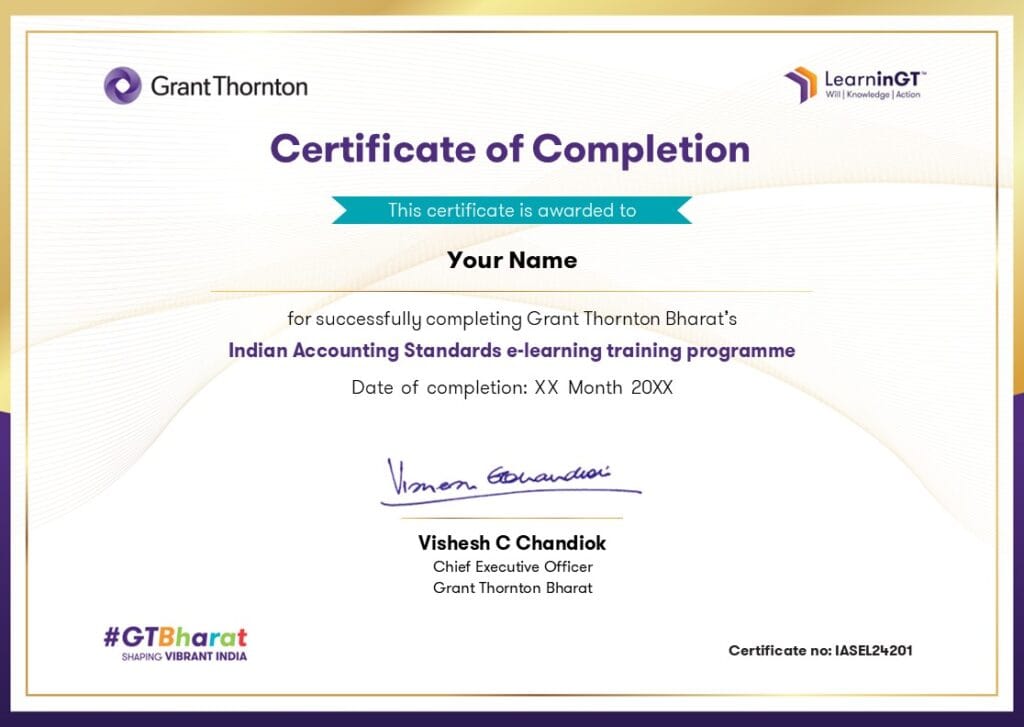
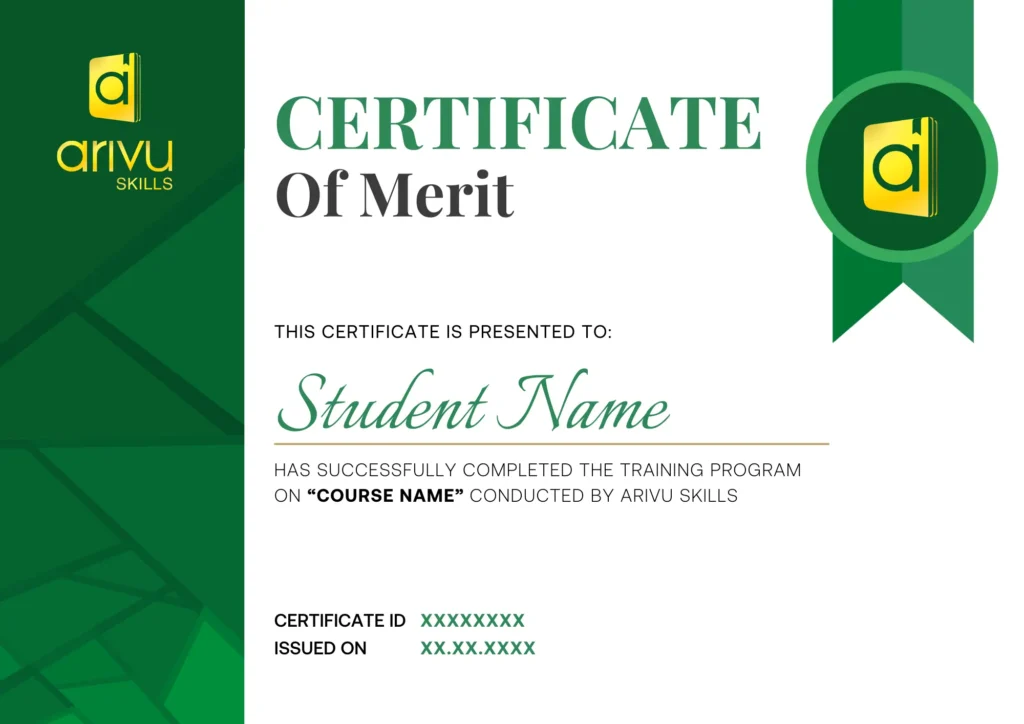
On successful completion of the final assessment, you receive a Certificate in US GAAP from Grant Thornton, in collaboration with Arivu Skills. This industry-recognized certification adds strong credibility to your profile with employers.
8. Will I work on real-world case studies and applications?
Yes. The program emphasizes practical application of US accounting standards in real-world business scenarios, including applying revenue recognition, fair value measurement, and lease accounting to actual transactions, and comparing US GAAP treatment with IFRS.
9. What topics are covered in the curriculum?
The curriculum spans the full US GAAP framework across the ASC codification — from the GAAP hierarchy and financial statement presentation (balance sheet, income statement, cash flows) to assets, liabilities and contingencies, equity, revenue and expenses, income taxes, leases, fair value, business combinations, and consolidation, closing with the key differences between US GAAP and IFRS.
10. Where is Arivu Skills located in Bangalore?
Arivu Skills is located at 1st Floor, Sai Prema, Christ Lane No. 39, Krishnanagar, Hosur Road, Koramangala, Bengaluru – 560029. The institute offers both classroom training and live online classes, making it accessible for students across Bangalore.